


The right hiring model depends on control, commitment, compliance, and how the work actually operates.
Employer of record vs independent contractor is a common question for companies hiring across borders or building flexible teams without opening a local entity. The choice matters because the operating model creates different responsibilities for payroll, taxes, benefits, control, documentation, and risk.
This article is not legal, tax, or HR advice. Worker classification depends on the facts, jurisdiction, role, contract, and daily working relationship. Use this as an operating guide, then involve qualified advisors before making classification or employment decisions.
What’s in this article?
- The practical difference between an employer of record and an independent contractor
- A decision table for choosing the right model
- A workflow for reviewing new hires before work starts
- Common mistakes that create compliance or operational problems
- Where Workhint fits when the decision needs to become a repeatable process
Employer of record vs independent contractor: the core difference
An employer of record, often called an EOR, is a third party that legally employs a worker in a country where your company may not have its own entity. The EOR typically handles local contracts, payroll, tax withholding, statutory benefits, and employment administration. Your company still manages the work, but the worker is an employee of the EOR.
An independent contractor is different. A contractor is generally an independent business or self-employed professional that sells services under a commercial agreement. You define the outcome, scope, timeline, and payment terms. The contractor typically controls how the work is performed, invoices for it, and handles their own taxes and benefits.
The IRS explains in its independent contractor or employee guidance that businesses should consider evidence of control and independence, including behavioral control, financial control, and the relationship. That is why the label in the contract is not enough. The operating reality matters.
Why this decision matters
The wrong model can create two problems at once. First, the company may carry legal or tax exposure if a contractor is really functioning like an employee. The U.S. Department of Labor says misclassification can happen when an employee under the FLSA is treated as an independent contractor, which may affect wage and overtime protections under its misclassification guidance.
Second, the wrong model creates operational friction. If a team needs daily control, recurring availability, deep system access, performance management, and exclusivity, a contractor setup may force managers to behave one way on paper and another way in practice. If the work is project-based, an EOR setup may add process the work does not need.
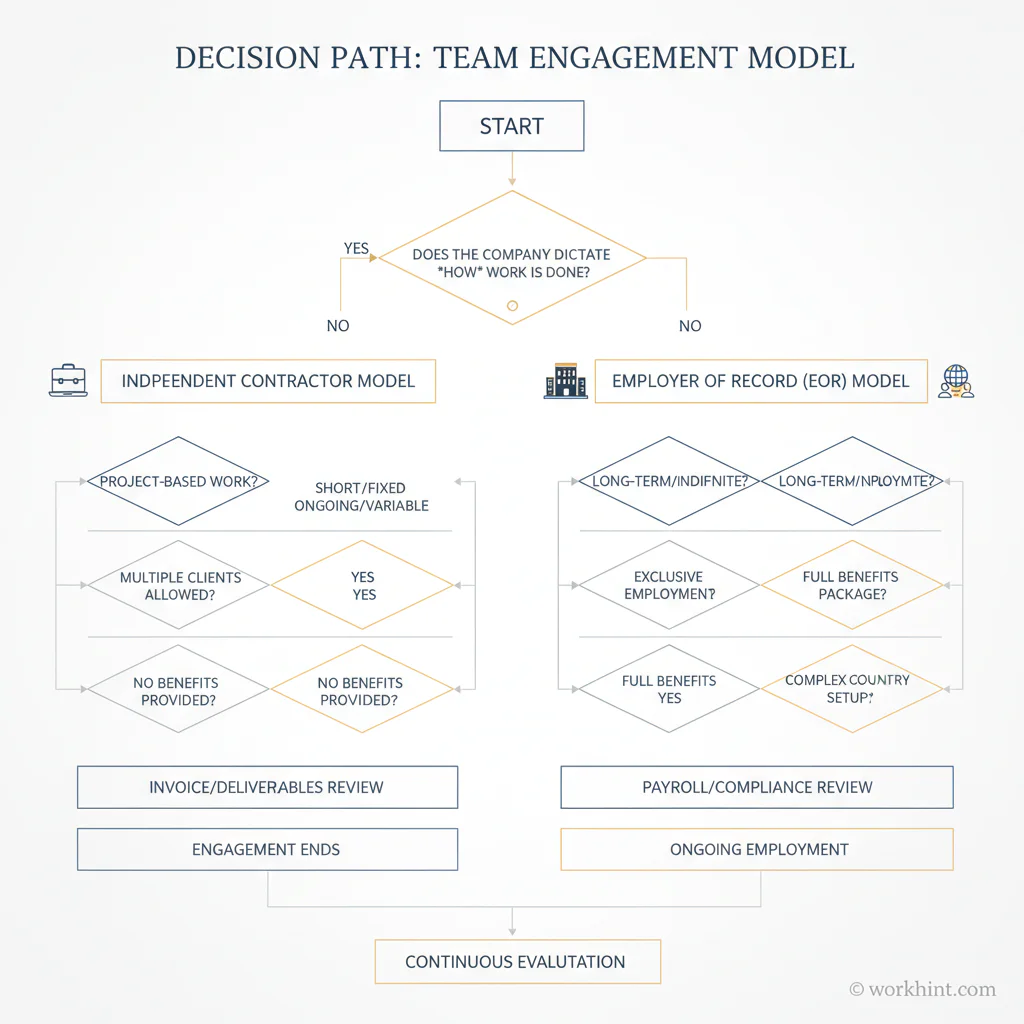
Decision table: when to use each model
| Decision factor | Independent contractor may fit | Employer of record may fit |
|---|---|---|
| Nature of work | Defined deliverable, project, or specialized service | Ongoing role embedded in the team |
| Control | Contractor controls methods, schedule, and tools | Company needs to direct hours, process, training, and priorities |
| Duration | Short-term or milestone-based engagement | Long-term employment relationship |
| Exclusivity | Contractor serves multiple clients | Worker is expected to work mainly or only for your company |
| Benefits and protections | Contractor provides their own coverage and business infrastructure | Worker should receive statutory employment benefits and protections |
| Country setup | No local payroll needed for a true contractor relationship | You need an employee in a country where you lack an entity |
A practical review workflow before work starts
- Define the business need. Write the role, deliverable, duration, location, access needs, budget, and manager.
- Describe how the work will be managed. Note whether the company will set hours, provide tools, require training, control methods, or review performance like an employee.
- Check country requirements. Employment status is not universal. The UK government notes that a person’s employment status affects rights and employer responsibilities, and tax status can differ from employment-law status.
- Choose the model that matches the facts. If the work is independent and project-based, contractor may fit. If the work is ongoing, controlled, and employee-like, consider direct employment or an EOR.
- Document the decision. Store the rationale, approvals, contract type, paperwork, scope, payment terms, access decisions, and renewal dates.
- Set review triggers. Revisit the model when scope expands, tenure extends, access deepens, schedule control increases, or the worker becomes exclusive.
Cost is only one part of the decision
Contractors can look less expensive because the company usually pays an invoice instead of payroll taxes, benefits, employer contributions, and EOR service fees. That comparison is incomplete if the contractor relationship does not fit the work. A lower invoice rate is not a saving if it creates reclassification exposure, payment confusion, or management workarounds.
EOR arrangements usually cost more because they include employment administration and local payroll infrastructure. That can be worthwhile when the company wants a long-term employee in a country where it has no entity, needs statutory benefits handled correctly, or wants the worker integrated without pretending the relationship is a vendor engagement.
Common mistakes to avoid
- Choosing based on price alone. Start with the facts of the work, then compare cost.
- Letting contractor relationships drift. A project contractor can become embedded over time. Review extensions before the facts change.
- Giving contractors employee-style controls. Set outcomes and acceptance criteria, but be careful with hours, methods, training, titles, and exclusivity.
- Ignoring local differences. Country rules, tax treatment, benefits, termination obligations, and worker protections vary.
- Skipping records. Keep the request, classification rationale, approvals, agreement, access, invoices or payroll records, and renewal history together.
Where Workhint fits
Workhint fits when the EOR vs contractor decision needs to become a repeatable workflow instead of a one-off Slack conversation. A business can use Workhint to collect hiring requests, route classification reviews, assign legal, HR, finance, procurement, and operations owners, capture documents, manage approvals, set role-based access, and trigger reminders before renewals or model changes.
For contractor engagements, Workhint can help coordinate onboarding, scopes of work, assignment status, invoice approvals, deliverable acceptance, and offboarding. For EOR-supported employees, it can coordinate internal access, manager handoffs, role permissions, training steps, approvals, and reporting while the EOR handles employment administration. The judgment remains with the company and its advisors; Workhint helps make the process visible and auditable.
FAQ
Is an employer of record the same as a contractor platform?
No. An employer of record is used for an employment relationship where a third party is the legal employer. A contractor platform or contractor workflow usually supports commercial engagements with independent businesses or self-employed professionals.
When should a company use an independent contractor?
Use an independent contractor when the work is genuinely independent, project-based, outcome-driven, and not controlled like employment. The contractor should usually manage their own methods, tools, schedule, taxes, and business obligations.
When should a company use an EOR?
Use an EOR when the worker should be an employee, the company wants ongoing control and integration, and the worker is in a country where the company does not have a legal entity or local payroll setup.
Can a contractor be converted to an EOR employee?
Yes. Many companies convert long-running contractors to EOR employment when the relationship becomes ongoing, exclusive, controlled, or central to the team. Review the transition with legal, HR, tax, finance, and the EOR provider.
Does using an EOR remove every compliance risk?
No. An EOR can handle important employment administration, but the company still needs clear internal controls for role access, supervision, data security, performance management, approvals, and local operating practices.
Conclusion
The cleanest way to choose between an employer of record and an independent contractor is to study the work before choosing the label. If the relationship is independent, scoped, and outcome-based, a contractor model may fit. If the company needs a long-term employee, direct control, benefits, and local employment infrastructure, an EOR may be better. The safest habit is simple: define the work, choose the structure that matches the facts, document the decision, and review the relationship before it drifts.
Leave a Reply