


Use this data retention policy template to define what you keep, why, and when records should be deleted.
A data retention policy template helps a business answer a hard question: what information should we keep, for how long, and who deletes it when the time comes? Without a written policy, teams often keep everything forever in shared drives, HR systems, finance folders, CRMs, and backups. That creates privacy risk, audit confusion, storage clutter, and inconsistent answers when a customer, employee, auditor, or regulator asks what happened to a record.
This resource gives you a practical structure for a business data retention policy. It is not legal advice, and retention periods vary by jurisdiction, industry, contract, and record type. Use it as a starting point, then have legal, finance, HR, and IT confirm the periods that apply to your business.
What is included in this data retention policy template?
The template covers the sections needed to turn vague retention rules into a working policy:
- Policy purpose and scope
- Record categories and data owners
- Retention periods and start events
- Legal or business basis for each period
- Storage locations and access controls
- Legal hold process
- Secure disposal methods
- Exceptions, audit evidence, and review cadence
The core idea is simple: every major record category should have a period, a reason, an owner, and a disposal method. The GDPR storage limitation principle, for example, expects personal data to be kept no longer than necessary for its purpose. Other obligations may require longer retention for tax, employment, financial, safety, or contract records. A useful policy reconciles those obligations instead of using one universal period.
How to use the template
Start with the retention schedule, not the policy wording. The schedule is the operating heart of the document. It tells the business which records are covered, where they live, how long they stay, and what happens when the clock expires.
- Inventory record categories. List the major records your company holds: customer accounts, contracts, invoices, payroll, employee files, recruiting data, vendor records, support tickets, system logs, marketing consents, and board materials.
- Map systems of record. Identify where each category lives, including SaaS tools, cloud drives, local files, email archives, backups, and paper storage.
- Confirm the retention period. For each category, define the minimum required period and business reason. The IRS recordkeeping guidance is useful for U.S. tax records, but it is only one source among many.
- Assign an owner. Every row needs a business owner who can approve retention rules and an operational owner who can execute them.
- Define disposal. Deletion should be specific. “Delete when expired” is weaker than “purge from HRIS, archive drive, and recruiting tracker; retain disposal log for audit.”
- Document legal hold exceptions. If litigation, investigation, audit, or a regulator request arises, routine deletion may need to stop until the hold is lifted.
- Review annually. Laws, tools, products, and data categories change. Put a dated review cycle in the policy.
Data retention schedule template
Use this table as the starting point. Replace the examples with periods validated for your jurisdiction and industry.
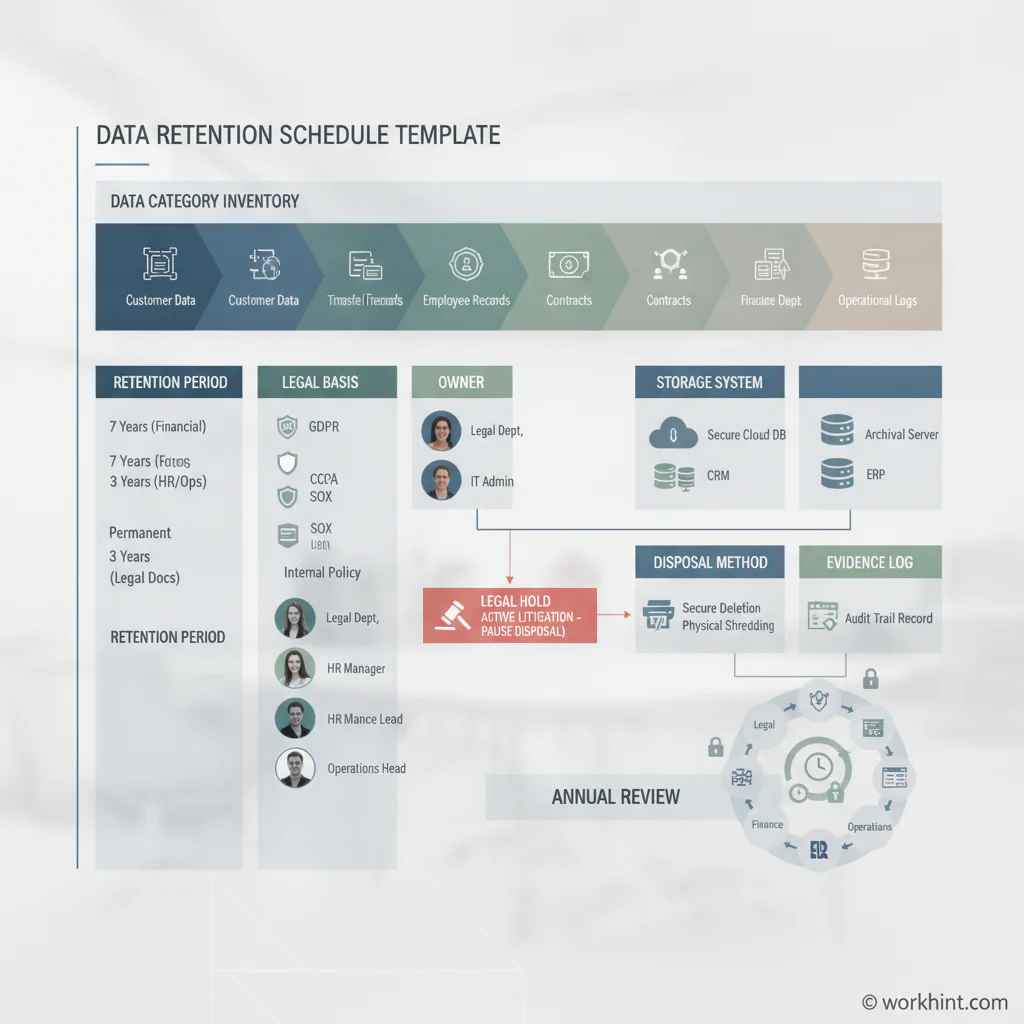
| Record category | Start event | Retention period | Owner | Disposal method |
|---|---|---|---|---|
| Customer contracts | Contract expiration or termination | Term plus applicable limitation period | Legal / Operations | Archive, then secure deletion after approval |
| Invoices and tax records | Tax filing date or transaction date | Period confirmed by finance and tax counsel | Finance | Retain in accounting system, then archive purge |
| Employee personnel files | Employment end date | Period confirmed by HR and legal | HR | Secure HRIS deletion and personnel file destruction |
| Recruiting applications | Role closure or candidate rejection | Period confirmed by employment counsel | Talent / HR | ATS purge with deletion log |
| System access logs | Log creation date | Security and audit period set by IT | IT / Security | Automated log expiration, unless on hold |
| Marketing consents | Consent capture or withdrawal | As long as needed to prove consent status | Marketing Operations | Suppress or delete according to consent record |
Policy language you can adapt
Purpose. This policy defines how long [Company Name] retains business records and personal data, who owns each record category, and how records are securely disposed of when the retention period expires.
Scope. This policy applies to electronic and physical records created, received, processed, or stored by [Company Name], including records in company systems, cloud applications, shared drives, email, backups, paper files, and third-party platforms.
Retention schedule. Each record category must be listed in the approved retention schedule with a retention period, start event, owner, storage location, legal or business basis, and disposal method. Records may not be kept indefinitely unless the retention schedule explicitly allows it.
Legal hold. Routine deletion must be suspended when legal, compliance, or leadership issues a legal hold notice. The notice should identify affected records, custodians, systems, and release conditions. No covered record may be deleted until the hold is lifted.
Secure disposal. Records that reach the end of their retention period must be disposed of using a method appropriate to the sensitivity and format of the record. For consumer report information, review the FTC Disposal Rule guidance. For media sanitization, IT teams can reference NIST SP 800-88 Rev. 1.
Review. The policy and schedule should be reviewed annually and whenever the company adds a material system, enters a new jurisdiction, changes employment practices, launches a regulated product, or receives new legal guidance.
Common mistakes to avoid
- Using one retention period for every record. Payroll, contracts, recruiting records, support tickets, and analytics logs do not carry the same obligations.
- Forgetting backups and shared drives. A deletion rule that only covers the primary SaaS system is incomplete.
- Keeping records without a reason. Over-retention can create privacy and discovery risk.
- Deleting during a legal hold. The policy needs a clear freeze process before automated deletion runs.
- Assigning no owner. If every department assumes someone else owns retention, nothing changes.
Where Workhint fits
A data retention policy becomes useful when it is connected to the way work happens. Workhint can help an operations team turn this template into a live workflow: collect record categories from each department, route retention periods to legal and finance, assign data owners, schedule annual reviews, trigger disposal tasks, track legal hold exceptions, and keep an audit trail. The document remains the policy, but the workflow makes sure it is followed across people, systems, approvals, and deadlines.
FAQ
Is a data retention policy required by law?
Requirements depend on your location, industry, and data types. Some laws require specific records to be retained, while privacy rules may require personal data not to be kept longer than necessary. Even when a single “data retention policy” is not mandated, many audits, vendor reviews, and privacy programs expect a documented schedule.
What is the difference between a policy and a retention schedule?
The policy explains the rules, roles, exceptions, and governance process. The retention schedule is the table that lists each record category, retention period, owner, storage location, legal basis, and disposal method.
How often should a business update its retention schedule?
Review it at least once a year. Update it sooner if you add a major system, enter a new market, change your employment model, receive new legal guidance, or start collecting a new category of customer or employee data.
Who should own data retention?
Ownership is usually shared. Legal or compliance owns the policy standard, IT owns technical deletion and storage controls, finance owns financial records, HR owns employee records, and each department owns the accuracy of its record categories.
Conclusion
A good data retention policy is practical, specific, and operational. It does not just say “keep records as required.” It names the records, owner, period, reason, system, legal hold exception, and disposal method. Use this template to build the first version, validate the periods with the right advisors, and turn the schedule into a recurring workflow your team can follow.
Leave a Reply