


A freelancer onboarding checklist keeps external talent productive without blurring scope, access, payment, or compliance boundaries.
A freelancer onboarding checklist should do more than welcome someone to a project. For a business team, it should confirm the work agreement, define the deliverables, collect the right tax and payment information, open only the access the freelancer needs, and make the first assignment clear enough that nobody has to chase context.
Most freelancer onboarding advice stops at introductions and style guides. Those steps matter, but they are not enough when freelancers touch customer data, join multiple projects, invoice different departments, or work with internal employees who are not used to external contributors. The better question is operational: what has to be true before a freelancer can begin work safely and finish work cleanly?
What’s in this article?
- The core checklist business teams should complete before work starts.
- A practical workflow for scope, classification, access, communication, and payment setup.
- A table you can use to assign owners across operations, legal, finance, IT, and the hiring manager.
- Common mistakes that slow freelancers down or create avoidable risk.
Why freelancer onboarding matters
Freelancers are not employees, and onboarding them like employees can create confusion. At the same time, treating freelancer onboarding as an informal handoff creates a different set of problems: missing contracts, unclear ownership, late invoices, exposed systems, and inconsistent quality.
Classification is one reason to be disciplined. The IRS says worker status depends on the facts of the relationship, including behavioral control, financial control, and the relationship of the parties. The Department of Labor also evaluates whether a worker is in business for themself or economically dependent on the business under the Fair Labor Standards Act. This article is not legal advice, but it is a reminder that the onboarding process should respect the freelancer relationship instead of turning it into an employee-style management model.
Security is another reason. NIST guidance on remote access emphasizes defined remote access methods, authorization, monitoring, authentication, and control of devices that may handle organization-controlled information. Freelancer onboarding should translate those principles into practical access rules: who approves access, what systems are opened, what data is visible, and when access expires.
Freelancer onboarding checklist
Use this checklist before assigning billable work. It works for creative freelancers, consultants, technical specialists, operators, analysts, and other external contributors.
| Onboarding area | What to confirm | Primary owner |
|---|---|---|
| Business need | Project goal, budget owner, expected outcome, and why a freelancer is the right model | Hiring manager |
| Scope | Deliverables, deadlines, review cycles, acceptance criteria, and out-of-scope work | Project owner |
| Agreement | Signed contract, statement of work, confidentiality terms, IP terms, and termination language | Legal or operations |
| Classification | Role design, independence, control boundaries, and escalation path for legal questions | Legal or HR |
| Payment | Rate, invoice process, tax forms, payment method, expense rules, and approval owner | Finance |
| Access | Systems, folders, data, communication channels, account expiration, and least-privilege access | IT or security |
| Kickoff | Context, stakeholders, communication norms, first task, and decision points | Project owner |
| Performance | Quality standard, milestone reviews, feedback rhythm, and deliverable acceptance | Project owner |
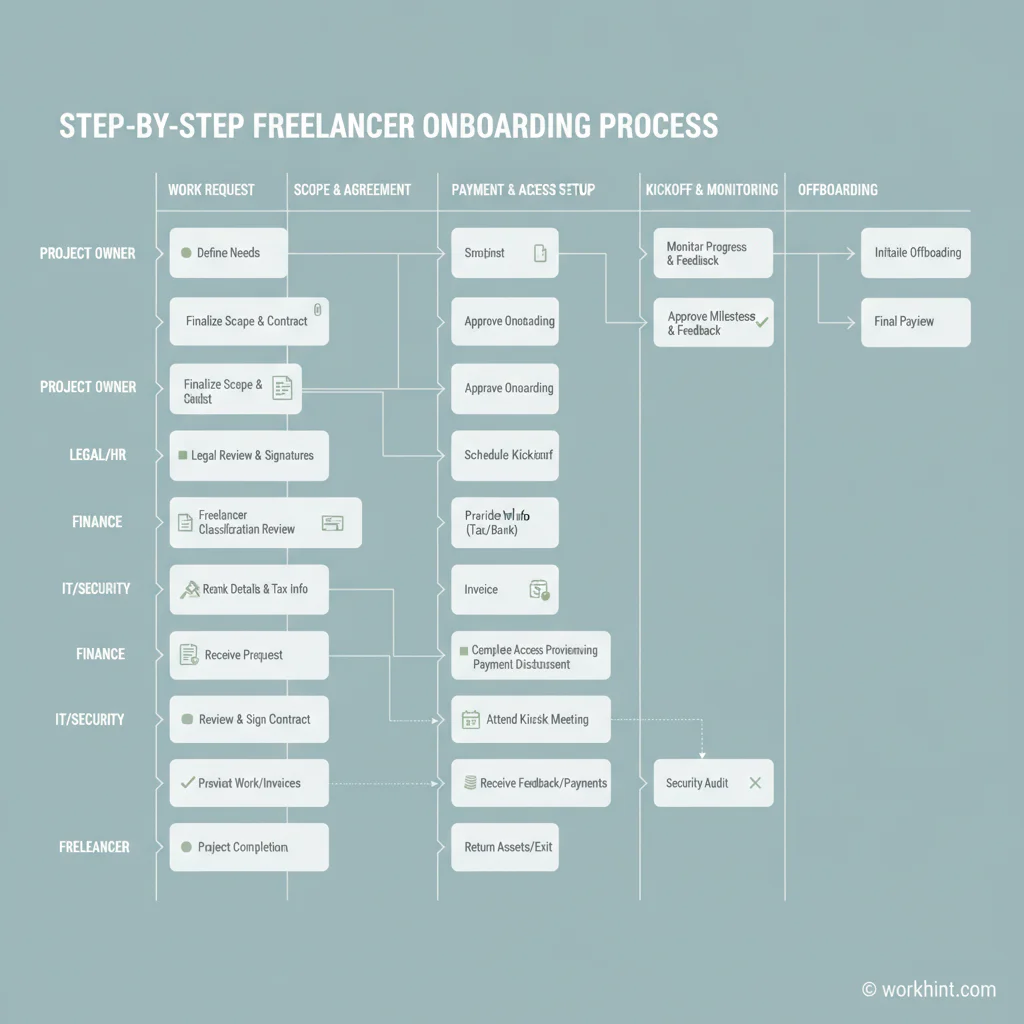
Step-by-step freelancer onboarding process
1. Start with the work request
Before you search for a freelancer, capture the business reason for the work. What outcome is needed? Who owns the budget? Which team will approve the final deliverable? What risk exists if the work is late, low quality, or incomplete? This prevents the freelancer from inheriting a vague internal request.
2. Write the scope before the kickoff
The scope should name the deliverables, deadlines, review rounds, communication expectations, dependencies, and acceptance criteria. If the freelancer is expected to advise, define the advisory output. If they are expected to produce, define the finished artifact. Ambiguity usually becomes rework.
3. Confirm classification-sensitive boundaries
Freelancer onboarding should avoid language and behavior that treats the freelancer like an employee unless that is the actual relationship. Do not assign employee-style schedules, internal reporting duties, or broad ongoing responsibilities without review. Use the IRS and DOL factors as prompts for internal review, then involve counsel for classification-sensitive roles.
4. Complete contract, tax, and payment setup
Do not wait until the first invoice arrives to decide how the freelancer will be paid. Confirm the agreement, tax documentation, payment method, invoice format, approval owner, payment terms, and expense rules before work begins. Freelancers notice when payment workflows are messy, and the best ones will avoid repeat work with teams that pay slowly or inconsistently.
5. Grant only the access needed for the work
Give freelancers the systems, folders, documents, and communication channels required for the project, not blanket access to internal workspaces. Name an access owner, set an expiration or review date, and record what was granted. This is especially important when freelancers work across customer records, source files, analytics, finance data, or production systems.
6. Run a focused kickoff
The kickoff should not be a long company orientation. It should connect the freelancer to the project. Cover the business context, stakeholders, first deliverable, review process, file locations, communication rhythm, and decision rules. End with the first concrete action and date.
7. Review the first milestone quickly
The first milestone tells you whether the onboarding worked. Review it quickly, give direct feedback, and update the scope or brief if expectations were unclear. Early feedback prevents a small misunderstanding from becoming a missed deadline.
Common freelancer onboarding mistakes
- Skipping the approval owner: Freelancers lose time when nobody knows who can accept the work.
- Opening too much access: Broad access is easier on day one but harder to control later.
- Using employee onboarding materials without editing them: Internal handbooks can confuse scope, status, and expectations.
- Leaving payment details informal: Rate, invoice cadence, payment terms, and tax documentation should be clear before work starts.
- Failing to define done: A freelancer cannot hit a quality bar that nobody has written down.
Where Workhint fits
Workhint fits after the checklist becomes a repeated operating process. A business can use Workhint to turn freelancer intake into a structured request, route approvals to the right owners, collect documents, assign role-based access tasks, manage kickoff steps, track deliverable acceptance, and keep payment status visible without rebuilding the process in spreadsheets each time.
The useful part is not replacing judgment. Legal still reviews classification-sensitive roles. Finance still owns payment rules. Managers still define the work. Workhint gives those teams one coordinated workflow so freelancer onboarding does not depend on memory, scattered messages, or a different checklist in every department.
FAQ
What should be included in a freelancer onboarding checklist?
A freelancer onboarding checklist should include the business need, scope, signed agreement, classification review prompts, payment setup, system access, kickoff context, communication rules, deliverable acceptance, and offboarding trigger.
How is freelancer onboarding different from employee onboarding?
Employee onboarding usually covers employment policies, payroll, benefits, training, and long-term team integration. Freelancer onboarding should focus on a defined scope of work, independent delivery, limited access, payment terms, and project-specific coordination.
Who should own freelancer onboarding?
The project owner should own the workflow, but legal, finance, IT, security, and operations may each own specific steps. The mistake is giving everyone partial responsibility without one person accountable for completion.
When should access be removed?
Access should be removed when the project ends, when the agreement terminates, when the freelancer no longer needs the system, or when the access review date arrives. For recurring freelancers, review access regularly instead of letting it accumulate.
Conclusion
A strong freelancer onboarding checklist protects both speed and control. It gives freelancers the context they need, gives internal teams a consistent workflow, and keeps scope, payment, access, and compliance from becoming last-minute problems. The best checklist is not a document people forget; it is a repeatable operating process that makes every external engagement easier to start, manage, and close.
Leave a Reply