


Good requirements do not come from better meetings. They come from a system that turns unclear input into accountable decisions.
A requirements gathering process is the way a team identifies, documents, validates, approves, and tracks what a business project or operational change must deliver. The process matters because vague requirements turn into rework, scope creep, stalled approvals, and work that technically ships but misses the business need.
For business teams, requirements gathering should not feel like a software-only discipline. The same system helps operations launch a service process, HR redesign onboarding, finance approve payment workflows, or customer success structure handoffs.
What’s in this article?
- What requirements gathering means in business operations
- The core owners and records every process needs
- A practical step-by-step workflow
- A requirements quality table teams can reuse
- Common failure points and how to prevent them
- Where Workhint fits when requirements become live work
Why requirements gathering matters
Requirements gathering is often treated as a kickoff task: ask stakeholders what they want, write notes, and move into execution. That is too light for work that crosses teams, systems, approvals, budgets, customers, vendors, compliance, or operational risk.
The IIBA BABOK Guide is widely used as a standard for business analysis practice, and its knowledge areas make a useful point for operators: requirements are not just collected. They are elicited, analyzed, communicated, traced, changed, and approved. IIBA also describes elicitation as work to identify information relevant to a change, which is broader than asking for a wish list.
That difference matters. Stakeholders may describe symptoms, preferences, constraints, or political concerns before they can clearly describe a requirement. A good process converts that input into something a team can build, approve, measure, and maintain.
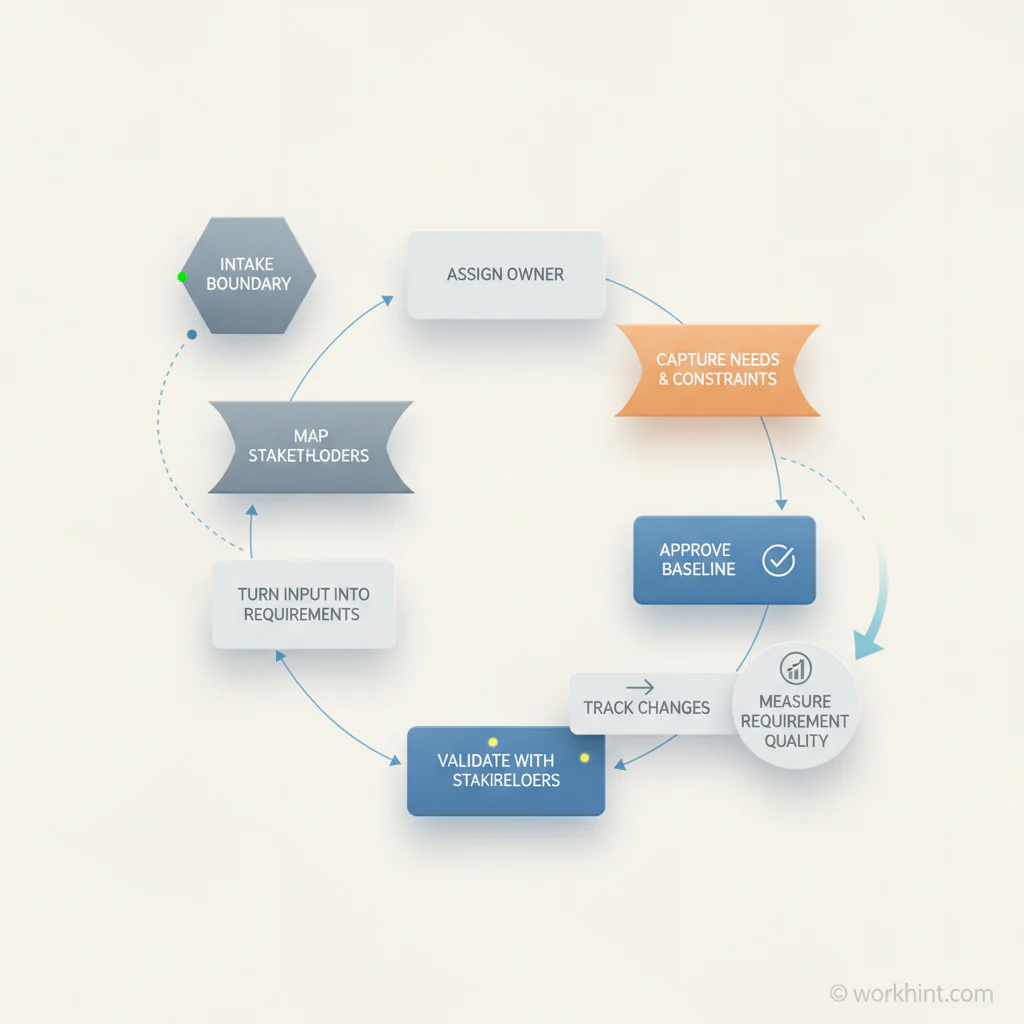
Requirements gathering process steps
The most useful requirements gathering process has eight steps. It is structured enough to prevent ambiguity, but light enough that teams can actually use it.
- Define the intake boundary. Clarify what problem, request, project, workflow, system, or change is being considered. This prevents general strategy drift.
- Assign a requirements owner. One person should own the process, timeline, decision record, and final requirements package. The owner may be a business analyst, product operations lead, project manager, operations lead, or functional owner.
- Map stakeholders by decision role. Separate sponsors, approvers, users, operators, compliance reviewers, finance partners, technical owners, and affected teams. Not every stakeholder gets the same decision power.
- Collect current-state evidence. Review existing processes, tickets, forms, customer examples, reports, policies, handoffs, support issues, and exceptions. Stakeholder interviews are useful, but evidence keeps the process grounded.
- Elicit needs and constraints. Ask what outcome is required, what cannot change, what risks matter, what approvals are needed, what systems are involved, and what would make the work fail.
- Turn input into requirement statements. Convert notes into clear business, operational, functional, reporting, compliance, access, workflow, and exception requirements.
- Validate and approve the baseline. Confirm that requirements are accurate, complete enough, feasible, prioritized, and approved by the right decision owner before execution starts.
- Track changes after approval. New requirements should move through change control, not side conversations. Record who requested the change, why it matters, what it affects, and whether it was approved.
This mirrors search intent around requirements gathering. Current guides such as Asana’s requirements gathering process emphasize roles, stakeholder input, documentation, approval, and monitoring. The operational gap is making those steps traceable after the meeting ends.
A requirements quality table
Before a requirement is approved, test it against quality criteria. Weak requirements create hidden work because teams must interpret them later.
| Quality check | Question to ask | Failure signal |
|---|---|---|
| Business outcome | What result should this requirement support? | The requirement describes activity but not value. |
| Owner | Who can clarify, approve, or reject changes? | Several teams are involved but nobody owns the call. |
| Measurability | How will we know the requirement is satisfied? | Success depends on opinion instead of evidence. |
| Constraint | What limits, policies, budgets, systems, or risks apply? | The requirement ignores real operating conditions. |
| Traceability | Which stakeholder input or business need does this map to? | Nobody remembers why the requirement exists. |
| Change path | What happens if this requirement changes later? | Changes arrive through chat and bypass approval. |
Questions to ask stakeholders
Good stakeholder questions make tradeoffs visible. Use questions that reveal outcomes, constraints, and decision rights.
- What business problem are we solving?
- Who is affected if this work succeeds or fails?
- What must be true before work can start?
- Which approvals, policies, data, or systems are involved?
- What is in scope, out of scope, and undecided?
- What exceptions happen today, and who handles them?
- What metric should improve when this is working?
- Who has authority to approve the final baseline?
The IIBA Business Analysis Standard groups elicitation with collaboration, confirmation, communication, and stakeholder management. That is a useful reminder: requirements gathering is not just asking questions. It is aligning people around a shared operating decision.
Common mistakes
The first mistake is confusing requirements with preferences. A stakeholder may prefer a dashboard, but the real requirement may be faster exception visibility for regional managers. Capture the preference, then ask what operating need sits underneath it.
The second mistake is skipping approval. Requirements that are documented but not approved become negotiation material during execution. Define who approves the baseline and what approval means.
The third mistake is ignoring exceptions. Normal-path requirements are easier to write, but exceptions often determine whether the process works. Include failed approvals, missing data, late submissions, duplicate requests, urgent changes, and compliance holds.
The fourth mistake is letting requirements live in a static document only. Documents are useful, but operational requirements also need status, ownership, routing, dependencies, change history, and reporting.
Where Workhint fits
Workhint fits when requirements gathering needs to become a live work system instead of a document attached to a project. A team can describe the operating challenge, then use Workhint to structure roles, intake fields, permissions, requirement types, approval paths, assignments, exceptions, dashboards, and change control.
For example, an operations team redesigning customer implementation could use Workhint to capture requirements from sales, implementation, finance, support, and customers; route missing information back to the right owner; approve the baseline; assign workflow build steps; and measure how often changes occur after approval. The value is not that AI writes requirements for the team. The value is turning requirements into an accountable system that supports execution.
FAQ
What is a requirements gathering process?
A requirements gathering process is the structured workflow for identifying, documenting, validating, approving, and tracking what a project, process, product, or operational change must deliver.
Who owns requirements gathering?
The owner depends on the work. Business analysts, project managers, product operations, operations leads, PMO teams, or functional leaders can own it. The important rule is that one accountable owner manages the process and final baseline.
What is the difference between intake and requirements gathering?
Intake decides whether a request should enter the system and where it should go. Requirements gathering defines what accepted work must deliver, who must approve it, what constraints apply, and how changes will be managed.
How detailed should requirements be?
Requirements should be detailed enough for the next team to act without guessing. They should include the business outcome, owner, constraints, acceptance criteria, priority, dependencies, and approval status.
Can AI help with requirements gathering?
Yes, but human review matters. AI can help structure questions, summarize stakeholder input, identify gaps, draft requirement statements, and route follow-ups. Humans should still approve tradeoffs, constraints, and final decisions.
Conclusion
A strong requirements gathering process gives business work a clear operating foundation. It turns stakeholder input into approved requirements, makes tradeoffs visible, connects requirements to owners, and protects execution from avoidable ambiguity.
The best process is not heavy. It is repeatable. Define the boundary, assign ownership, gather evidence, elicit needs, write clear requirements, validate the baseline, and manage changes through a controlled path.
Leave a Reply