


You can validate a moving company before owning trucks by selling booked jobs and coordinating trusted independent crews.
How to start a moving company is usually explained as a capital-heavy plan: buy trucks, hire movers, rent storage, and hope demand arrives. A leaner path is to build the branded platform that wins customers, coordinates qualified provider partners, and proves demand before expensive assets.
This article focuses on starting without cutting corners on licenses, insurance, safety, or customer trust. Begin with labor-only moves, packing help, apartment moves, senior moves, office moves, and partnerships with independent truck owners or rental options until the numbers justify owned vehicles.
What’s in this article?
- Why a moving business can work without owning trucks first
- What you need before launch
- How to price early services
- Where first customers come from
- How Workhint can become the branded operating platform
- A practical 7-day launch plan
Why this business works
Moving is stressful, time-sensitive, and often local. Customers do not only buy transportation. They buy reliability, clear pricing, careful handling, and someone who can coordinate the job without confusion.
The search demand is steady because people keep relocating for housing, family, jobs, school, downsizing, and office changes. Census data shows 11.8 percent of the U.S. population moved to a different residence in 2024, which still represents a large recurring pool of local demand. That demand creates room for focused operators who can serve specific segments well.
The platform-first model works because many first jobs do not require owning a fleet. You can start with loading, unloading, packing, furniture rearranging, dorm moves, and local jobs fulfilled through vetted independent providers.
Providers join because you bring organized demand, clean job details, scheduling, documentation, and payment flow. Customers buy because your branded process makes the move feel less risky than hiring random help from a marketplace.
How to start a moving company without trucks
The first version should be narrow. Choose one market, one or two service types, and one customer segment, such as apartment loading or senior downsizing support.
You still need business registration, local or state moving requirements, insurance advice, clear terms, provider screening, service checklists, and customer intake. Interstate household goods movers may need federal operating authority and a USDOT number. Intrastate rules vary by state, so verify requirements before accepting jobs.
| Startup item | Lean launch approach | Typical early budget |
|---|---|---|
| Business registration | LLC or local business setup | $50 to $500 |
| Licensing and permits | State and local moving requirements first | $300 to $2,500 |
| Insurance planning | General liability, cargo, and professional advice | $500 to $3,000 deposit or early premium |
| Brand and website | Simple local brand with clear service pages | $200 to $1,000 |
| Workhint platform setup | Customer intake, quoting, scheduling, provider onboarding, payments | Start lean before custom software |
| Supplies | Dollies, straps, pads, gloves, labels, forms | $300 to $1,500 |
| First marketing tests | Google Business Profile, flyers, referral partners, local SEO | $200 to $1,500 |
The biggest avoided expense is the truck. Validate demand first, then decide whether trucks, employees, warehouse space, or storage partnerships are justified.
How to price it
Start with simple packages customers can understand. Moving customers hate vague pricing. Use an intake form to collect address type, stairs, elevator access, inventory size, distance, packing needs, date flexibility, and truck requirements before quoting.
| Offer | Best first customer | Example pricing model |
|---|---|---|
| Labor-only loading or unloading | Apartment renters using rental trucks | Two-person crew minimum, hourly rate, 2-hour minimum |
| Packing help | Busy families and seniors | Hourly package or room-based quote |
| Small local move | Students, renters, small offices | Base fee plus hourly crew and truck partner cost |
| Senior move coordination | Adult children and senior communities | Planning fee plus packing, loading, and setup packages |
| Office move support | Small businesses | Quoted project with after-hours premium |
Do not compete only on being cheap. Compete on clear scope, careful handling, responsive scheduling, and proof the job was completed properly.
How to get first customers
Your first customers usually come from trust channels, not broad advertising. Start with property managers, apartment communities, real estate agents, storage facilities, senior communities, college housing groups, and neighborhood pages.
Offer one launch package in one service area. Ask referral partners what requests they cannot fulfill reliably, then turn those requests into intake and quote workflows.
The week-one goal is not to look national. It is to prove customers request quotes, providers accept jobs, pricing works, and fulfillment stays organized.
How Workhint helps launch it
A moving business without trucks needs operational trust. Workhint can generate the branded platform for that trust before you build custom software or stitch together forms, spreadsheets, calendars, payment tools, and text threads. A truck-light moving company can use service marketplace software to match customers with vetted movers, truck partners, labor crews, booking windows, job checklists, and payments.
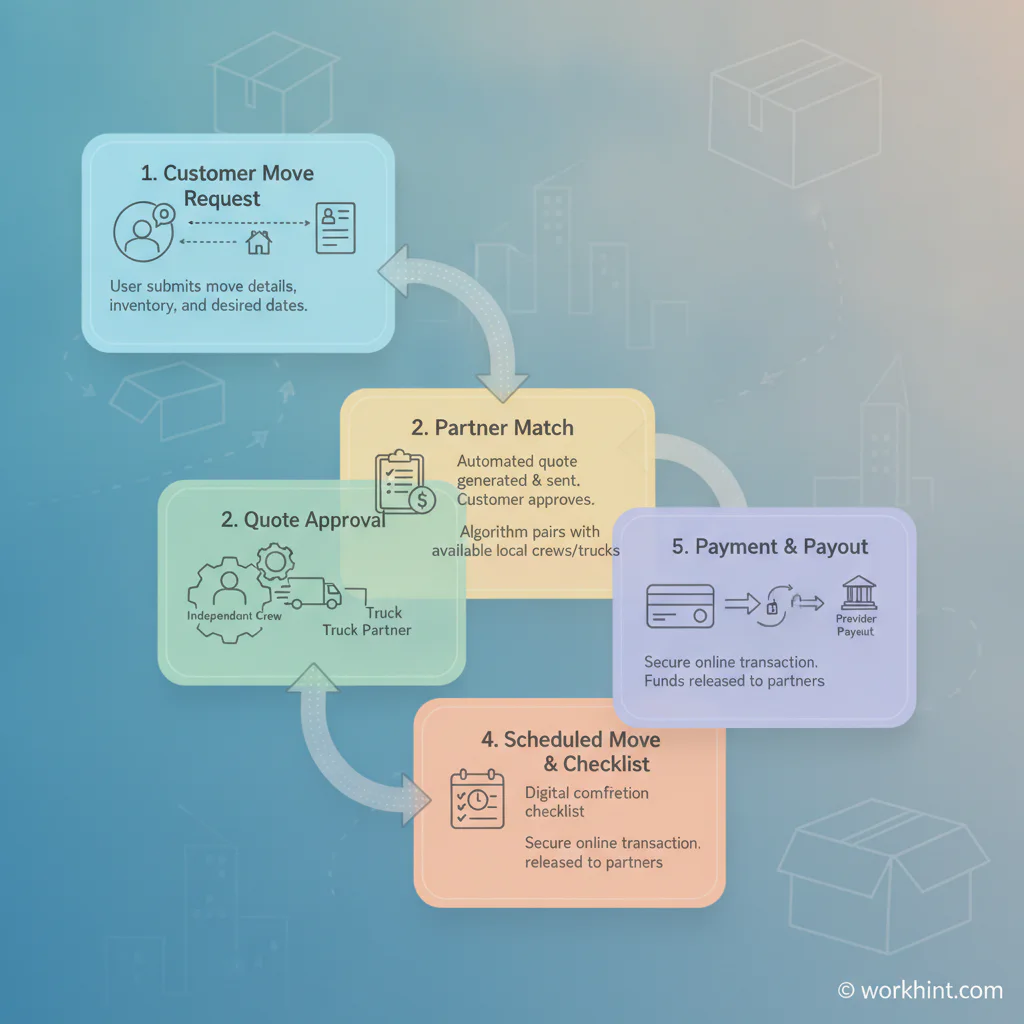
Customers request a move through your branded portal, upload job details, choose the service type, and receive a quote approval flow. Your dashboard shows move dates, addresses, crew requirements, truck requirements, risk notes, and provider availability. Independent movers or truck partners can complete onboarding, accept jobs, follow mobile checklists, upload completion photos, and receive payouts after the customer pays.
This lets you test labor-only moves, packing services, and truck-partner jobs under one customer experience. If demand becomes predictable, you can later buy a truck, hire employees, or open a location with evidence.
First 7-day launch plan
- Day 1: Pick one market, one customer segment, and one simple offer, such as labor-only apartment moving help.
- Day 2: Set up the branded Workhint portal with customer intake, service areas, quote fields, and provider roles.
- Day 3: Build the quote, scheduling, payment, provider payout, checklist, and review process.
- Day 4: Recruit independent movers, packing helpers, and truck-owner partners. Verify experience, documents, availability, and expectations.
- Day 5: Contact apartment managers, storage facilities, agents, senior communities, and local groups with the launch offer.
- Day 6: Route every inquiry through the platform, quote quickly, and confirm provider availability before accepting payment.
- Day 7: Review quote requests, close rate, provider reliability, customer concerns, and margins before adding services.
A good first week ends with evidence: quote demand, provider readiness, pricing quality, and repeatable job types.
Final launch checklist
- Choose a clear moving niche and service area.
- Verify state, local, and federal requirements before accepting regulated moves.
- Get insurance guidance for liability, cargo, workers, and contractor risk.
- Create service packages for labor-only, packing, small moves, or partner-truck jobs.
- Configure the branded Workhint platform for intake, quotes, scheduling, payments, checklists, and payouts.
- Recruit and vet the first independent providers or truck partners.
- Create customer terms, cancellation rules, damage reporting, and completion documentation.
- Launch local outreach to referral partners before spending heavily on ads.
- Validate demand before buying trucks, leasing space, or hiring employees.
FAQ
Can I start a moving company without owning a truck?
Yes, if you begin with loading, unloading, packing, small move coordination, or jobs fulfilled through qualified truck partners. Follow the rules that apply in your state and service type.
How much does it cost to start a moving company?
Traditional budgets rise quickly because trucks, payroll, insurance, and equipment add up. A lean launch starts with registration, licensing checks, insurance planning, brand setup, provider onboarding, supplies, and marketing tests.
Do moving companies need licenses?
Often, yes. Requirements depend on whether moves are local, intrastate, or interstate. Verify state rules before selling regulated services.
What insurance does a moving business need?
Talk with an insurance professional about general liability, cargo coverage, commercial auto exposure, workers’ compensation, and contractor-related risk.
What is the easiest moving service to start with?
Labor-only loading and unloading is often the simplest first offer because the customer may provide the truck. Packing help, furniture rearranging, and small local move coordination can also be easier than launching a full-service fleet.
How do I get first moving customers?
Start with apartment managers, storage facilities, real estate agents, senior communities, college housing groups, local SEO, referral offers, and neighborhood groups.
Should I hire employees right away?
Usually not before demand is proven. Build a vetted provider network first, then hire later if volume, margins, and compliance requirements justify it.
Conclusion
A moving company does not have to begin with trucks, payroll, and a large fixed-cost base. You can start by building the brand, service platform, provider network, and customer acquisition process first.
The smart early move is to validate demand, fulfill narrowly, document every job, and learn which services customers buy repeatedly. Workhint gives you the branded operating foundation to test that model quickly, then expand only when the market has shown you what to build next.
Leave a Reply