


Use this template to clarify who can approve work, spending, contracts, exceptions, and operational decisions before bottlenecks start.
A delegation of authority matrix defines who has authority to approve specific business decisions, usually by role, decision type, risk level, and financial threshold. It is most common in finance, procurement, hiring, contracting, vendor management, operations, and compliance-heavy workflows.
The value is simple: people should not have to guess who can approve a purchase, contract, exception, hire, discount, payment, vendor, change order, or operational commitment. A useful matrix gives teams speed and control at the same time. This resource gives you a copy-ready structure you can adapt for a growing business.
What is included
This resource includes a practical authority matrix, setup steps, example approval levels, common mistakes, and guidance for turning the document into a working approval workflow. It is designed for operators, finance leaders, procurement teams, founders, HR leaders, department heads, and anyone trying to reduce approval confusion without centralizing every decision.
The GSA describes delegation of procurement authority as written authority that clarifies responsibilities between contracting roles. The same principle applies inside companies: authority should be documented, role-based, and clear enough that work can move without informal side approvals.
How to use this delegation of authority matrix
- List decision categories. Start with the decisions that create cost, risk, commitments, access, legal exposure, or customer impact.
- Define thresholds. Use spend amounts, contract value, term length, headcount impact, risk level, customer tier, data sensitivity, or operational impact.
- Assign authority by role. Name business roles, not individual people, so the matrix survives personnel changes.
- Add conditions. Some approvals only apply when budget exists, legal language is unchanged, vendor risk is low, or the request matches an approved policy.
- Define exceptions. Name what happens when a decision falls outside the matrix, needs emergency approval, or conflicts with policy.
- Connect evidence. Require the records needed for auditability: request form, quote, contract, invoice, risk review, budget owner, or approval note.
- Review on a cadence. Revisit the matrix after reorganizations, new markets, new products, budget changes, risk events, or major process changes.
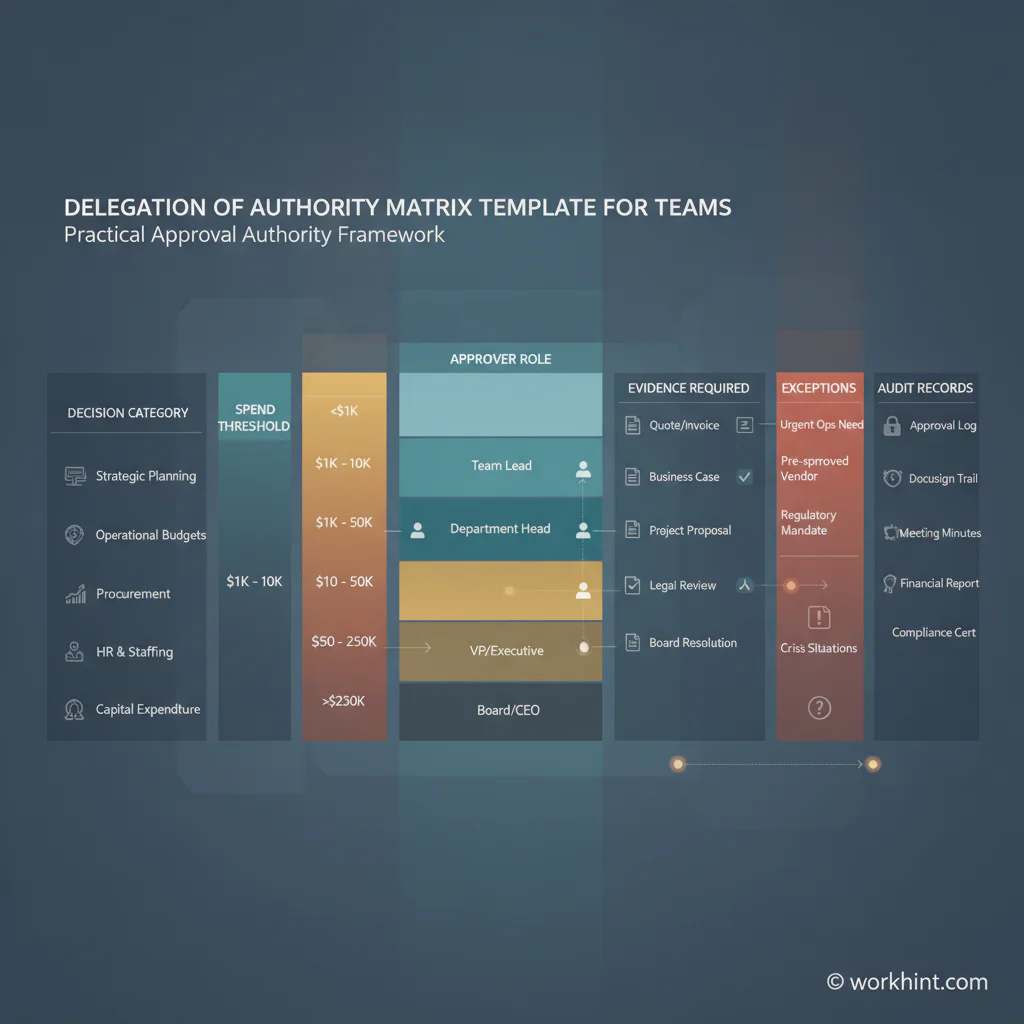
Delegation of authority matrix template
Copy this structure into a spreadsheet, policy document, procurement workflow, finance system, or operations workspace. Replace the example thresholds with your company rules and legal requirements.
| Decision type | Threshold or condition | Requester | Approver | Required evidence | Exception path |
|---|---|---|---|---|---|
| Purchase request | Up to $2,500 and within approved budget | Team lead | Department manager | Business reason, vendor quote, budget code | Finance review if budget is missing |
| Purchase request | $2,501 to $25,000 | Department manager | Department head and finance | Quote, budget owner, delivery timeline, vendor record | CFO review if unbudgeted |
| Vendor contract | New vendor or contract over 12 months | Business owner | Legal, finance, and accountable executive | Contract, risk notes, payment terms, data access review | Legal escalation for nonstandard terms |
| Hiring approval | Replacement role within approved headcount plan | Hiring manager | Functional leader and HR | Job requisition, compensation range, budget confirmation | CEO or finance review if outside plan |
| Customer discount | Within standard discount band | Sales owner | Sales manager | Deal value, margin impact, contract term | Executive approval if below floor |
| System access | Access to financial, customer, or production systems | Manager or system owner | System owner and security or IT | Role need, duration, permission level, offboarding owner | Security review for privileged access |
Example approval levels
A small company might start with three levels: manager approval for routine low-risk decisions, department head approval for larger commitments, and executive approval for high-value, cross-functional, legal, or out-of-policy decisions. A larger company may need separate paths for procurement, contracts, hiring, customer commitments, payments, data access, and vendor risk.
The GGGI delegation of authority policy is a useful public example because it treats delegated authority as functional rather than personal and reserves undelegated authority. That distinction matters for businesses too. The matrix should clarify what roles can approve, what remains reserved, and what cannot be delegated casually.
Roles to define before rollout
An authority matrix works best when decision roles are explicit. Borrow from common responsibility models where useful, but keep the template understandable for daily business use.
- Requester: the person asking for approval and providing required evidence.
- Business owner: the person accountable for the outcome, budget, vendor, hire, or customer commitment.
- Approver: the role with authority to approve, reject, or request changes.
- Reviewer: finance, legal, HR, IT, security, compliance, or operations roles that must review before approval.
- Informed parties: people who need the decision record but do not approve it.
Atlassian’s DACI framework separates driver, approver, contributors, and informed stakeholders. AIHR’s RACI guidance similarly clarifies responsible, accountable, consulted, and informed roles. You do not need to force either model into every approval, but the idea is useful: decisions move faster when each role is unambiguous.
Common mistakes
Writing the matrix around names instead of roles. Names change. Roles, authority levels, and fallback rules are easier to maintain.
Leaving exceptions informal. Every business has urgent exceptions. Define how they are documented, who can approve them, and when retroactive review is required.
Using spend thresholds only. Low-dollar decisions can still create legal, data, brand, security, or customer risk. Add nonfinancial triggers where needed.
Separating approvals from evidence. An approval without the quote, budget code, contract, invoice, risk review, or request record is hard to audit later.
Never reviewing the matrix. Authority should change when the company changes. Review after leadership changes, new departments, new markets, new compliance obligations, or repeated exceptions.
Where Workhint fits
A delegation of authority matrix is useful as a reference, but it becomes much stronger when it is connected to the workflow where approvals happen. Workhint can help teams turn the matrix into a live operating system with request intake, role-based permissions, approval routing, evidence collection, exception paths, reminders, and reporting.
For example, a purchase request can collect the business reason, budget code, quote, vendor details, and risk notes, then route approval based on threshold and decision type. The same pattern can support hiring approvals, contract reviews, system access, vendor onboarding, payment approvals, and change orders. The matrix defines the rules. Workhint helps the team run those rules consistently.
FAQ
What should a delegation of authority matrix include?
It should include decision categories, thresholds, requester roles, approver roles, required reviewers, evidence requirements, exception paths, fallback owners, and review cadence.
Who owns the authority matrix?
Ownership depends on the decision area. Finance often owns spending thresholds, legal owns contract approval rules, HR owns hiring-related approvals, IT or security owns access approvals, and operations often owns the workflow that connects them.
Is a delegation of authority matrix only for large companies?
No. Small companies need it as soon as decisions start slowing down, approvals become inconsistent, or founders are pulled into routine spending, hiring, vendor, or customer exceptions.
How often should the matrix be reviewed?
Review it at least annually and whenever the business changes materially. Reorganizations, new markets, new compliance obligations, budget resets, leadership changes, and repeated exceptions are all good triggers.
Does this replace legal or finance policy?
No. Treat this as an operating template, not legal, tax, accounting, or compliance advice. For regulated decisions, contracts, employment, financial controls, or public-sector procurement, have the matrix reviewed by the appropriate finance, legal, or compliance owner.
Conclusion
A strong delegation of authority matrix gives teams clear decision rights without making every approval dependent on the most senior person in the room. Define the decision categories, thresholds, approvers, evidence, exceptions, and review cadence before confusion turns into delay or risk.
Use the template above as a starting point, then adapt it to your company size, risk profile, operating model, and approval tools. The goal is not a perfect spreadsheet. The goal is a business approval system people can actually follow.
Leave a Reply