


You can validate pet transport demand before buying vans, hiring drivers, or building dispatch software.
If you want to start a pet transport business, the fastest path is not to buy a fleet first. It is to choose one clear transport use case, prove pet owners will pay for it, recruit reliable independent transport partners, and run every request through a branded operating platform.
This guide shows how to launch a lean pet transport business with no vans, validate demand first, and use Workhint as the operating foundation before you make expensive vehicle or staffing commitments.
What’s in this article?
- Why a pet transport business works
- What you need before the first booking
- How to price pet transport services
- How to get first customers without overbuilding
- How Workhint helps launch the transport platform
- A 7-day launch plan, checklist, and FAQ
Why this business works
A pet transport business works because pet owners buy trust, safety, and convenience. The customer is not just paying for a ride. They are paying for a careful handoff, a clear schedule, documented instructions, and confidence that the pet will arrive safely.
The best first version is narrow. Start with one market and one service type: local vet appointment transport, airport pet pickup, adoption transport coordination, breeder-to-owner delivery, or relocation support inside a defined region. A narrow offer is easier to price, easier to sell, and easier to fulfill through vetted providers.
What you need to launch
Before the first booking, set up the business around safety and coordination. You need a legal business setup, insurance guidance, provider agreements, a clear service area, pet handling rules, emergency instructions, cancellation terms, and a way to collect detailed trip information from customers.
Check federal, state, and local rules before advertising. Interstate animal transport can trigger additional requirements, and pet handling rules vary by location and service type. If you work with independent providers, review classification, insurance, and contract terms with qualified advisors.
| Launch item | Lean first version | Typical early budget |
|---|---|---|
| Business setup | Registration, bank account, basic terms, provider agreement review | $150 to $900 |
| Branded platform | Customer request form, provider onboarding, scheduling, payments, updates | $0 to $500 to configure |
| Insurance and compliance | General liability review, transport coverage research, rule checks | $300 to $2,000 |
| Provider onboarding | Driver checks, vehicle requirements, pet handling checklist, payout setup | $100 to $600 |
| Customer acquisition | Local SEO page, vet outreach, shelter partnerships, referral materials | $100 to $1,000 |
How to price it
Pet transport pricing depends on distance, urgency, pet size, special handling, waiting time, documentation, and whether the trip is local or long-distance. Keep the first pricing model simple enough for customers to understand and providers to fulfill.
| Offer | Example price | Best for |
|---|---|---|
| Local appointment ride | $60 to $150 plus waiting time | Vet, grooming, daycare, or boarding trips |
| Local point-to-point transport | $100 to $300 | Airport pickup, adoption transfer, local relocation |
| Regional transport | $250 to $750 | Longer ground trips inside one state or nearby states |
| Shared-route transport | Per-mile or zone-based quote | Cost-sensitive owners with flexible timing |
Do not underprice the operational work. You need margin for customer support, provider payout, routing, cancellations, schedule changes, insurance, marketing, and payment fees. If a route requires special handling, overnight care, medication timing, or multiple pets, quote it separately.
How to get first customers
Start where pet transport demand already appears. Contact veterinarians, animal hospitals, groomers, boarding facilities, shelters, breeders, trainers, senior living communities, and relocation companies. Explain the narrow offer and make it easy for them to refer one customer at a time.
Create a local landing page for one service area. Use clear language such as pet taxi, vet appointment transport, airport pet pickup, or pet relocation help. The first goal is not national scale. It is to prove that customers in one market will submit requests, accept quotes, and trust your provider network.
How Workhint helps launch it
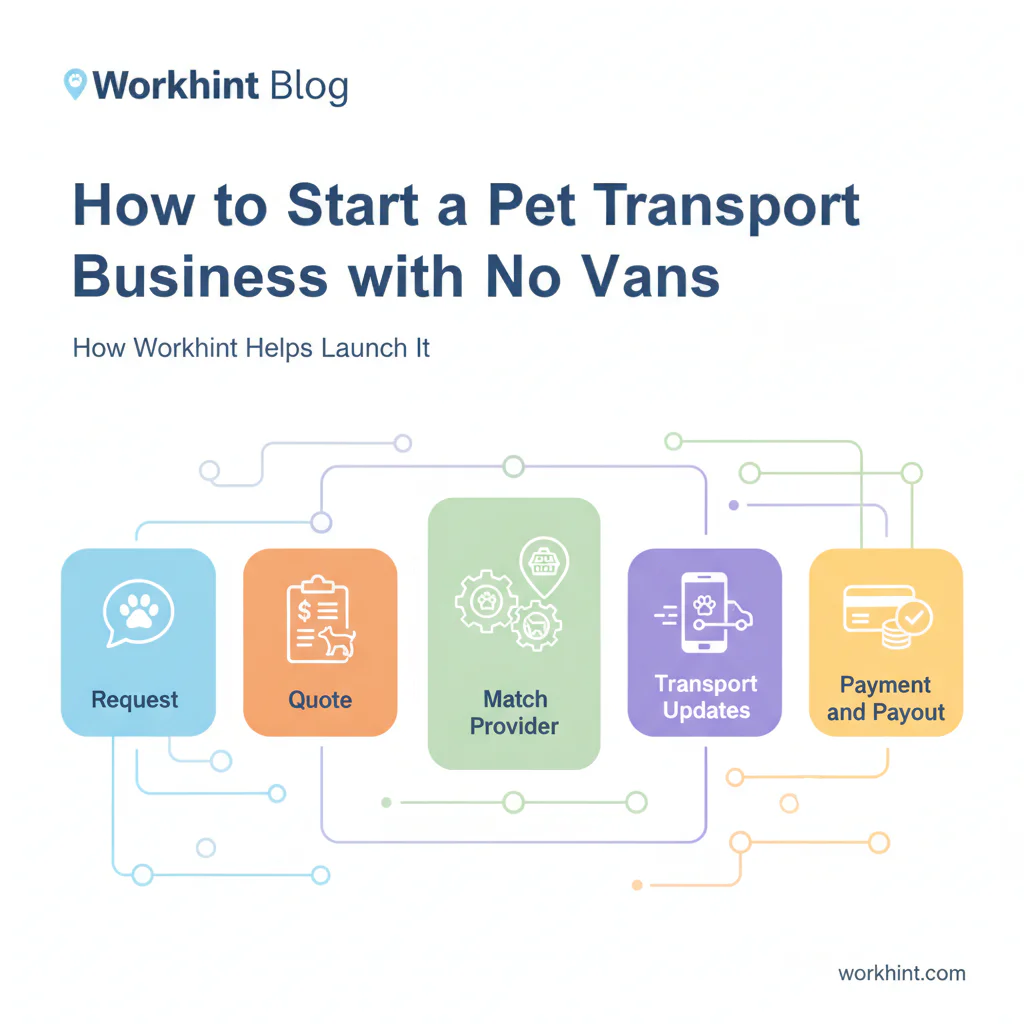
Workhint helps you launch the pet transport platform before you invest in vans, staff, or custom dispatch software. The customer sees a branded portal where they request transport, enter pet details, upload vaccination or handling notes when needed, choose timing, approve a quote, pay online, and receive updates.
Behind the scenes, Workhint gives the owner an operating system for provider onboarding, trip review, route assignment, scheduling, customer communication, document collection, payment tracking, and provider payouts. Independent transport partners can receive assigned trips, view handling instructions, confirm pickup, submit completion notes, and trigger payout steps after the job is verified.
That matters because pet transport is an operations business. Trust depends on clear instructions, reliable handoffs, fast updates, and consistent documentation. Workhint lets the founder sell the service as a professional branded platform while keeping the first version lean enough to validate demand.
First 7-day launch plan
- Day 1: Choose the launch market, customer type, and first offer. Keep it narrow, such as local vet transport for busy pet owners.
- Day 2: Set up the branded Workhint platform basics: request form, service area, pet details, quote workflow, and customer dashboard.
- Day 3: Create pricing, scheduling rules, cancellation terms, payment collection, provider payout logic, and emergency instructions.
- Day 4: Recruit the first independent transport partners with suitable vehicles, clear availability, insurance awareness, and pet handling experience.
- Day 5: Contact vets, groomers, shelters, boarding facilities, breeders, and relocation partners in the launch area.
- Day 6: Follow up, book first requests, route every inquiry through the platform, and test the customer update process.
- Day 7: Review demand, quote acceptance, provider reliability, route economics, and customer concerns before spending on owned vehicles.
Final launch checklist
- Choose one pet transport niche and one launch market.
- Register the business and review local transport rules.
- Check insurance needs before accepting paid bookings.
- Create the branded Workhint customer portal.
- Build intake, quote approval, scheduling, payment, and payout workflows.
- Recruit and vet the first independent transport partners.
- Create pet handling, pickup, update, and completion checklists.
- Build referral relationships with local pet businesses.
- Validate paid demand before buying vans or hiring drivers.
FAQ
How much does it cost to start a pet transport business?
A lean launch can often start with a few hundred to a few thousand dollars for business setup, insurance research, a branded platform, provider onboarding, and local marketing. Costs rise quickly if you buy vans, crates, equipment, or commercial coverage before demand is proven.
Can I start a pet transport business with no vans?
Yes, if you structure the business around qualified independent transport partners or resource partners who already have appropriate vehicles. You still need clear standards, contracts, insurance review, customer communication, scheduling, and payout workflows.
Do I need a license to transport pets?
Rules vary by location and service type. Interstate animal transport, commercial animal movement, or certain breeding and adoption scenarios may require additional registration or compliance steps. Check federal, state, and local requirements before launch.
What insurance does a pet transport business need?
Most founders should review general liability, commercial auto exposure, animal bailee or care coverage, and provider insurance requirements with an insurance professional. Do not assume a personal auto policy covers commercial pet transport.
How should I price pet transport?
Price based on distance, pet size, waiting time, urgency, special handling, route complexity, and provider payout. Local trips may use flat packages, while regional trips often need custom quotes.
Where do first customers come from?
Good early sources include vets, groomers, shelters, breeders, boarding facilities, relocation companies, senior communities, local SEO, neighborhood groups, and referral partners that already serve pet owners.
When should I buy my own van?
Buy a van only after you see repeat routes, strong quote acceptance, reliable margins, and enough booking volume to justify the fixed cost. Until then, use the provider-network model to learn faster with less risk.
Conclusion
A pet transport business can start lean when you treat it as a trusted coordination platform, not a vehicle purchase. Pick one market, recruit reliable providers, prove customers will book, and build the operating system before adding fixed assets.
Workhint gives you the branded foundation to manage requests, routes, providers, payments, and payouts from the first week. That lets you validate the business before buying vans, hiring drivers, or building custom software.
Leave a Reply