


Use this form to document handbook receipt, policy awareness, employee questions, and signed acknowledgment without adding unnecessary legal clutter.
An employee handbook acknowledgment form template gives HR and managers a consistent way to confirm that employees received the handbook, had a chance to review it, and understand where policies live. It is a simple document, but it matters because handbook updates often touch conduct, safety, time off, remote work, security, confidentiality, reporting channels, and other rules employees are expected to follow.
This resource is a business template, not legal advice. Handbook language, at-will statements, wage rules, leave policies, privacy notices, and state-specific requirements should be reviewed by HR or counsel before use.
What’s included
- A copy-ready employee handbook acknowledgment form template
- A field-by-field checklist for HR, managers, and employees
- A rollout workflow for new hires and handbook updates
- An exception process for employees who refuse to sign or have questions
- Common mistakes that weaken records or create confusion
How to use this employee handbook acknowledgment form template
Use the form whenever an employee receives a new handbook, a materially revised handbook, or an important policy manual update. SHRM maintains sample handbook receipt and policy manual acknowledgment forms, which is a useful signal that the acknowledgment should be treated as a standard HR record.
Do not ask employees to sign before they can access the handbook. Send the current version, give them time to review it, tell them where to ask questions, then collect the signed acknowledgment. Keep the completed form with the handbook version, effective date, delivery method, and signature date.
Employee handbook acknowledgment form template
| Section | Template field or statement | Owner |
|---|---|---|
| Employee details | Employee name, role, department, manager, work location, and employee ID if used. | HR |
| Handbook version | Handbook title, version number, publication date, effective date, and delivery method. | HR |
| Receipt statement | I acknowledge that I received access to the employee handbook identified above. | Employee |
| Review statement | I understand that I am responsible for reading the handbook and asking questions about any policy I do not understand. | Employee |
| Policy awareness | I understand that the handbook describes company policies, expectations, reporting channels, and workplace standards. | Employee |
| Change statement | I understand that the company may update policies, and I am responsible for reviewing future updates when provided. | HR |
| Non-contract statement | This acknowledgment does not create an employment contract unless a separately signed agreement says otherwise. | Legal or HR |
| Questions | I had the opportunity to ask questions before signing, or I have listed open questions below. | Employee and HR |
| Signatures | Employee signature, date, HR or manager witness, and submission method. | Employee and HR |
Copy-ready acknowledgment language
Use this as a starting point and adapt it to your approved handbook language:
I acknowledge that I have received access to the current employee handbook for [Company Name], version [Version/Date]. I understand that I am responsible for reading the handbook, following the policies that apply to my work, and asking HR or my manager if I have questions. I understand that the handbook may be updated from time to time and that I am responsible for reviewing future updates when they are provided. I also understand that this acknowledgment does not create an employment contract or change any separate written employment agreement. Employee signature: [Name]. Date: [Date].
If the company uses at-will language, union-specific rules, arbitration agreements, state addenda, or separate policy acknowledgments, keep those statements aligned with approved legal language and the handbook itself.
Handbook acknowledgment workflow
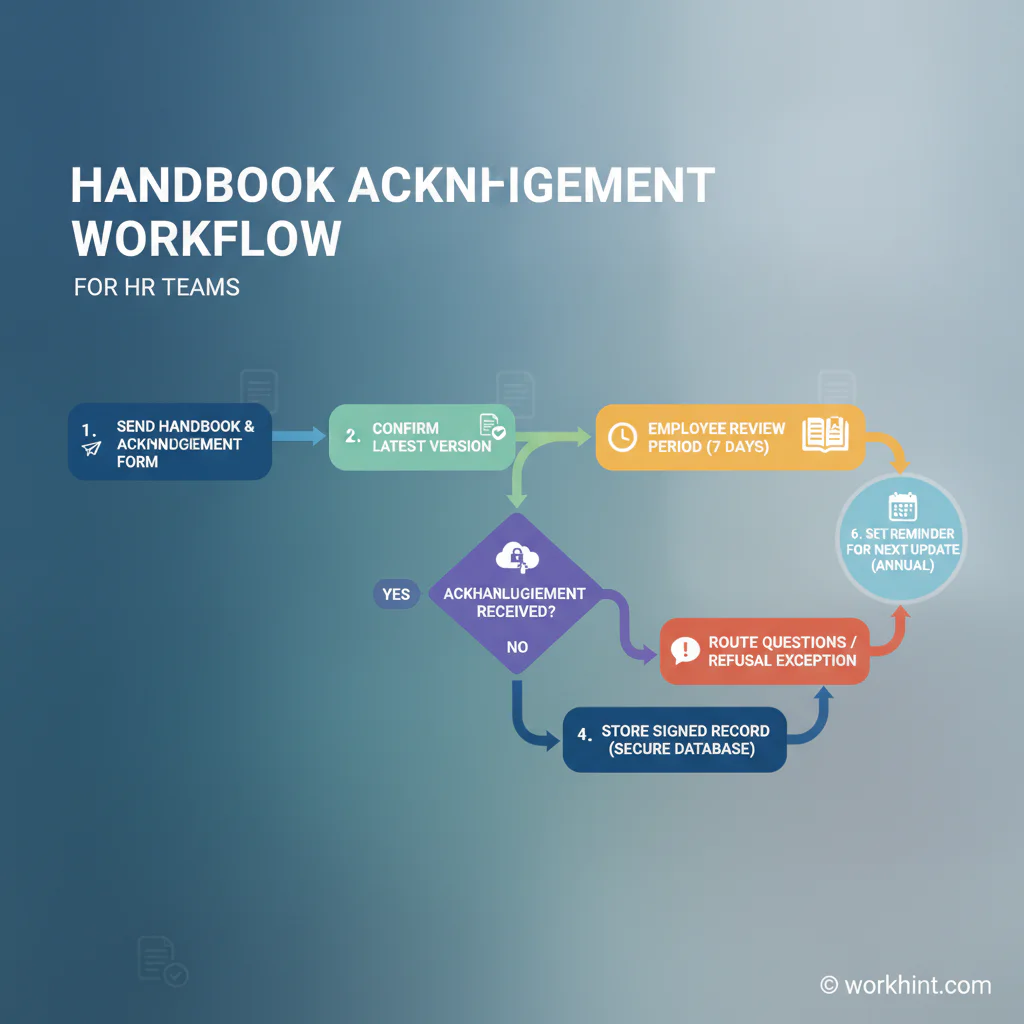
- Confirm the handbook version. Use one controlled handbook file, version date, and owner. Avoid collecting signatures against an outdated PDF or unofficial copy.
- Deliver the handbook. Send the handbook through the HR system, onboarding workflow, employee portal, or controlled document link.
- Give review time. Tell employees when the acknowledgment is due and where to raise questions before signing.
- Collect the signed form. Capture signature, date, version, and delivery method. Electronic signatures are useful if your process can preserve audit history.
- Store the record. Save the acknowledgment in the employee file with access controls. The Texas Workforce Commission’s sample acknowledgment of receipt language notes that the signed form may be retained in the personnel file.
- Track exceptions. If an employee has questions, assign HR follow-up. If an employee refuses to sign, document the issue and follow company policy instead of arguing in the moment.
- Repeat after major updates. Significant handbook changes should trigger a new acknowledgment cycle, not just a notice buried in a message thread.
When to collect a new acknowledgment
| Trigger | New acknowledgment? | Why |
|---|---|---|
| New hire onboarding | Yes | The employee is receiving the handbook for the first time. |
| Annual handbook refresh | Usually | Confirms employees saw the current version and know where policies live. |
| Major policy change | Yes | Important changes deserve a clear record of distribution and receipt. |
| Minor typo or formatting fix | Usually no | A version note may be enough if the substance did not change. |
| Employee transfer to another state or role | Often | Different policies, addenda, reporting lines, or safety rules may apply. |
Common mistakes
The first mistake is treating the signature as proof that the employee read and understood every detail. It is better to say the employee received the handbook, is responsible for reviewing it, and had a channel for questions. That is more realistic and easier to support operationally.
The second mistake is leaving the form disconnected from handbook version control. A signed acknowledgment is much less useful if HR cannot prove which handbook was sent. Keep the version number, effective date, and file location tied to the record.
The third mistake is mixing too many agreements into one form. Handbook acknowledgment, confidentiality, invention assignment, arbitration, restrictive covenants, and policy-specific consents may need different treatment. The U.S. Equal Employment Opportunity Commission reminds employers to keep hiring and employment practices aligned with anti-discrimination obligations, so sensitive policy language should be reviewed carefully.
Where Workhint fits
Workhint helps organizations turn the handbook acknowledgment form into a live HR workflow instead of another file in a folder. A team can digitize handbook distribution, assign acknowledgment tasks, route employee questions to HR, control access by role or location, track overdue signatures, and connect signed records to onboarding or policy update workflows.
This is useful when handbook acknowledgment crosses HR, managers, employees, legal, IT, and distributed teams. The form stays simple, while the surrounding process shows who received the handbook, which version they acknowledged, who has questions, and which records are complete.
FAQ
What is an employee handbook acknowledgment form?
It is a signed record confirming that an employee received access to the company handbook and understands their responsibility to review the policies and ask questions.
Is an employee handbook acknowledgment legally required?
Requirements vary by location, policy, contract, and employer type. Many companies use acknowledgments as a good HR recordkeeping practice, but legal counsel should review the exact language.
Should employees sign a new form after every handbook update?
Not necessarily. Major policy changes, annual releases, state addenda, or role-specific updates often deserve a new acknowledgment. Minor formatting changes may only need version notes.
What if an employee refuses to sign?
Do not ignore it. Ask what concern they have, document the response, involve HR, and follow company policy. Some employers document that the handbook was provided even if the employee declines to sign.
Can handbook acknowledgments be electronic?
Yes, if the company’s electronic signature process records the signer, date, handbook version, and audit trail in a reliable way.
Conclusion
A good employee handbook acknowledgment form is short, specific, and connected to a repeatable process. It should identify the handbook version, confirm receipt, create space for questions, capture signatures, and preserve the record where HR can find it later.
The real value comes from the workflow around it: sending the right handbook, answering questions, collecting signed records, tracking exceptions, and repeating the process when policies change.
Leave a Reply