


Agencies lose margin when approvals live in email, chat, and memory instead of one clear decision path.
A client approval workflow for agencies is the repeatable process used to move work from brief to internal review, client feedback, revisions, final signoff, and delivery records. It is not just a status column. It defines who can approve, what they are approving, what happens when changes are requested, and when the agency is cleared to publish, hand off, invoice, or start the next phase.
This matters because agency work depends on outside decision makers. A campaign, design, video, landing page, event plan, or consulting deliverable can be finished and still stuck if feedback is scattered or no one knows whether a comment is a suggestion or a blocker.
What’s in this article?
- Why client approvals break down
- The client approval workflow
- A practical approval table agencies can use
- How to define revision and signoff rules
- Common approval mistakes
- Where Workhint fits
- FAQ
Why client approval matters for agency work
Approval is where scope, quality, timeline, and payment meet. If the approval process is vague, the agency absorbs extra coordination work: chasing reviewers, reconciling comments, rebuilding versions, and explaining why a deadline moved. The client also suffers because they cannot see what needs their attention or who is blocking progress.
Research on client-agency relationships has long pointed to dissatisfaction around briefing and approval processes. The Association of National Advertisers reported that briefing, approval, and compensation issues remain sources of friction even when relationships are otherwise strong. More recently, the 4A’s and ANA described longer client-agency relationships as more value-based, which depends on visible expectations and decisions.
For marketing, influencer, and social content, approvals can also carry compliance weight. The FTC Endorsement Guides make clear that advertising and endorsement claims must be handled carefully across media, including social channels. Agencies need a workflow that routes risk-sensitive content to the right reviewer before publication.
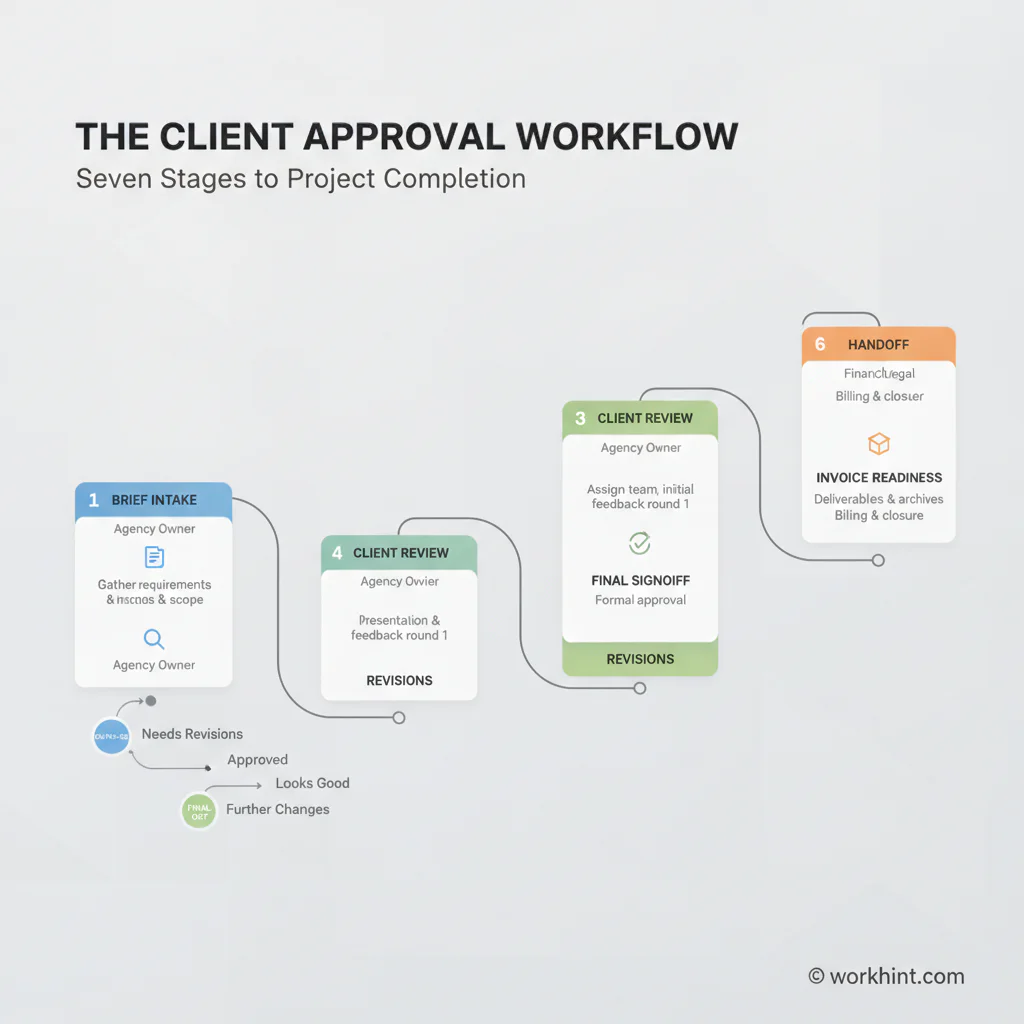
The client approval workflow
The best approval workflow is simple enough for clients to follow and structured enough for the agency to rely on. It should capture decisions, preserve versions, and make the next action obvious.
| Stage | Owner | Decision | Record to keep |
|---|---|---|---|
| Brief confirmation | Agency lead and client owner | Is the objective, audience, scope, deadline, and approval group clear? | Approved brief, scope, timeline, approver list |
| Internal review | Agency delivery lead | Is the work ready for the client to see? | Version number, internal notes, unresolved issues |
| Client review | Named client approver | Approve, request changes, or reject with reason? | Comments, decision, timestamp, reviewer |
| Revision routing | Agency project owner | Are requested changes in scope or a change request? | Revision list, scope decision, due date |
| Final signoff | Client decision maker | Is this version accepted for launch, handoff, or billing? | Final approval, accepted version, signoff note |
| Delivery handoff | Agency operations | What must happen after approval? | Publish instructions, files, access, ownership |
| Invoice readiness | Finance or account lead | Does approval trigger a milestone invoice or payment request? | Approved deliverable, PO or contract reference |
Start with approval rights, not tools
The fastest way to make approvals messy is to let everyone comment and no one decide. Every project should name one business approver and any specialist reviewers. For example, marketing may approve direction, legal may review claims, brand may check tone, and finance may only care if budget changes.
Separate feedback rights from approval rights. A client stakeholder can leave comments without authority to accept the work. That distinction lets the agency listen broadly while still knowing whose decision moves the project forward.
Define what counts as approval
Approval should mean more than a casual message that says something looks good. Define the accepted signal before work starts: a signed form, an approval button, an email from a named approver, or a decision recorded in the project system.
For service work, strong scopes describe required results and measurable outcomes rather than only activity. Federal performance work statement guidance in FAR 37.602 uses that same principle. Agencies can apply it commercially by tying approval to deliverables, acceptance criteria, and outcomes in the statement of work.
Set revision rules before review starts
Revision rules should answer four questions: how many rounds are included, who consolidates feedback, how quickly the client must respond, and when a request becomes a scope change. Without those rules, the agency ends up treating every new idea as part of the original work.
A practical rule is to require consolidated feedback for each review round. If three client stakeholders comment separately, the client owner should resolve conflicts before sending the agency a final revision list.
Connect approval to the next operational step
The approval workflow should not end with “approved.” It should trigger the next step. For social content, approval may release scheduling. For a design project, it may release production files. For consulting work, it may trigger a phase closeout. For milestone contracts, it may make the invoice ready.
This is especially important when agencies use freelancers, subcontractors, media partners, or production vendors. Client approval may affect who gets assigned next, who can be paid, and whether additional access or materials are needed.
Common mistakes to avoid
- Using comments as decisions: Feedback is not the same as approval. Record the final decision separately.
- Sending work to too many reviewers: More reviewers can improve quality, but only if one person owns consolidation.
- Ignoring version control: Clients should approve a specific version, not a vague idea of the work.
- Letting revisions reset the timeline silently: Material changes should update due dates, budget, or both.
- Skipping approval records: If approval affects publishing, delivery, or billing, keep a durable record.
Where Workhint fits
Workhint fits when an agency or business team needs client approval to become part of the operating workflow, not a side conversation. A team can use Workhint to create the approval intake, assign agency and client roles, route internal and client reviews, collect comments, track accepted versions, trigger change-request review, connect approvals to task handoff, and keep invoice readiness visible.
That makes approval easier to manage across agencies, freelancers, vendors, and client stakeholders. The value is not replacing judgment. It is giving the people involved one system for who owns the decision, what evidence they reviewed, what changed, and what happens next.
FAQ
What is a client approval workflow for agencies?
A client approval workflow for agencies is the process for sending work to clients, collecting feedback, managing revisions, recording final signoff, and connecting approval to delivery, publishing, or billing.
Who should approve agency work?
Each project should have one named client approver. Other stakeholders can review, but the agency needs one decision owner who can accept the work or consolidate required changes.
How many revision rounds should an agency include?
Many agencies include one or two revision rounds, but the right number depends on the work type, contract, timeline, and risk. The important part is defining the included rounds before review starts.
Should client approval trigger invoicing?
For milestone-based work, yes. If the contract ties payment to accepted deliverables, final approval should create an invoice-ready record with the approved version and scope reference.
What is the difference between feedback and approval?
Feedback is input on what should change. Approval is the decision that a specific version is accepted for the next step, such as launch, handoff, production, or billing.
Conclusion
A good client approval workflow for agencies gives both sides clarity. The agency knows who can decide, which version is under review, what changes are required, and when work is accepted. The client gets a cleaner review experience and fewer missed decisions.
Start with the operating rules: approvers, acceptance criteria, revision limits, decision records, and next-step triggers. Once those are clear, tools become much easier to choose. The goal is not more process. It is faster decisions, cleaner scope, stronger records, and less hidden coordination work.
Leave a Reply