


Requirements do not fail only when they are unclear. They fail when teams lose the line between need, decision, work, and proof.
A requirements traceability matrix helps business teams keep that line visible. It connects each business need to the requirement that represents it, the owner responsible for it, the workflow or system change that delivers it, and the evidence that proves it was handled correctly.
This matters beyond software projects. Operations teams use requirements every time they redesign an intake process, automate approvals, launch a vendor workflow, or change how work moves across teams. Without traceability, a request can be approved in one meeting, rewritten in another, built differently, and accepted without anyone noticing what changed.
PMI treats requirements management as a discipline for aligning project outcomes with stakeholder needs, and the International Institute of Business Analysis describes traceability as the ability to connect requirements to related business analysis information. For business teams, the practical point is simple: every meaningful requirement should have a visible path from why it exists to how it is delivered.
What’s in this article?
- What a requirements traceability matrix is for business teams
- The columns a practical matrix should include
- A step-by-step workflow for building one
- Common mistakes that make traceability performative
- How Workhint can turn traceability into a live operating system
Why a requirements traceability matrix matters
A requirements traceability matrix is useful when work has multiple stakeholders, approvals, handoffs, dependencies, or audit expectations. It prevents three failures: requirements getting lost, delivery happening without evidence, and late arguments about what was agreed.
In a small, low-risk workflow, a checklist may be enough. In a cross-functional process, traceability becomes more important. Think about customer onboarding: sales wants a faster handoff, operations wants complete intake data, finance wants payment status visible, customer success wants role-based tasks, and leadership wants reporting. The matrix keeps those needs connected.
The ISO/IEC/IEEE 29148 requirements engineering standard is written for systems and software work, but its discipline is useful for business operations too. A practical RTM translates that rigor into a working business tool.
Requirements traceability matrix columns
The best matrix is the smallest structure that lets the team answer: what is this requirement, who owns it, where is it implemented, how will we know it works, and what decision approved it?
| Column | Purpose | Example |
|---|---|---|
| Requirement ID | Creates a stable reference that survives meetings and tools | ONB-014 |
| Business need | Explains why the requirement exists | New customers need account setup within one business day |
| Requirement | Defines the specific condition the system or workflow must satisfy | Assign onboarding tasks automatically when the contract is signed |
| Owner | Names the person accountable for clarity and acceptance | Head of Customer Operations |
| Linked work | Connects the requirement to tasks, workflow steps, automations, or configuration | Customer onboarding workflow, step 2 |
| Evidence | Shows how the team will prove the requirement was met | Test run, dashboard event, approval log, completed checklist |
| Status | Tracks whether the requirement is proposed, approved, built, tested, or released | Approved, in build, verified, deferred |
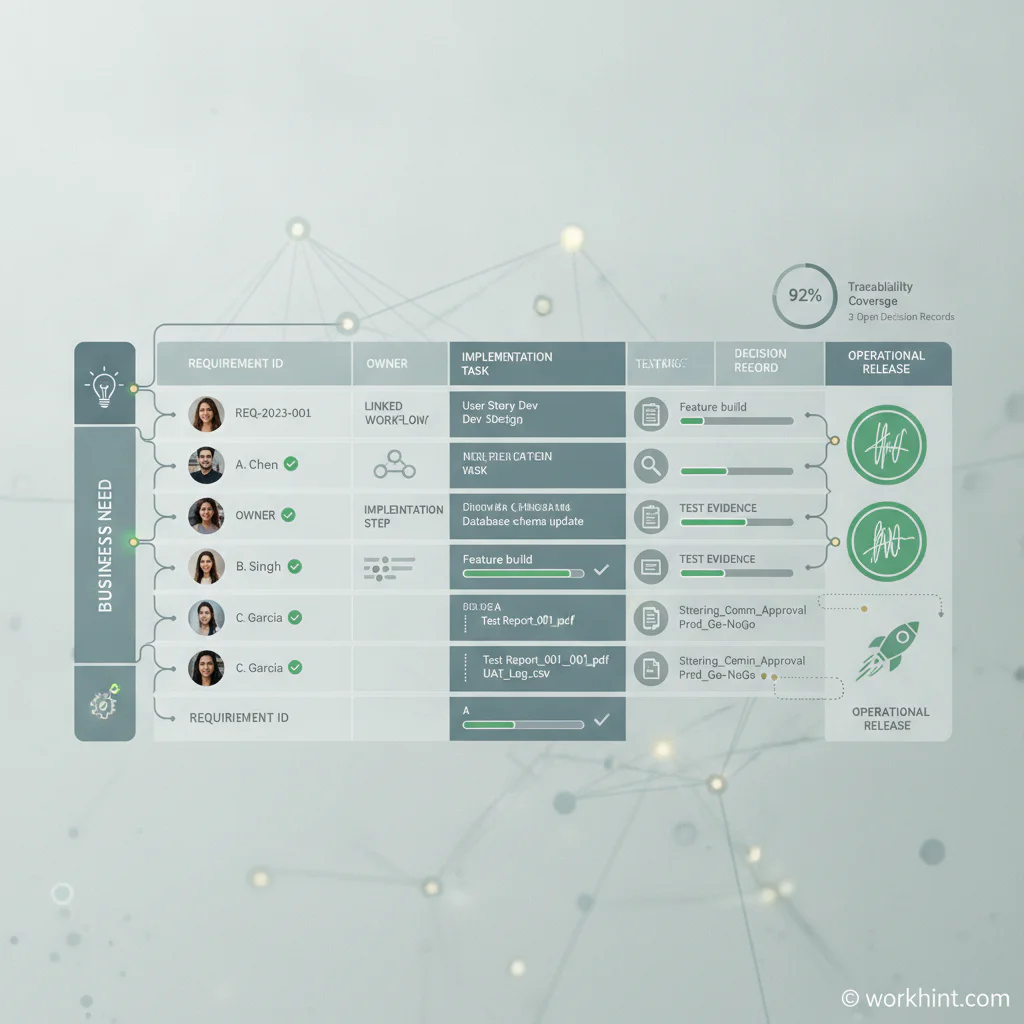
Requirements traceability workflow
Do not start by filling a spreadsheet. Decide what decisions the matrix must support. A compliance-heavy vendor approval workflow needs stronger evidence fields than a lightweight internal request process.
- Define the business outcome. Write the operational result the work must create, such as faster onboarding, fewer approval delays, cleaner handoffs, or better reporting.
- List stakeholder needs. Capture needs from the people who request, approve, perform, receive, and measure the work.
- Convert needs into requirements. Turn broad needs into specific conditions that can be reviewed and verified.
- Assign owners. Every requirement needs one accountable owner. Contributors can advise, but ownership cannot be shared vaguely.
- Link requirements to work. Connect each requirement to a workflow step, task, automation, form field, dashboard, policy, or integration.
- Define proof before delivery. Decide what evidence will show that the requirement was met before anyone starts building.
- Track decisions and changes. Record approvals, rejected options, scope changes, and deferred requirements so the team can explain why the final system looks the way it does.
- Review before release. Use the matrix as a release checklist: approved requirements should have completed work, evidence, and owner signoff.
Atlassian’s guidance on agile requirements emphasizes keeping requirements connected to user value and delivery work. That is the same idea business teams need: a requirement is only useful if it remains connected to execution.
A practical example
Suppose an operations team is redesigning its internal request workflow. Employees submit requests for legal review, finance approval, vendor setup, and systems access through disconnected forms and messages. Leadership wants one request system with routing, owners, approvals, and reporting.
A weak requirement would say, “Improve request tracking.” A traceable requirement would say, “Every internal request must have a visible owner, due date, current status, and approval history before it can be marked complete.” That requirement can then be linked to the intake form, assignment rule, dashboard field, approval log, and acceptance test.
The matrix lets each stakeholder check whether the final workflow still matches the operating need. Legal can verify approval history. Finance can verify spend approval. Operations can verify ownership and SLA fields. Leadership can verify reporting.
Common mistakes
- Tracking too much. If every preference becomes a requirement, the matrix turns into noise. Reserve it for decisions that affect delivery, risk, reporting, compliance, or cross-functional coordination.
- Using vague owners. “Operations” is not an owner. A named role or person must be accountable for accepting the requirement.
- Adding evidence after the fact. Evidence should be defined before work starts, not improvised at the end.
- Separating the matrix from work. A static file that is never linked to tasks, approvals, or dashboards becomes stale.
- Ignoring change history. Requirements change. The problem is not change; the problem is undocumented change that breaks trust later.
Where Workhint fits
Workhint is useful when the matrix should become more than documentation. A team can use Workhint to turn business requirements into a working system with roles, permissions, intake forms, workflow steps, approvals, assignments, dashboards, and automation rules connected around the actual work.
For example, the requirement ID can live with the workflow step it governs. The owner can be tied to the approval role. Evidence can come from tasks, documents, status changes, checkpoints, or dashboard events. When a requirement changes, the operating system can show what steps, roles, and reports are affected.
That is the difference between storing requirements and operationalizing them. The matrix defines what needs to stay connected; Workhint can help teams build the system that keeps those connections alive as work moves.
FAQ
What is a requirements traceability matrix?
A requirements traceability matrix is a structured record that links each requirement to its source, owner, related work, verification evidence, status, and approval history. It helps teams confirm that approved needs are actually delivered.
Do business teams need an RTM if they are not building software?
Yes, when the work involves meaningful handoffs, approvals, risk, compliance, automation, or cross-functional change. Business teams can use a lighter version than software QA teams, but the traceability principle is still valuable.
What should be included in a traceability matrix?
At minimum, include a requirement ID, business need, requirement statement, owner, linked work, evidence, status, and decision history. Add fields only when they improve operating decisions.
How often should the matrix be updated?
Update it whenever requirements are approved, changed, built, tested, deferred, or released. If it is only updated at the end, it will not prevent misalignment during the work.
Conclusion
A requirements traceability matrix gives business teams a practical way to keep needs, decisions, work, evidence, and ownership connected. It is most valuable when work crosses functions, changes systems, affects compliance, or needs clear operational signoff.
Keep the matrix focused. Give each requirement an owner, linked workflow step, and proof point. Then use it as a living operating tool.
Leave a Reply