


A recruiting agency can start lean when you sell one hiring outcome and coordinate independent recruiters through a branded platform.
How to start a recruiting agency with no staff is a practical question for operators who know a market, understand hiring pain, and want to launch before building payroll. The mistake is assuming you need an office, internal recruiters, expensive software, and a large candidate database before you can win the first client.
A lean recruiting agency starts with a narrow niche, a clear placement offer, a branded client intake experience, and a private network of independent recruiters or sourcers. You validate demand first. Then you expand capacity after clients prove which roles they will actually pay you to fill.
What’s in this article?
- Why recruiting works as a low-overhead professional service business
- What you need to launch before hiring internal staff
- How to price recruiting services and placement fees
- How to get first clients and qualified candidates
- How Workhint helps launch the recruiting agency platform
- A 7-day launch plan, checklist, and FAQ
Why a Recruiting Agency Works
Recruiting works because companies do not buy resumes. They buy speed, focus, candidate access, and confidence that a hard role will not sit open forever. That demand exists in many niches: healthcare, construction, logistics, sales, accounting, hospitality, technology, home services, and executive search.
The U.S. staffing and recruiting market is large and fragmented. American Staffing Association data has reported tens of thousands of staffing and recruiting companies across the country. That matters because buyers are used to working with outside recruiting partners, but they still want specialization, responsiveness, and cleaner process.
The no-staff model works best when you do not try to become a general staffing company on day one. Start with permanent placement, contract recruiting, fractional sourcing, or niche talent pipelines before taking on payroll-heavy temporary staffing. You can recruit independent recruiters and sourcers around specific roles, markets, or candidate communities while you own the brand, client relationship, quality bar, and operating system.
What You Need to Launch
You need a simple business foundation and a reliable recruiting workflow. You do not need a big office, a full internal team, or a complex tech stack before you know which niche converts.
Start by choosing one buyer and one role category. For example, recruit dental hygienists for multi-location practices, project managers for construction firms, SDRs for B2B software companies, nurses for clinics, drivers for logistics companies, or bookkeepers for local service businesses. A narrow market makes your outreach sharper and your recruiter network easier to build.
| Launch item | Lean starting point | Why it matters |
|---|---|---|
| Business registration | $50 to $500 depending on location | Creates the legal foundation for contracts and banking |
| Contracts and terms | Attorney-reviewed client and recruiter agreements | Defines fees, replacement terms, confidentiality, and payouts |
| Insurance | Professional liability and general business coverage | Reduces risk when advising clients and handling candidate data |
| Branded platform | Client intake, role requests, recruiter onboarding, submissions, approvals, and payments | Lets you operate like a real agency before hiring staff |
| Recruiter network | Three to five independent recruiters or sourcers in the niche | Adds fulfillment capacity without fixed payroll |
| Marketing | $100 to $750 for focused tests | Validates whether buyers respond before you scale |
Be careful with compliance. Recruiting touches candidate privacy, equal employment opportunity rules, background-check workflows, pay transparency laws, and industry-specific hiring requirements. For temporary staffing, payroll funding, workers’ compensation, tax withholding, and employer-of-record responsibilities can add major complexity. If you are launching lean, permanent placement or contract recruiting is usually simpler than payroll-heavy temp staffing.
How to Price It
Recruiting pricing should match the risk and value of the role. Many permanent-placement agencies charge a percentage of the candidate’s first-year salary. Contract recruiting may be hourly, monthly, or project-based. Sourcing-only work may be priced per qualified candidate, but that model needs tight definitions.
| Model | Example pricing | Best use |
|---|---|---|
| Contingency placement | 15% to 30% of first-year salary | Permanent roles where payment happens after a hire |
| Retained search | Upfront retainer plus success fee | Senior, niche, confidential, or urgent searches |
| Contract recruiting | $75 to $200 per hour or monthly package | Clients that need recruiting capacity without hiring a recruiter |
| Sourcing sprint | $1,500 to $5,000 per role sprint | Validated candidate lists and outreach support |
| Recruiter network split | Predefined percentage of collected fee | Independent recruiters filling roles through your platform |
Do not underprice the operational work. A good recruiting agency manages role intake, sourcing, screening, submission quality, interview coordination, client feedback, candidate communication, offer support, replacement terms, invoices, and recruiter payouts. Your margin must cover all of that.
How to Get First Clients
The first clients usually come from a specific pain, not broad brand awareness. Build a list of companies hiring the role you understand. Look for repeated job posts, long-open roles, new locations, funding, expansion, seasonal demand, or teams that clearly lack recruiting bandwidth.
Your first offer should be simple: help a narrow buyer fill a specific role faster. For example, offer a 10-day candidate sourcing sprint, a contingency search for one hard role, or a small retained pilot for three similar openings. Send prospects to a branded intake form so every conversation turns into structured role data.
- Start with founder, COO, head of people, or hiring manager outreach in one niche.
- Use job boards to identify roles that have been reposted or left open.
- Ask independent recruiters which client categories are active and underserved.
- Publish one niche landing page instead of a generic recruiting website.
- Track every role, contact, candidate source, submission, interview, and fee in one system.
How Workhint Helps Launch It
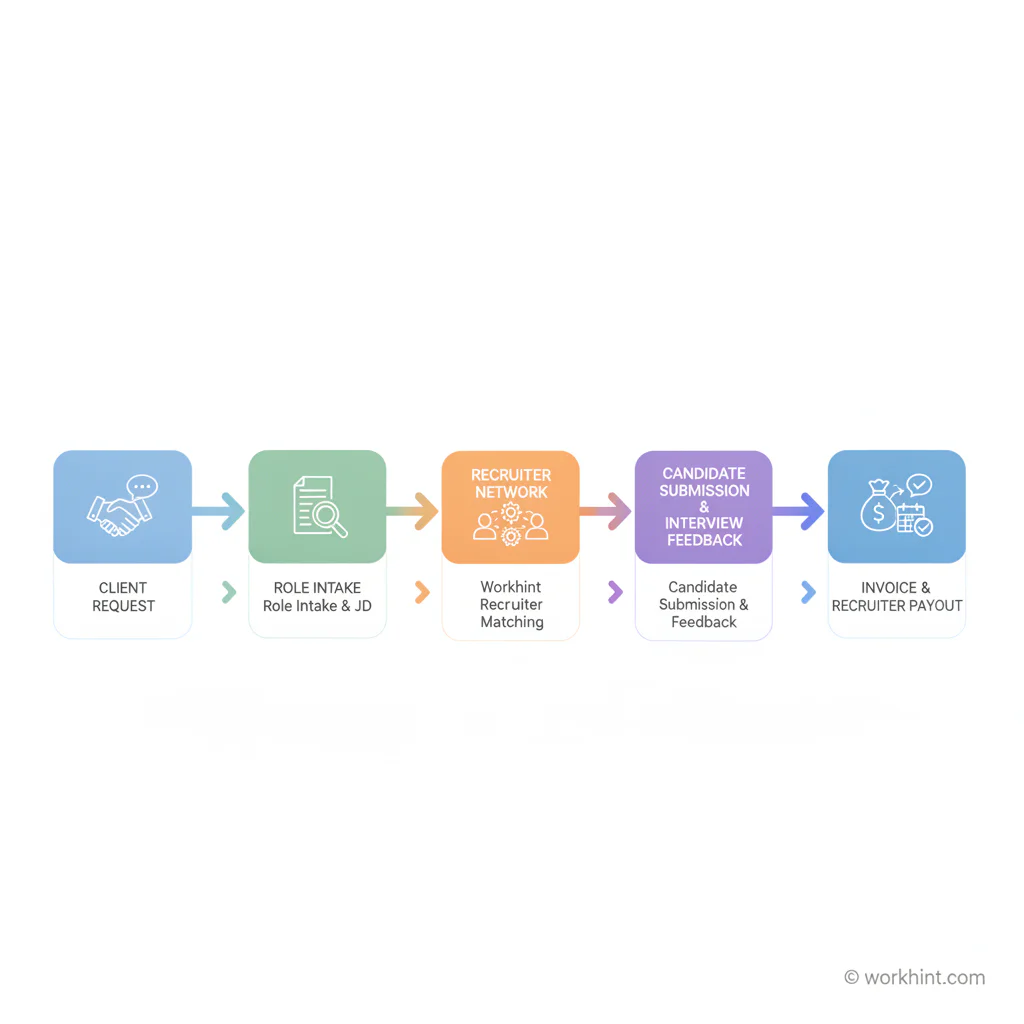
Workhint can help you launch the recruiting agency as a branded business platform before you hire internal recruiters or build custom software. The client sees your agency brand, role intake flow, status updates, candidate submissions, approval steps, invoices, and communication in one place.
A client can request help filling a role, complete a structured intake, approve the fee terms, and track candidate progress through your branded portal. Behind the scenes, you can invite independent recruiters, collect their specialties and agreements, assign searches, manage submissions, route interview feedback, control candidate data access, trigger invoices, and calculate recruiter payouts after a successful placement.
That operating foundation is the difference between a loose network and a real agency. Workhint gives you the customer portal, recruiter onboarding, internal operations dashboard, role-based permissions, candidate submission workflow, interview coordination, document collection, approvals, payments, payouts, and reporting. You can start with one niche, prove demand, and expand the recruiter network only when the pipeline justifies it.
First 7-Day Launch Plan
- Day 1: Pick one niche, one buyer, one role category, and one launch market. Avoid general recruiting.
- Day 2: Set up the branded Workhint platform basics: client portal, role intake, recruiter onboarding, and admin dashboard.
- Day 3: Create fee terms, submission rules, interview feedback steps, invoice triggers, and recruiter payout logic.
- Day 4: Recruit three to five independent recruiters or sourcers with relevant candidate access.
- Day 5: Contact hiring managers with active roles and send them to the intake flow.
- Day 6: Run first intake calls, qualify the roles, assign searches, and test candidate submission quality.
- Day 7: Review client demand, recruiter capacity, fee objections, and fulfillment gaps before spending more.
Final Launch Checklist
- Choose a narrow recruiting niche and one role category.
- Register the business and open a business bank account.
- Create client agreements, recruiter agreements, fee terms, and replacement rules.
- Confirm privacy, EEO, background-check, and local compliance requirements.
- Configure the branded Workhint client portal, role intake, submissions, approvals, invoicing, and payouts.
- Recruit a small network of independent recruiters or sourcers.
- Build one landing page and one outreach list of active hiring targets.
- Validate demand before hiring employees, leasing office space, or buying expensive tools.
FAQ
How much does it cost to start a recruiting agency?
A lean recruiting agency can often start with a few thousand dollars for registration, contracts, insurance, platform setup, outreach tools, and basic marketing. Payroll-heavy staffing models usually need much more working capital.
Can I start a recruiting agency with no staff?
Yes. You can start as the founder-operator and use independent recruiters or sourcers for extra capacity. Use clear agreements, defined payout rules, and legal guidance so the model is structured correctly.
Do I need a license to start a recruiting agency?
Requirements vary by location and service model. Some places regulate employment agencies, staffing, or temporary labor more heavily than permanent placement. Check state and local rules before signing clients.
What is the easiest recruiting niche to start with?
The easiest niche is one where you understand the buyer, know where candidates gather, and can explain the role clearly. Local healthcare, skilled trades, logistics, sales, accounting, and specialized B2B roles can work if demand is visible.
How do recruiting agencies make money?
Common models include contingency placement fees, retained search fees, contract recruiting retainers, sourcing sprints, and recruiter-network fee splits. The best model depends on role difficulty, client urgency, and your delivery capacity.
How do I get my first recruiting clients?
Find companies with active or repeated job posts in your niche, then offer a specific hiring outcome. Start with a narrow pitch, a structured intake process, and proof that your network can reach candidates they are missing.
Should I start with temporary staffing or permanent placement?
Permanent placement is usually simpler for a lean launch because it avoids payroll funding, workers’ compensation, time tracking, and employer-of-record complexity. Temporary staffing can be attractive later, but it needs stronger financial and compliance infrastructure.
Conclusion
A recruiting agency does not need to start with employees, an office, or a massive database. Start with one niche, validate buyer demand, build a small independent recruiter network, and use Workhint as the branded operating foundation for role intake, submissions, approvals, payments, and payouts. Once clients are buying and recruiters can fulfill consistently, invest where the demand is already proven.
Leave a Reply