


You can test local welding demand before buying a rig by coordinating trusted mobile welders through one branded platform.
How to start a mobile welding business is usually explained as a truck, tools, and trade-skill problem. That is one path. A lower-risk path is to launch the business as a branded mobile welding platform first, recruit qualified independent welders, validate job demand, and invest in owned equipment only after the work volume proves it.
What’s in this article?
- Why mobile welding can work as a lean local service business
- What you need before taking customer requests
- How to price mobile welding jobs
- How to find first customers without overbuilding
- How Workhint can run the customer, welder, scheduling, payment, and payout flow
- A 7-day launch plan, checklist, and FAQ
Why this business works
Mobile welding solves urgent, location-specific problems. A contractor may need a gate repaired, a property manager may need metal railing fixed, a farmer may need equipment welded, or a small manufacturer may need field fabrication support. The customer often cares less about your office and more about whether a qualified welder can show up, assess the job, complete safe work, document it, and invoice clearly.
The platform-first model works because you do not need to personally own every asset on day one. Define a narrow first offer, such as light repair, gate and fence welding, trailer repair, or small commercial maintenance. Then build a private network of insured independent welders who already own or access the right equipment.
This reduces business risk, not safety standards. Welding has real liability.
What you need to launch
Start with the operating system, not the truck. Your first version should let customers request work, upload photos, describe materials, approve a quote, and pay online. It should also let you invite welders, collect credentials, assign jobs, track completion notes, and manage payouts.
Your early budget should prioritize legal setup, insurance, platform setup, provider onboarding, and local demand generation.
| Launch item | Lean starting range | Why it matters |
|---|---|---|
| Business registration and basic legal setup | $100 to $800 | Creates a formal business before accepting paid work. |
| Insurance planning | $1,000 to $5,000+ | Mobile welding can carry meaningful liability; get coverage advice before launch. |
| Branded platform and intake flow | $300 to $2,000 | Lets customers request jobs and lets you coordinate providers. |
| Provider vetting and onboarding | $200 to $1,000 | Covers credential checks, agreements, forms, and documentation. |
| Local marketing tests | $300 to $1,500 | Validates demand before buying equipment. |
| Owned welding rig or truck | Later investment | Buy only after job volume supports ownership. |
Depending on your location and scope, you may need a local business license, contractor registration, welding certifications, commercial auto coverage, general liability, or job-specific compliance. Check requirements before accepting structural, commercial, municipal, or high-risk jobs.
How to price it
Mobile welding pricing depends on job complexity, travel, materials, risk, equipment, and provider availability. Use a quote process that screens the job first, asks for photos, confirms access, and separates labor, travel, materials, and minimum service fees.
| Pricing model | Best for | Example structure |
|---|---|---|
| Minimum service call | Small repair jobs | $150 to $350 minimum before materials |
| Hourly plus travel | Open-ended repairs | $75 to $150+ per hour plus trip fee |
| Half-day job rate | Field repair blocks | $500 to $900 depending on market and equipment |
| Quoted project | Fabrication or commercial work | Fixed quote after photos, site details, and provider review |
| Maintenance partner plan | Property managers or fleets | Priority response plus quoted work per job |
Your margin comes from the spread between customer price and provider pay after insurance, processing, support, marketing, and rework risk. Keep early scopes tight.
How to get first customers
Start where mobile welding problems already happen. Contact property managers, fence companies, trailer repair shops, farms, equipment rental companies, small manufacturers, contractors, landscapers, and facility managers. The pitch is simple: submit photos, get a quote, schedule a qualified mobile welder, and pay through one local platform.
Set up a Google Business Profile, build service pages for your first city and top job types, ask providers for referrals, and create a photo-based quote request. The goal is to learn which job types repeat, which providers are reliable, and which customers pay without heavy friction.
How Workhint helps launch it
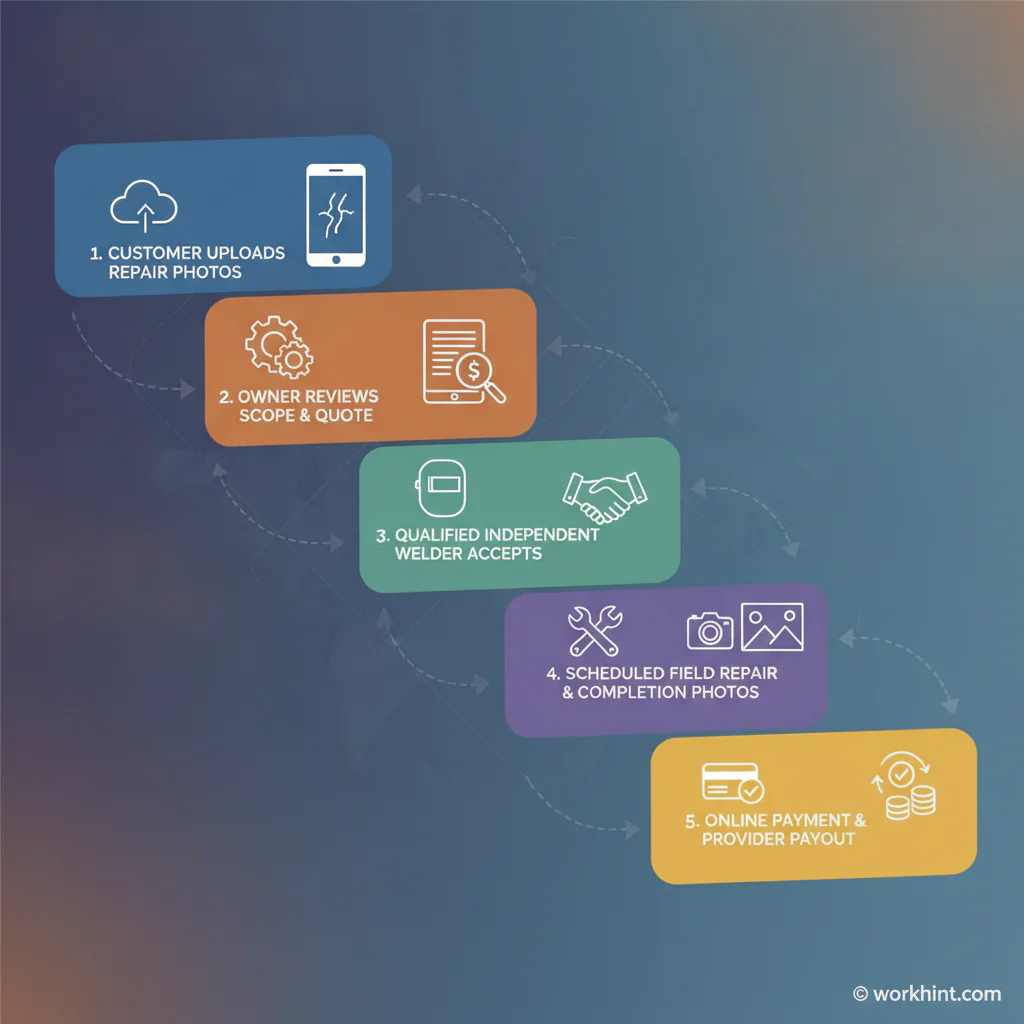
Workhint lets you build the branded operating foundation for a mobile welding business before you invest in a truck, office, dispatcher, or custom software. A customer lands on your branded portal, chooses a job type, uploads photos, shares location details, and requests a time window. The system routes the request to your internal dashboard so you can review risk, request more details, or send it to a qualified independent welder.
Once a provider accepts, Workhint can coordinate the schedule, job checklist, quote approval, customer updates, completion notes, invoice, online payment, and provider payout. For a gate repair, the customer approves the quote, the welder captures completion photos, and the owner releases payout after documentation.
This makes the platform-first model practical. You are creating a local service platform that connects customer demand with a vetted provider network while keeping intake, assignment, documentation, payment, and payout in one place.
First 7-day launch plan
- Day 1: Choose one launch market and one narrow offer, such as gate repair, trailer repair, or light commercial maintenance.
- Day 2: Set up the branded Workhint platform basics: customer portal, job request form, provider roles, and internal dashboard.
- Day 3: Create the quote, scheduling, payment, completion checklist, and provider payout process.
- Day 4: Recruit five to ten qualified independent welders or small welding shops that can handle your approved scopes.
- Day 5: Contact 30 local demand sources, including property managers, contractors, fence companies, farms, and repair shops.
- Day 6: Route every serious request through the platform, collect photos, test quote turnaround, and confirm provider availability.
- Day 7: Review demand, pricing, provider quality, insurance gaps, and repeatable job types before spending on owned equipment.
Final launch checklist
- Choose the first city and approved welding job types.
- Register the business and confirm licensing requirements.
- Speak with an insurance broker about mobile welding liability.
- Create the branded Workhint customer portal and intake form.
- Recruit qualified independent welders or partner shops.
- Collect provider credentials, availability, service areas, and equipment limits.
- Build quote, scheduling, job documentation, payment, and payout workflows.
- Create starter pricing rules and minimum service fees.
- Contact local businesses that already need field repair.
- Validate demand before buying a truck, trailer, or welding rig.
FAQ
How much does it cost to start a mobile welding business?
A traditional launch can require thousands of dollars for a truck, welder, generator, tools, insurance, and supplies. A platform-first launch can cost less upfront because you validate demand with qualified independent providers before buying owned equipment.
Can I start a mobile welding business with no staff?
Yes, if you build a vetted network of independent welders or partner shops and keep the business focused on customer acquisition, job intake, quote coordination, scheduling, documentation, payment, and payout.
Do I need welding certifications?
Requirements vary by job type and location. Even when a specific certification is not legally required, customers may expect qualified providers. For structural, commercial, municipal, or specialized work, credentials and compliance matter more.
What insurance does a mobile welding business need?
Common needs may include general liability, professional or contractor coverage, commercial auto, workers compensation where applicable, and coverage specific to hot work. Speak with a qualified insurance broker before taking jobs.
What are the best first customers?
Good early targets include property managers, contractors, fence companies, farms, equipment repair shops, small manufacturers, landscapers, and facility managers with recurring repair needs.
Should I buy a truck before launching?
Not if you are using the provider-network model. Start by proving demand, understanding job types, and coordinating qualified providers. Buy or lease equipment later when volume and margins justify it.
How do mobile welding businesses make money?
They charge customers for service calls, hourly work, half-day blocks, quoted projects, materials, travel, and sometimes maintenance relationships. The owner keeps margin after provider pay and operating costs.
Conclusion
A mobile welding business can be launched leaner than the traditional equipment-first model suggests. The practical move is to validate demand, recruit qualified independent providers, build a branded customer platform, and use Workhint to coordinate the work from request to payout. Once repeatable jobs appear, you can decide whether owned equipment is a smart investment instead of an expensive assumption.
Leave a Reply