


When decision rights are unclear, every workflow slows down at the exact moment it needs a clear owner.
A decision rights framework defines who has authority to make specific decisions, who must contribute input, when a decision should escalate, and how the outcome gets recorded. For operations teams, this is not an org chart exercise. It is part of the work system.
The decision rights framework matters because repeatable work depends on repeatable judgment. A customer exception, vendor issue, budget change, staffing tradeoff, access request, or process deviation should not require a fresh debate every time. The team needs a documented way to know who decides, what evidence they need, and what happens next.
What’s in this article?
- What decision rights mean in an operating system
- How to build a decision rights framework step by step
- A practical decision rights matrix for business operations
- Common mistakes that create bottlenecks
- How Workhint can help turn decision rules into live workflows
Why decision rights matter in operations
Operations teams sit between strategy and execution. They turn plans into schedules, assignments, approvals, handoffs, customer updates, vendor actions, and measurable outcomes. When nobody knows who can decide, work waits. When too many people believe they can decide, work fragments.
Deloitte describes decision rights models as a way to clarify empowered decision-makers and decision-making groups. BCG frames decision rights as an explicit agreement about who decides, who contributes, and in what capacity. That distinction is useful: decision rights are not only about authority. They are about the whole path from issue to outcome.
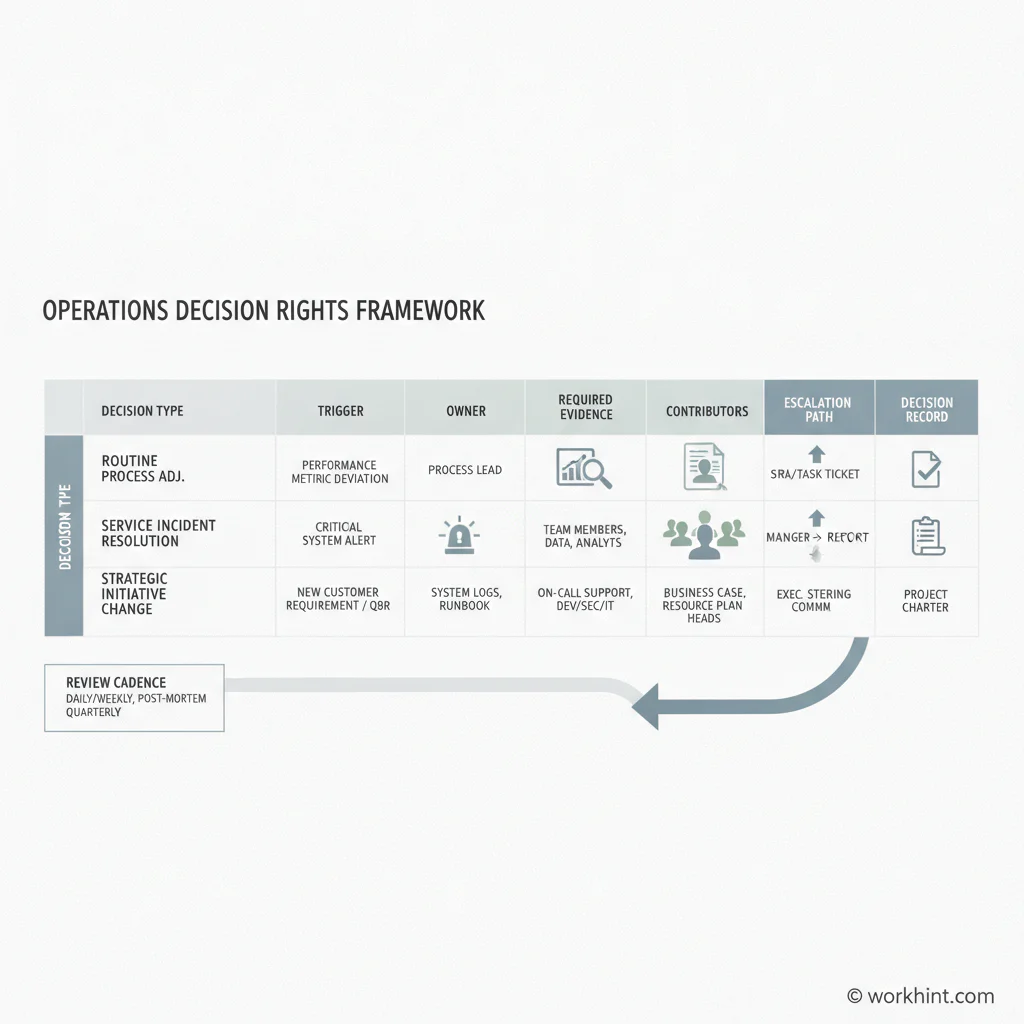
Decision rights framework template
A useful decision rights framework should be specific enough to operate without interpretation. Start by mapping the decisions that repeat, create risk, block work, or consume leadership attention. Then define the rules for each decision type.
| Element | What to define | Why it matters |
|---|---|---|
| Decision type | The recurring decision category | Prevents one-off debates |
| Trigger | The event or threshold that requires a decision | Stops teams from escalating too early or too late |
| Decision owner | The role with final authority | Creates accountability |
| Required evidence | The data, context, or documentation needed | Improves decision quality |
| Contributors | Roles that provide input before the decision | Prevents missed expertise |
| Escalation path | When and where the decision moves upward | Keeps exceptions from stalling |
| Decision record | Where the outcome and rationale are logged | Creates learning and auditability |
How to build a decision rights framework
1. Inventory the decisions that slow work down
Do not start with every possible decision. Start with the ones that repeatedly create delays, rework, conflict, or customer impact. Good candidates include pricing exceptions, hiring approvals, vendor changes, customer escalations, refund decisions, access approvals, scope changes, and operational tradeoffs.
2. Separate work ownership from decision authority
The person doing the work is not always the person who should make the decision. A coordinator may own the request, a manager may own the decision, finance may provide a constraint, and legal may need to review a risk. Atlassian’s DACI model is useful here because it separates the Driver from the Approver, Contributors, and Informed stakeholders.
3. Define the evidence required before a decision
Many decision meetings are slow because the inputs are missing. For each decision type, define the minimum evidence: request details, customer impact, cost, timing, risk, policy, alternatives, recommendation, and deadline. If the evidence is incomplete, the workflow should route back for completion rather than reaching an approver half-formed.
4. Set thresholds and escalation rules
Decision rights work best when the rules include thresholds. For example, a department lead may approve budget changes under $5,000, but anything above that moves to finance and the executive owner. A customer success lead may approve a service credit within a defined policy, but exceptions beyond that require a commercial decision.
5. Record the decision and review patterns
Every important decision should leave a record: what was decided, by whom, when, why, and what action followed. This does not need to become bureaucracy. It becomes useful when teams review patterns: repeated exceptions, unclear policies, approval delays, or decisions being escalated because the first owner lacks authority.
Common mistakes to avoid
- Using RACI for everything. RACI can clarify execution roles, but McKinsey warns that RACI can make decision-making worse when it adds labels without resolving who actually decides.
- Assigning committees instead of owners. Groups can provide input, but a decision still needs one accountable owner.
- Skipping thresholds. Without thresholds, every exception feels political.
- Documenting rights outside the workflow. A matrix in a slide deck does not help if the live request never uses it.
- Forgetting review cadence. Decision rights should change when the business, team, risk, or volume changes.
Where Workhint fits
Workhint helps teams turn a decision rights framework into a live operating system. Instead of storing rules in a spreadsheet, a team can define request types, roles, permissions, required fields, approval thresholds, escalation paths, decision logs, and dashboards inside the workflow itself.
That matters when decisions span operations, finance, HR, legal, customer success, vendors, contractors, or field teams. Workhint can route the right request to the right decision owner, collect the evidence before approval, notify contributors, record the outcome, and keep bottlenecks visible. The framework remains practical because it is embedded in how work moves.
FAQ
What is a decision rights framework?
A decision rights framework is a structured way to define who can make specific decisions, who provides input, what evidence is required, when to escalate, and how decisions are recorded.
How is decision rights different from RACI?
RACI clarifies roles around tasks or deliverables. Decision rights focus on authority: who has the final say, under what conditions, and with what input.
Who should own decision rights in a business?
Operations, leadership, and functional owners should define decision rights together. The best owner depends on the decision type, risk level, budget impact, and customer or compliance exposure.
How often should decision rights be reviewed?
Review decision rights quarterly for high-volume operations and whenever the team changes structure, launches a new service, adds risk, or sees repeated escalations.
Conclusion
A decision rights framework makes work more scalable because it removes avoidable hesitation. Teams know who decides, what information is needed, when to escalate, and where the outcome lives. Start with the decisions that slow execution most often, define clear ownership and thresholds, and connect the framework to the workflow where decisions actually happen.
Leave a Reply