


Vendor records become operational risk when ownership, payment data, approvals, and audit history are scattered across tools.
Vendor master data management is the process of keeping the core record for every vendor, supplier, agency, subcontractor, and external service provider accurate, approved, secure, and ready for work.
This is not just a procurement database issue. Duplicate records, outdated bank details, missing tax forms, and unclear status all create avoidable risk.
What’s in this article?
- What vendor master data management should include
- How to structure the vendor master workflow from request to offboarding
- Which fields, owners, and controls matter most
- Where Workhint fits when vendor operations need a live workflow
Why vendor master data management matters
Vendor master data is the operational record that tells the business who a vendor is, what they are approved to do, who owns the relationship, how they are paid, what documents are current, and which systems they can access.
Tax and payment requirements are one reason accuracy matters. The IRS says Form W-9 is used to provide a correct Taxpayer Identification Number to a party required to file an information return, and businesses may need to report independent contractor payments on Form 1099-NEC when IRS conditions are met. Confirm requirements with qualified tax advisors, but the vendor record must support accurate reporting before payments begin.
Fraud controls matter too. The Association of Certified Fraud Examiners’ 2026 fraud research highlights billing schemes and payment tampering as major occupational fraud risks. Nacha also announced 2026 risk management rule changes intended to strengthen fraud monitoring across the ACH Network. A clean vendor master gives finance and operations control points before money moves.
What to include in the vendor master record
A useful vendor master record should be complete enough to run the relationship, but not so cluttered that nobody maintains it. Start with fields that support approval, delivery, payment, compliance, and ownership.
| Data area | Fields to maintain | Primary owner | Control question |
|---|---|---|---|
| Identity | Legal name, DBA, address, tax ID, country, entity type | Procurement or finance | Do we know who we are paying? |
| Relationship | Vendor category, business owner, contract owner, approved services | Operations | What is this vendor approved to do? |
| Documents | Agreement, W-9 or W-8, insurance, certificates, security review, renewals | Legal, compliance, or procurement | Are required records current? |
| Payment | Payment method, bank details, currency, payment terms, invoice rules | Finance or AP | Can this vendor be paid safely? |
| Access | Systems, locations, portals, data permissions, expiration dates | IT or security | Does access match approved work? |
| Status | Requested, approved, active, paused, under review, inactive, offboarded | Vendor owner | Should teams still use this vendor? |
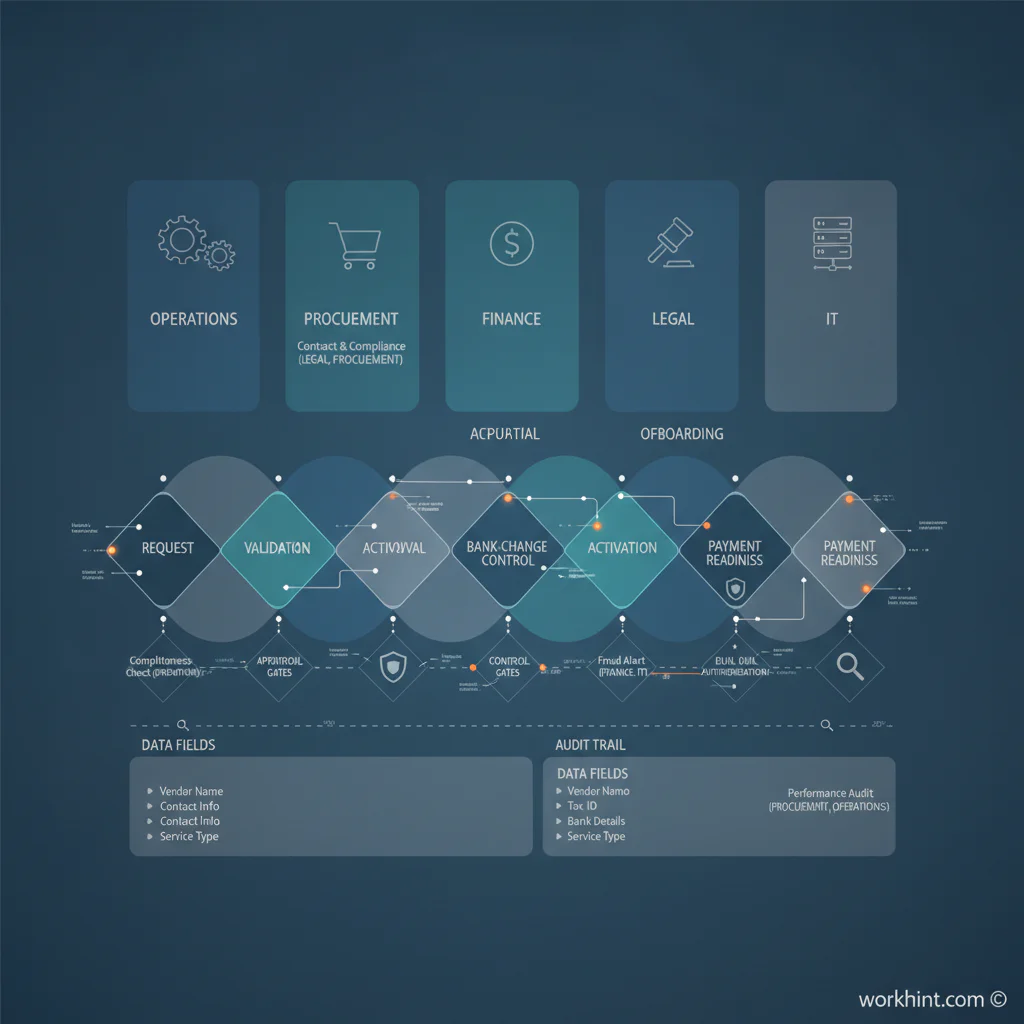
A practical vendor master data workflow
The best vendor master data management process follows the vendor lifecycle. Each step needs an owner, evidence, and a clear status change.
- Request the vendor. Capture the business reason, vendor type, expected work, budget owner, risk level, location, contract need, and urgency.
- Check for duplicates. Search by legal name, DBA, tax ID, domain, address, and bank account markers before creating a new record.
- Validate core identity. Confirm legal name, country, address, tax documentation, business registration where relevant, and primary contact.
- Route risk review. Send the vendor through legal, finance, procurement, security, or compliance review based on category and risk.
- Approve scope and ownership. Assign the business owner, contract owner, approved services, spending limit, and renewal cadence.
- Activate payment readiness. Collect payment terms, invoice rules, remittance details, currency, tax forms, and payment approval route.
- Control bank changes. Require a separate approval path, callback or trusted-channel confirmation, and audit trail before changing bank details.
- Review periodically. Reconfirm active vendors, expired documents, access, performance issues, payment exceptions, and duplicate records.
- Pause or offboard cleanly. Block new work, close open invoices, remove access, archive records, and mark the vendor inactive when the relationship ends.
Controls that prevent avoidable vendor risk
Vendor master controls should focus on moments where bad data creates real damage. The first control is duplicate prevention. A request should not create a second record for an existing supplier because the spelling, department, or contact person changed.
The second control is bank-change governance. Treat a change in remittance details as a high-risk event. Approval should be separate from the requester, supported by verification, and logged with who changed what, when, and why.
The third control is status discipline. Active, paused, inactive, and offboarded should mean different things inside the workflow. If a vendor is paused for missing insurance, security review, tax information, or performance concerns, purchasing and payment workflows should reflect that status.
The fourth control is sanctions and restricted-party awareness for relevant vendors. OFAC’s Sanctions List Search helps users work with sanctions lists, though it is not a substitute for appropriate due diligence. Teams working across countries, regulated industries, or sensitive payment flows should define when screening is required.
Common mistakes
Confusing onboarding with governance. Vendor onboarding creates the first approved record. Vendor master data management keeps that record accurate through renewals, bank changes, access changes, performance issues, and offboarding.
Letting every department edit vendor data. Business owners can request updates, but tax IDs, bank details, legal names, and payment terms need controlled ownership and approval.
Leaving inactive vendors available. Old vendors create clutter, payment risk, and poor reporting. Inactive records should be blocked from new work unless reactivation is approved.
Managing evidence in email. Store the agreement, tax form, insurance certificate, approval history, access record, and bank-change evidence with the vendor record or linked workflow.
Where Workhint fits
Workhint fits when vendor master data management needs to become an operating workflow instead of a spreadsheet, inbox, and finance-system note. A team can use Workhint to define vendor request forms, required fields, owner roles, approval paths, document collection, access steps, payment-readiness status, reminders, and reporting around each vendor relationship.
That matters because vendor data is only useful when it drives the next action. Operations can request a vendor, procurement can validate it, legal can approve the agreement, finance can control payment setup, IT can manage access, and the business owner can see whether the vendor is approved, blocked, active, or ready for renewal.
FAQ
What is vendor master data management?
Vendor master data management is the process of creating, approving, maintaining, reviewing, and retiring the core records a business uses to manage vendors, suppliers, agencies, and external service providers.
What is the difference between vendor onboarding and vendor master data management?
Vendor onboarding is the initial approval and setup process. Vendor master data management is the ongoing governance of the vendor record after setup, including updates, renewals, payment details, risk status, and offboarding.
Who should own vendor master data?
Ownership is usually shared. Procurement or finance may own the master record, while business owners, legal, IT, security, and compliance own specific fields or approvals. The important rule is that every sensitive field has one accountable owner.
How often should vendor master data be reviewed?
High-risk and high-spend vendors should be reviewed more often, often quarterly or semiannually. Lower-risk vendors may be reviewed annually. Bank details, tax forms, insurance, access, and contract status should also be reviewed when changes occur.
What are the most important vendor master controls?
The most important controls are duplicate checks, tax and identity validation, controlled bank changes, role-based edit permissions, required approvals, document expiration reminders, status rules, and clear offboarding.
Conclusion
Vendor master data management is one of the quiet operating systems behind external work. When it is weak, teams chase documents, pay from incomplete records, miss renewal risks, and struggle to know which vendors are approved.
Start with the vendor lifecycle. Define the required fields, assign owners, protect sensitive updates, connect approval status to payment readiness, and review records before they become stale. Clean vendor data is not administrative hygiene. It is how companies coordinate external partners without losing visibility or control.
Leave a Reply