


A3 works best when it becomes a disciplined operating rhythm, not another document people complete and forget.
The A3 problem solving process gives operations teams a compact way to define a problem, understand why it is happening, choose countermeasures, and follow through until the work actually improves. The format comes from Lean management practice: one page, usually A3 paper size, used to make thinking visible and align people around the same evidence.
That simplicity is the reason A3 is useful. It is also the reason teams misuse it. A weak A3 becomes a tidy slide about a messy issue. A strong A3 becomes a shared work system: clear owner, measured current condition, tested causes, assigned countermeasures, and visible follow-up.
What’s in this article?
- What the A3 process is designed to do
- The sections operations teams should include
- How to run A3 as a workflow with owners and checkpoints
- A practical example for recurring operational delays
- Common mistakes that make A3 reports ineffective
Why the A3 problem solving process matters
Most recurring operational problems are not solved by asking for more effort. They are solved by making the work visible enough that the team can see the real constraint. The Lean Enterprise Institute describes the A3 report as a structured way to capture the problem, analysis, corrective actions, and follow-up on a single page. That single-page constraint keeps the team from hiding unclear thinking behind long documentation.
For business operations, the A3 process is useful when a problem crosses roles or tools: delayed approvals, rework, missed handoffs, inconsistent service delivery, backlog growth, onboarding delays, or quality issues. The method forces the team to move from symptoms to causes, then from causes to owned action.
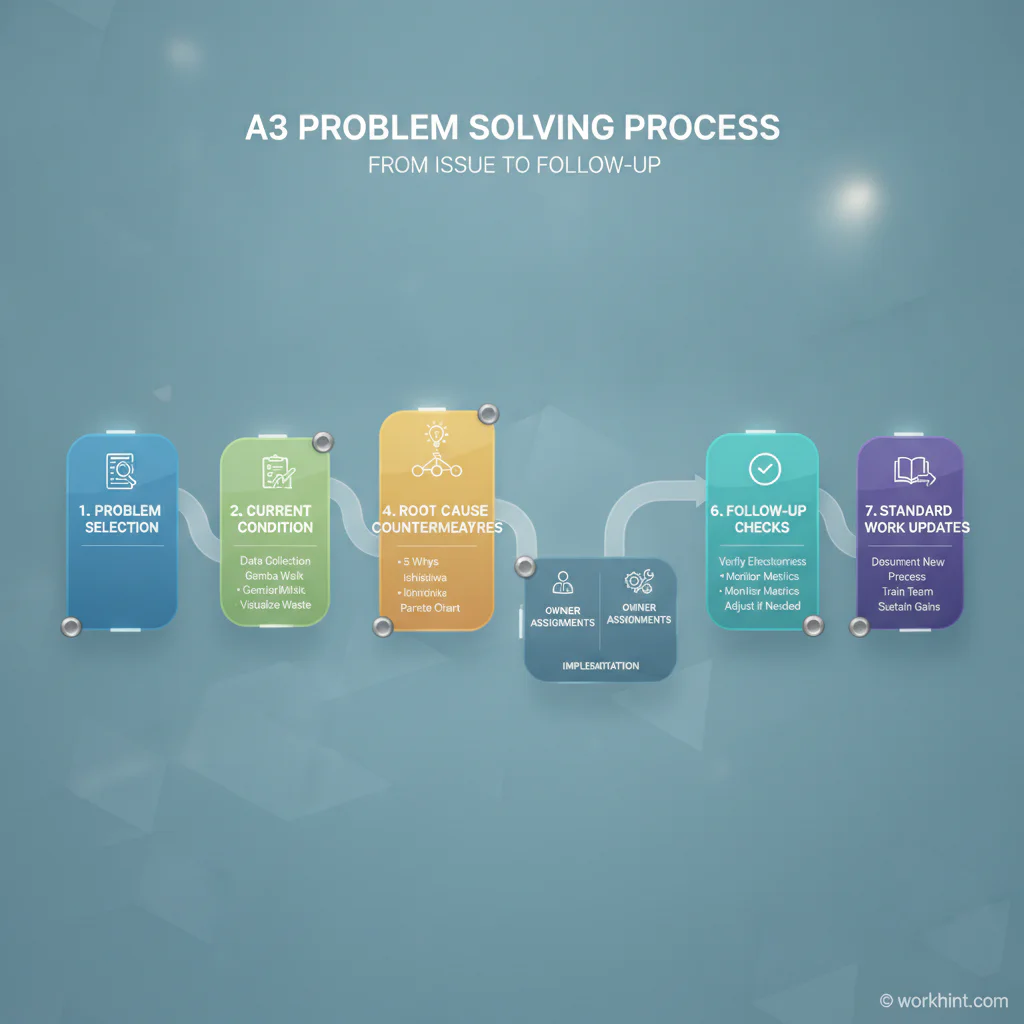
A3 problem solving process from issue to follow-up
A practical A3 has seven working sections. The names vary by organization, but the logic should stay consistent.
| A3 section | What it should answer | Operational output |
|---|---|---|
| Problem statement | What is happening, where, and why does it matter? | A narrow issue tied to impact |
| Current condition | How does the work actually move today? | Evidence, process map, baseline metric |
| Target condition | What should improve and by when? | Measurable goal |
| Root cause | What conditions create the problem? | Validated causes, not guesses |
| Countermeasures | What changes will be tested? | Prioritized actions |
| Implementation plan | Who will do what, by when? | Owners, due dates, approvals |
| Follow-up | Did the change work, and what becomes standard? | Review date, metric result, new standard work |
Montana State University’s A3 guide uses the same basic logic: understand the situation before jumping to solutions, then use the report to guide discussion and improvement. The A3 is not a form to fill out after the answer is chosen. It is the thinking process that gets the team to a better answer.
How to run A3 as an operations workflow
Start by choosing the right problem. Good A3 topics are recurring, measurable, and owned by more than one person or team. “Approvals are slow for customer onboarding” is better than “the team needs to be faster.” The first gives you a place, a workflow, and a metric to inspect.
Assign one A3 owner, but do not make that person the only contributor. The owner keeps the process moving. Participants supply evidence, constraints, and countermeasure ideas. A sponsor removes blockers when the countermeasure requires priority, policy, system, or budget changes.
Map the current condition before discussing fixes. Capture the actual steps, queues, handoffs, waiting points, exceptions, and tools involved. Pull a baseline metric such as cycle time, backlog size, error rate, approval aging, rework rate, or missed-service percentage. If the current condition is not evidence-based, it is too early to approve a solution.
Use root cause analysis to test the explanation. ASQ defines root cause analysis as a way to identify underlying causes rather than treating symptoms. In A3 work, that means asking whether the problem is caused by unclear intake, missing decision rights, poor handoff design, system gaps, capacity mismatch, ambiguous standards, or incentives that reward the wrong behavior.
Then choose countermeasures. A countermeasure is not a permanent policy announcement. It is a change you expect to reduce the problem because it addresses a validated cause. Examples include a new intake rule, an approval threshold, an escalation path, a queue owner, a checklist, a dashboard alert, or a revised handoff step.
A practical A3 example
Imagine a services company where new customer implementations regularly miss their target start date. A weak response would be to tell account managers to communicate earlier. An A3 approach would narrow the problem: 38 percent of implementations are delayed more than five business days because required customer data is incomplete when setup begins.
The current condition shows that sales collects some data in email, operations asks for missing fields later, finance verifies billing separately, and no one owns readiness before kickoff. The root cause is not “customers are slow.” The process has no readiness gate, no accountable owner, and no visible queue for missing information.
The countermeasure might be a single implementation readiness workflow: required fields, owner assignment, finance approval, customer document upload, exception path, and automated status dashboard. The follow-up metric is the percentage of implementations that reach kickoff-ready status before the target date. After four weeks, the team reviews whether delays dropped and decides which steps become standard operating practice.
Common mistakes to avoid
- Starting with a solution. If the team already knows the answer, the A3 becomes theater.
- Writing a vague problem statement. Define the workflow, impact, frequency, and baseline metric.
- Skipping the current condition. A3 thinking depends on seeing the work as it really happens.
- Confusing activity with countermeasures. Meetings, reminders, and documentation are not enough unless they change the cause.
- Ending at the action plan. Follow-up is where the team learns whether the change worked.
Research on A3 thinking in improvement work also emphasizes that the method is as much about shared learning and disciplined reasoning as it is about the final report.
Where Workhint fits
Workhint fits after the team has defined the A3 process it wants to run. Instead of leaving the report in a document, Workhint can turn the improvement workflow into roles, intake fields, assignments, approvals, due dates, escalation paths, dashboards, and follow-up records.
That matters because many operational improvements fail between decision and execution. The A3 identifies what should change. A work system makes the change repeatable: who owns the next step, what evidence is required, which approvals are needed, when exceptions escalate, and how leaders see whether the countermeasure is working.
FAQ
What is the A3 problem solving process?
The A3 problem solving process is a structured Lean method for defining a problem, analyzing the current condition, identifying root causes, testing countermeasures, and following up on results.
When should an operations team use A3?
Use A3 for recurring, cross-functional, measurable problems where the cause is not obvious and the solution requires alignment across people, process, and systems.
Is an A3 the same as root cause analysis?
No. Root cause analysis is one part of the A3 process. A3 also includes problem framing, target condition, countermeasures, implementation planning, and follow-up.
How long should an A3 take?
Small operational issues may take a few days. Larger cross-functional problems may need several weeks because the team must gather evidence, test causes, and review whether countermeasures worked.
Conclusion
The A3 problem solving process helps operations teams slow down enough to solve the right problem, then move fast with better alignment. Treat the A3 as a live operating workflow: define the issue, study the current condition, test root causes, assign countermeasures, and verify the result. The value is not the one-page report. The value is a better way to make operational problems visible, owned, and fixable.
Leave a Reply