


Bench time is not just idle capacity; it is a signal about forecasting, skills, sales timing, and delivery readiness.
Consulting bench management is the operating discipline of managing consultants, contractors, analysts, specialists, or delivery staff who are available but not currently assigned to billable client work. For consulting firms, agencies, implementation partners, and professional services teams, bench time can either protect future delivery or quietly drain margin.
The goal is not to force every person to be billable every hour. A firm with no available capacity may struggle to start new projects, cover changes, or respond to urgent client needs. The goal is to know which bench capacity is strategic, which is accidental, and what decision should happen next.
What’s in this article?
- Why consulting bench management matters for professional services teams
- A practical bench management workflow
- Metrics and ownership rules to track
- Common mistakes that increase idle time or delivery risk
- Where Workhint fits when bench management needs to become a live operating system
Why consulting bench management matters
Consulting work depends on matching the right expertise to the right project at the right time. The Bureau of Labor Statistics projects management analyst employment to grow 9 percent from 2024 to 2034, faster than average, and notes that demand for consulting services is expected to rise as organizations seek efficiency and cost control. That demand creates opportunity, but it also makes capacity planning harder.
Bench time becomes expensive when the firm cannot explain why it exists. A consultant may be unassigned because a project slipped, a deal moved later, a skill mismatch blocked staffing, a client delayed kickoff, or the person is being protected for a strategic opportunity. Those situations need different decisions.
Bench management also affects client quality. Assigning the first available person can hurt delivery if the fit is weak. Waiting for the perfect person can delay revenue. Strong teams manage the tradeoff deliberately.
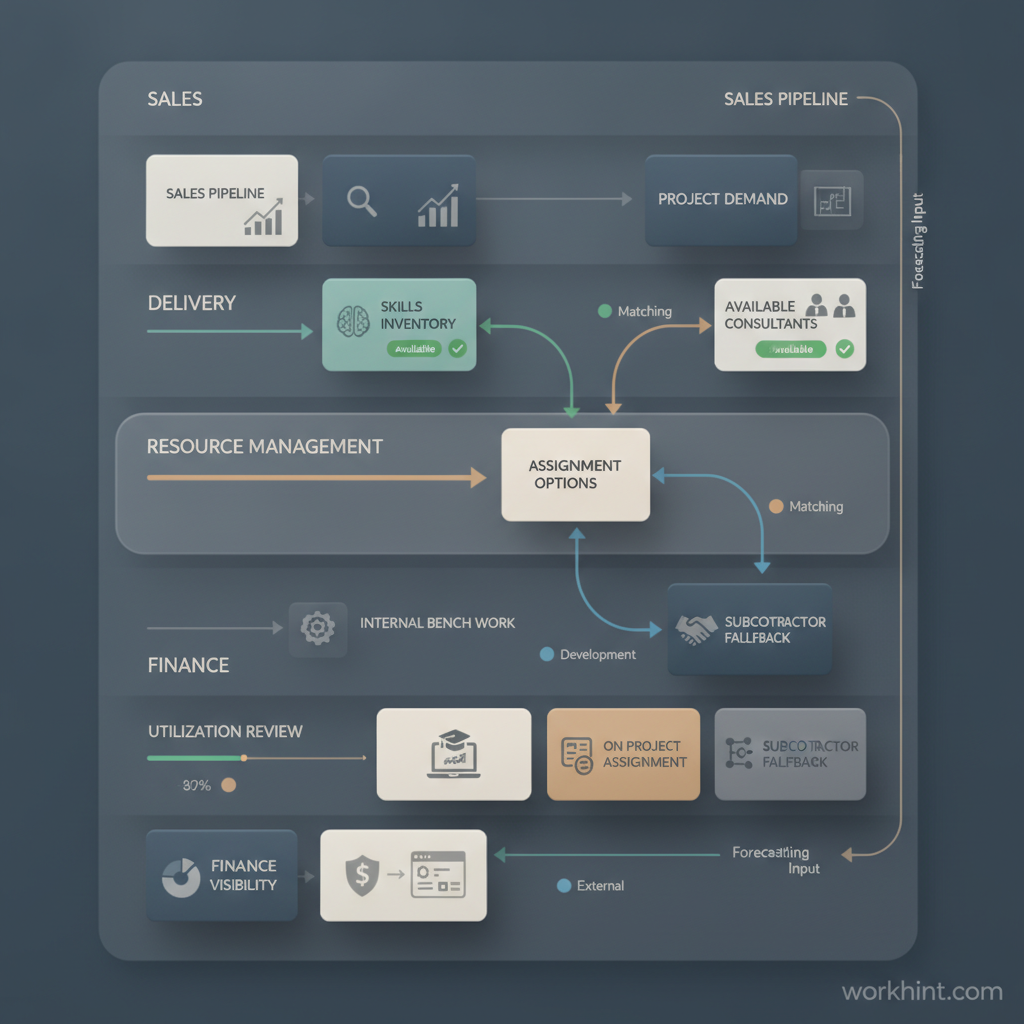
Consulting bench management workflow
A practical bench process should connect pipeline, projects, people, skills, availability, and financial impact. Use this workflow as the starting model.
- Define the bench clearly. Decide who counts as bench capacity: full-time consultants, fractional experts, subcontractors, partner resources, newly hired staff, or people rolling off projects in the next 30 days.
- Segment capacity by readiness. Separate immediately assignable people from those in training, shadowing, internal work, sales support, leave, or pending client approval.
- Connect sales pipeline to staffing demand. Review probability-weighted opportunities, expected start dates, skill requirements, locations, security needs, and client approval constraints.
- Match by skill and context, not only availability. Track skills, industry experience, rates, certifications, client history, time zone, and delivery level. Availability is only one input.
- Create assignment options early. For upcoming work, identify primary fit, backup fit, subcontractor option, training path, and start-date risk before the deal is signed.
- Use the bench for productive work. Assign proposal support, discovery calls, internal tools, documentation, training, knowledge transfer, reusable templates, QA, or client success work when it directly improves future delivery.
- Review exceptions weekly. Flag long bench duration, skill mismatch, repeated project delays, uncertain start dates, and people assigned to low-value internal work for too long.
- Close the loop after assignment. Record whether the match worked, what skills were missing, how fast staffing happened, and what should change in hiring, sales qualification, or subcontractor planning.
Bench metrics that actually help decisions
Bench dashboards often become noisy because they track too much. Focus on metrics that help the team staff work, protect margin, and prevent overload.
| Metric | What it tells you | Decision it should support |
|---|---|---|
| Bench duration | How long a person remains unassigned | Reassign, retrain, sell, subcontract, or change hiring plan |
| Billable utilization | How much available time becomes client work | Adjust staffing, pricing, project mix, or capacity plan |
| Forecast coverage | Whether upcoming deals have likely delivery capacity | Reserve capacity, hire, delay start dates, or use partners |
| Skill gap | Where demand and available skills do not match | Train, recruit, subcontract, or narrow sales focus |
| Time to assignment | How quickly available people move into useful work | Improve sales handoff, staffing decisions, or onboarding |
The NetSuite guide to consulting resource management emphasizes skills inventories, demand forecasting, flexible resource pools, and utilization visibility. SPI Research’s 2026 Professional Services Maturity Benchmark frames utilization, project margins, and operating maturity as key performance areas.
How to assign ownership
Bench management fails when nobody owns the whole system. Sales controls likely demand. Delivery owns project fit. Finance owns margin visibility. Talent or operations owns skills, availability, and assignment readiness. Leadership owns tradeoffs between utilization, growth, hiring, and client quality.
Use a weekly bench review with one accountable owner. The meeting should be short and decision-based: who is available now, what work is likely to start, where skill gaps exist, what internal work is valuable, and which exceptions need action. Avoid turning the meeting into a status recital.
Common bench management mistakes
- Treating all bench time as waste. Some availability is healthy if it supports upcoming work, training, sales support, or project recovery.
- Staffing by availability alone. A poor skill match can damage the client relationship and create more margin loss than short bench time.
- Ignoring pipeline uncertainty. A signed project, verbal commitment, and early-stage opportunity should not drive the same capacity decision.
- Letting internal work become a hiding place. Bench projects should have owners, outcomes, and deadlines, just like client work.
- Reviewing utilization after the month closes. By then, the staffing decision has already been missed. Bench risk needs a forward-looking view.
Bench targets should be realistic. Deltek’s summary of SPI benchmark KPIs notes that billable utilization is central to professional services performance, while best-practice targets need to be balanced against quality and burnout. The useful lesson is not to chase one universal number. It is to understand whether your utilization level supports the business model you are actually running.
Where Workhint fits
Workhint fits when consulting bench management needs to move from spreadsheets and weekly memory into a live operating workflow. A firm can use Workhint to structure project intake, map roles and skills, track consultant availability, assign internal bench work, route staffing approvals, manage subcontractor readiness, connect project assignments to finance, and report on bench duration, utilization, and forecast coverage.
That matters when a consulting firm uses a mix of employees, contractors, freelancers, implementation partners, or specialist vendors. Workhint can help teams keep the bench record connected to actual work so sales, delivery, finance, and operations are making decisions from the same system.
FAQ
What is consulting bench management?
Consulting bench management is the process of tracking and assigning available consulting capacity so the firm can balance billable utilization, client demand, skill fit, training, subcontractor usage, and delivery readiness.
Is bench time always bad?
No. Some bench time is useful when it supports upcoming projects, sales support, training, onboarding, internal product work, or project recovery. It becomes a problem when it is unplanned, unexplained, long-running, or disconnected from demand.
Who should own consulting bench management?
One operations or resource management owner should coordinate the process, but ownership is shared. Sales provides pipeline timing, delivery confirms fit, finance reviews margin impact, talent tracks skills, and leadership decides tradeoffs.
What metrics should consulting firms track for bench management?
Track bench duration, billable utilization, forecast coverage, skill gaps, time to assignment, project start slippage, subcontractor usage, and margin impact. Keep the dashboard small enough that each metric triggers a decision.
Conclusion
Good consulting bench management is not a campaign to eliminate every idle hour. It is a workflow for turning available capacity into the right next action. Define the bench, connect it to demand, match people by skill and context, use internal time deliberately, and review exceptions before they become margin problems. When the process is visible, consulting firms can protect utilization without sacrificing delivery quality or future readiness.
Leave a Reply