

You can start a mobile mechanic business by testing repair demand before buying vans or hiring a full-time crew.
If you want to start a mobile mechanic business, the traditional advice usually begins with a service van, expensive tools, and a solo operator schedule. A leaner model is to launch as a branded mobile repair platform first.
What’s in this article?
- Why mobile mechanic demand exists
- What you need before taking the first job
- How to price service calls, diagnostics, and repairs
- How to get first customers without looking oversized
- How Workhint helps launch the operating platform
- A first 7-day launch plan, checklist, and FAQ
How to Start a Mobile Mechanic Business Without Vans
Mobile mechanic services solve a clear customer problem: car repair is inconvenient. Customers do not want towing, shop waiting rooms, or losing a vehicle for small repairs that can be handled at home or work.
The business can also work well for skilled mechanics. Many independent technicians already own tools and want flexible work without running sales, scheduling, billing, and customer communication themselves.
That creates the platform opportunity. Instead of acting only as the mechanic, you can become the local operating brand that connects customers with vetted mobile technicians. The first version can focus on simple, high-demand jobs such as diagnostics, battery replacement, brakes, oil changes, filters, belts, starters, alternators, and pre-purchase checks.
Start with one city, a short service menu, clear pricing, and a small group of providers. Book real requests before buying vans or inventory.
What You Need To Launch
You do not need a fleet to test the model. You need a legitimate business, qualified providers, insurance guidance, and a customer-facing platform that makes the company feel trustworthy from the first request.
Licensing depends on the market. Expect business registration and local permits. Some locations require auto repair registration, written estimates, customer authorization, itemized invoices, environmental rules, or repair facility compliance.
The provider-network model changes the startup budget. Your first costs should support trust, compliance, marketing, provider onboarding, scheduling, and payment flow. Heavy assets can wait until job volume proves they are worth owning.
| Launch item | Lean budget range | Why it matters |
|---|---|---|
| Business setup and local permits | $100 to $800 | Creates the legal business and local operating permission. |
| Insurance review and basic coverage | $1,000 to $4,000 upfront or annualized | Protects the business and clarifies provider requirements. |
| Branded platform and intake flow | $500 to $2,500 | Lets customers request service, approve quotes, and pay online. |
| Provider recruiting and onboarding | $300 to $1,500 | Builds the first network of independent mobile mechanics. |
| Local marketing tests | $500 to $2,000 | Validates demand through search, referrals, fleets, and neighborhood campaigns. |
How To Price It
Pricing should be simple enough for customers to understand and strong enough to cover travel, admin, provider pay, payment processing, support, and margin.
Many mobile mechanic guides show hourly labor rates around $75 to $150, with diagnostic fees, service call fees, and parts markups depending on the market and job type. Use local research to set your numbers, then keep the first menu narrow.
| Offer | Example customer price | Operating note |
|---|---|---|
| Mobile diagnostic visit | $89 to $149 | Good first offer because it qualifies the job and creates trust. |
| Battery replacement | $60 to $120 labor plus parts | Simple, fast, and easy to schedule through a provider network. |
| Brake pad replacement | $175 to $350 per axle plus parts | Requires clear scope, parts confirmation, and provider skill matching. |
| Pre-purchase inspection | $149 to $299 | Strong local SEO service with clear customer value. |
Keep the early promise tight. Avoid complex engine work, warranty-heavy repairs, or jobs that require specialized lifts until you know which providers can deliver consistently.
How To Get First Customers
The first customers usually come from local intent and urgent convenience. Build around search phrases such as mobile mechanic near me, battery replacement at home, brake repair at home, car diagnostic visit, and pre-purchase inspection.
Start with a simple local landing page, Google Business Profile if eligible, neighborhood groups, apartment communities, office parks, rideshare driver groups, used car dealers, small fleets, property managers, and referral partners such as detailers or tire shops.
Your first goal is to prove that customers will submit requests, accept quotes, and pay for mobile service in a specific area. Track service type, location, response time, approval, completion, payout, and review.
How Workhint Helps Launch It
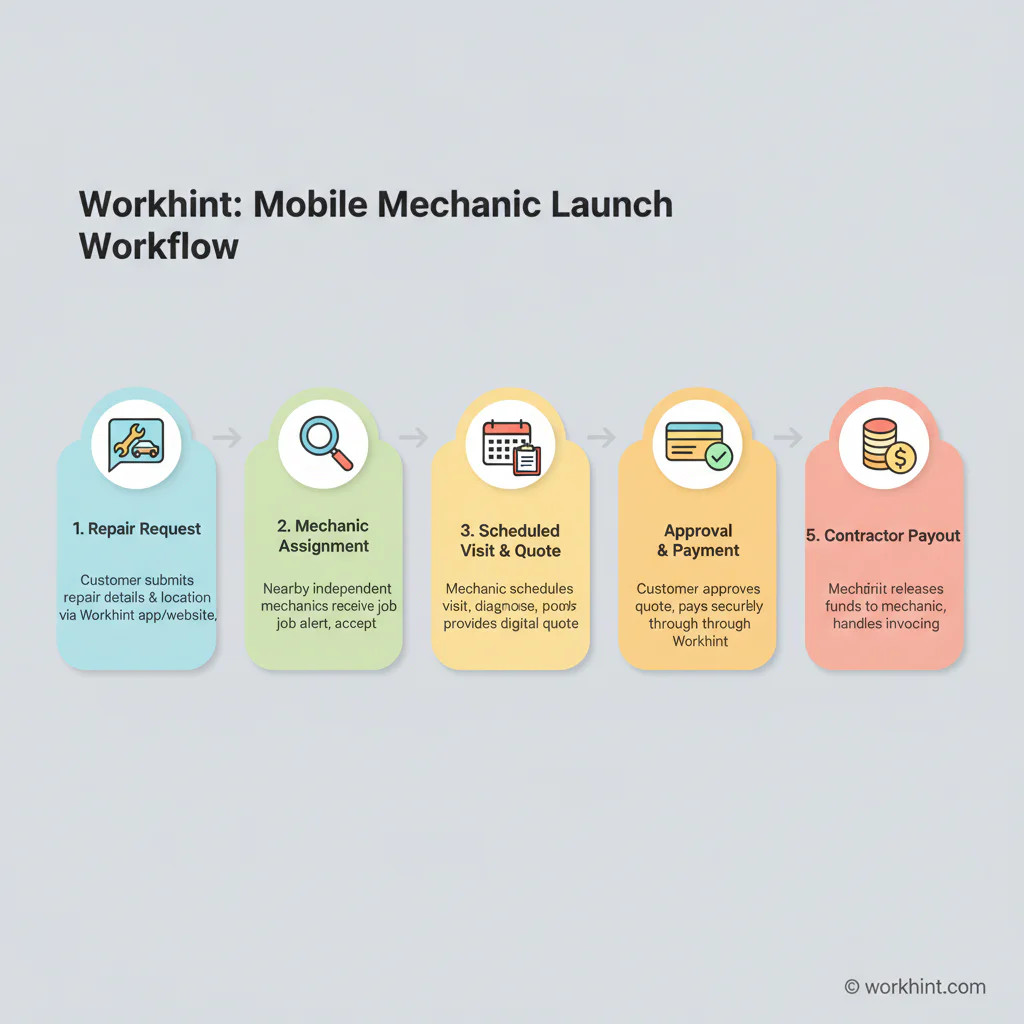
Workhint helps you launch the business as a branded operating platform before you buy vans or build custom software.
A customer can visit your branded portal, request a diagnostic or repair, enter vehicle details, upload photos, choose availability, and receive a quote. Your dashboard routes the request to qualified independent mechanics based on area, skills, credentials, insurance status, and availability.
Once a provider accepts the job, Workhint can coordinate appointment scheduling, customer confirmation, mobile job checklists, estimate approval, invoices, online payment, reviews, and contractor payout. The owner can see requests, booked jobs, provider performance, revenue, cancellations, and unresolved issues from one operating system.
The hardest part is coordinating trust across customers, vehicles, providers, parts, time windows, approvals, and payments. Workhint lets the founder sell like a serious local brand while keeping the first version lean.
First 7-Day Launch Plan
- Day 1: Choose one launch area, three core services, and the customer profile you want first.
- Day 2: Set up the branded Workhint portal with intake questions for vehicle, issue, location, photos, and availability.
- Day 3: Build quote approval, scheduling, payment, provider payout, and job completion flows.
- Day 4: Recruit three to five independent mechanics and verify service areas, skills, tools, credentials, and insurance.
- Day 5: Launch local outreach to apartment managers, office parks, rideshare communities, used car sellers, and fleet operators.
- Day 6: Route every request through the platform, test response times, and follow up with undecided customers.
- Day 7: Review demand, pricing, provider readiness, job quality, and customer feedback before spending more.
Buy assets only when repeated jobs, provider constraints, or margin data show that ownership would improve profit or reliability.
Final Launch Checklist
- Choose a business name and launch market.
- Check local business, repair, estimate, environmental, and consumer protection rules.
- Define a short service menu for jobs that can be delivered safely in the field.
- Confirm insurance requirements for the business and independent providers.
- Configure the branded Workhint customer portal and internal operations dashboard.
- Create intake, quote approval, scheduling, payment, job checklist, review, and payout workflows.
- Recruit and vet the first independent mobile mechanics.
- Launch local demand tests before buying vans, inventory, or hiring employees.
- Track every request and use the data to decide whether to expand.
FAQ
How much does it cost to start a mobile mechanic business?
A lean platform-first launch can start with a few thousand dollars if independent mechanics bring their own tools and vehicles. A traditional owner-operator setup can cost much more.
Can I start a mobile mechanic business without buying a van?
Yes, if the business model is built around independent providers who already have transportation, tools, and qualifications. Your role is to create the brand, customer platform, provider network, scheduling process, payment flow, and quality control. Once multiple mechanics are involved, service marketplace software can connect customer diagnostics, technician matching, mobile job scheduling, parts approvals, completion records, and payments.
Do mobile mechanics need a license?
Requirements vary by location. Most operators need business registration, and some markets require repair registration, written estimates, customer authorization, environmental compliance, or inspection credentials.
What insurance does a mobile mechanic business need?
Common coverage areas include general liability, commercial auto, garage keepers or care-custody-control coverage, tools and equipment coverage, and workers’ compensation if employees are hired.
What services should I offer first?
Start with repeatable services such as diagnostics, battery replacement, brakes, filters, belts, oil changes, pre-purchase inspections, and light maintenance.
How do I get the first customers?
Use local SEO, Google Business Profile if eligible, referral partners, apartment communities, office parks, small fleets, rideshare groups, and used car sellers.
Can this become a larger company?
Yes, but expansion should follow demand. Add providers, service areas, and fleet accounts before buying vehicles or hiring staff.
Conclusion
A mobile mechanic business does not have to begin with a van purchase or a full-time team. The smarter first move is to validate demand with a branded platform, a focused menu, and a vetted provider network.
Workhint gives that model an operating foundation from the first customer request through provider assignment, scheduling, quote approval, payment, review, and payout. Start small, prove the market, and invest only after the workflow shows where scale is needed.
Leave a Reply