


The wrong external workforce model creates hidden management work, unclear accountability, and invoices nobody can confidently approve.
SOW vs staff augmentation is a practical decision about what your company is buying. Staff augmentation buys external capacity that your team directs. A statement of work buys a defined outcome, project, or deliverable that the provider manages against agreed scope.
The difference sounds contractual, but it becomes operational fast. It affects who sets priorities, who manages work, who grants access, who accepts deliverables, how invoices are approved, and what happens when scope changes. This article is not legal advice; involve the right advisors when classification, employment, tax, or contract risk matters.
What’s in this article?
- A plain-language comparison of SOW and staff augmentation.
- A decision table for choosing the right model.
- The workflow each model needs after approval.
- Common mistakes that create cost, delivery, and compliance risk.
- Where Workhint fits when external work needs structure.
Why SOW vs staff augmentation matters
The core question is ownership. In staff augmentation, the business usually manages the external worker’s priorities, tasks, collaboration, and execution. In an SOW model, the provider owns delivery and the business manages acceptance, changes, milestones, and performance against the agreement.
Public procurement guidance from the Virginia Information Technologies Agency makes this distinction directly: staff augmentation addresses short-term staffing needs or specialized skills, while SOW work is used when a firm completes a project and manages the activities needed to produce deliverables.
External workforce programs are growing more complex. The U.S. Bureau of Labor Statistics reported that independent contractors made up 7.4 percent of employment in July 2023, and alternative arrangements also include temporary help agency workers and workers provided by contract firms. Businesses need models that fit the work, not labels that sound convenient.
SOW vs staff augmentation comparison
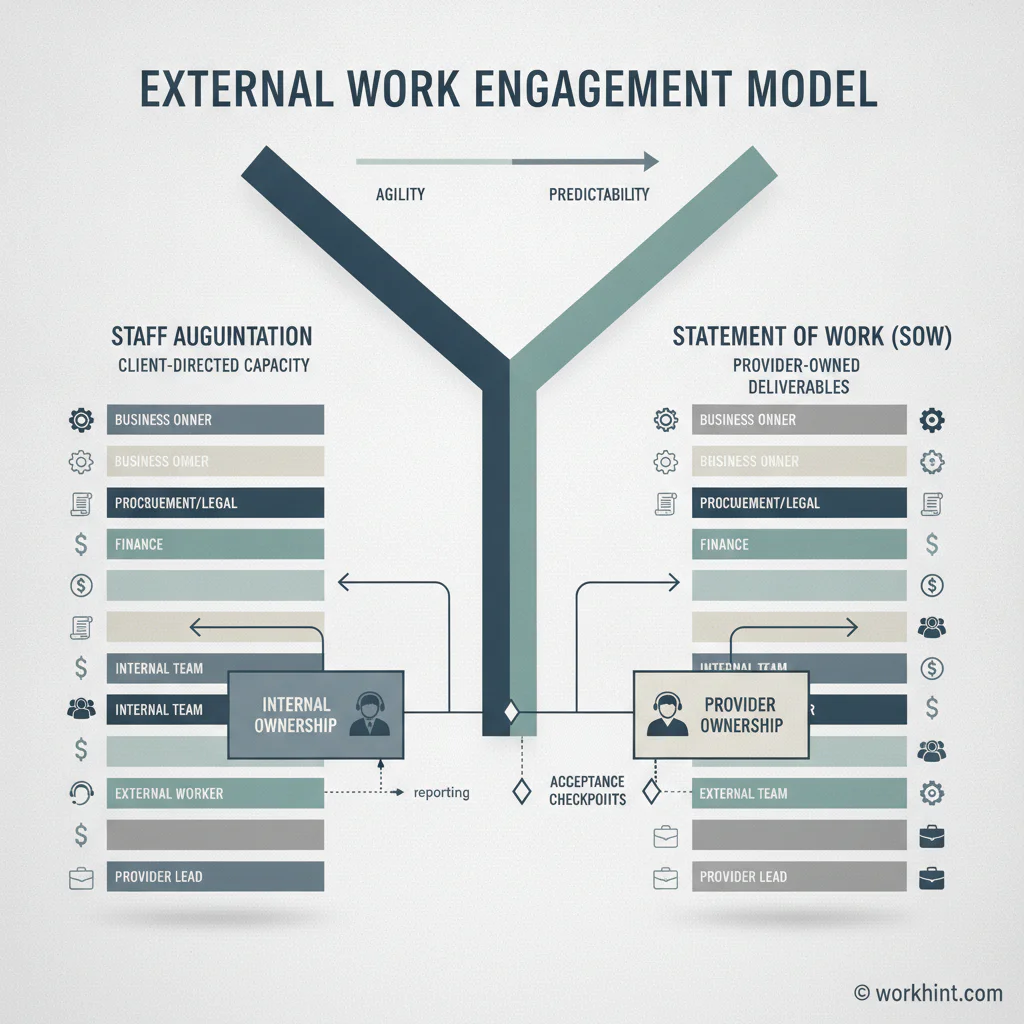
| Decision area | Staff augmentation | SOW |
|---|---|---|
| What you buy | Capacity, skills, and time from external workers | A defined outcome, project, service, or deliverable |
| Who manages daily work | Your internal manager or project owner | The provider or delivery lead |
| Best when | You know the work but need more hands or scarce skills | You can define the outcome, scope, milestones, and acceptance criteria |
| Pricing model | Often hourly, daily, weekly, or monthly by person | Often milestone, fixed-fee, retainer, or deliverable-based |
| Main operating risk | Management overhead, access sprawl, long-running pseudo-headcount | Vague scope, weak acceptance rules, change disputes, hidden assumptions |
| Invoice trigger | Approved time, attendance, or resource period | Accepted milestone, deliverable, service period, or agreed event |
Choose staff augmentation when you need capacity
Staff augmentation fits when the business has strong internal direction but not enough capacity. You may need a data analyst for six months, implementation support during a migration, extra engineers for a release, or operations coordinators during seasonal demand. The work is inside your operating rhythm, and your team is prepared to manage priorities.
The benefit is flexibility. You can add specialized capacity without opening a permanent role or outsourcing an entire function. The tradeoff is management load. Someone internal must define work, approve access, coordinate handoffs, review output, manage blockers, and prevent scope drift.
Classification and employment relationship risk must be handled carefully. The IRS says businesses should look at the entire relationship and degree of control when deciding whether a worker is an employee or independent contractor. The U.S. Department of Labor says FLSA status depends on the economic realities of the relationship. Labels alone are not enough.
Choose an SOW when you need an outcome
An SOW fits when the business can define the result clearly enough for a provider to own delivery. Good examples include a data migration, a customer onboarding implementation package, a field-service rollout, a content production package, a security assessment, a process redesign, or a managed back-office service.
The benefit is accountability. Instead of supervising each worker, the business agrees on scope, milestones, acceptance criteria, reporting, change control, and payment triggers. The provider coordinates its own team; your team reviews progress and approves the result.
The risk is ambiguity. A weak SOW can be worse than staff augmentation because nobody is sure who owns delivery. The SOW should define deliverables, assumptions, exclusions, dependencies, customer responsibilities, timeline, acceptance criteria, change order rules, and invoice triggers before work starts.
A practical decision workflow
- Define the work type. Is the need extra hands inside your process, or a provider-owned outcome?
- Identify who should manage execution. If your team must set daily priorities, staff augmentation may fit. If the provider should manage delivery, use an SOW.
- Check scope certainty. Clear deliverables support SOW work. Uncertain or evolving priorities often need staff augmentation with strong governance.
- Set the payment trigger. Staff augmentation usually needs time approval. SOW work needs milestone, deliverable, service, or acceptance approval.
- Route risk review. Legal, HR, finance, security, and procurement should review higher-risk work before access or payment setup begins.
- Build the operating workflow. Define intake, approvals, access, assignment, status reporting, deliverable acceptance, invoices, renewals, and closeout.
Common mistakes
- Using an SOW to hide staff augmentation. If the contract says deliverables but the client manages individuals every day, the operating model is confused.
- Buying staff augmentation without an internal owner. External capacity does not manage itself. Without ownership, the business pays while work waits for direction.
- Approving invoices without acceptance rules. Finance needs to know whether it is approving hours, milestones, deliverables, usage, or service levels.
- Ignoring access boundaries. External workers and providers should receive only the access needed for the approved scope, with removal tied to closeout.
- Letting the model drift. A short staff augmentation role can become long-term pseudo-headcount. A fixed SOW can become endless change requests. Review the model on a set cadence.
Where Workhint fits
Workhint helps businesses turn the SOW vs staff augmentation decision into a workflow instead of a one-time contracting choice. A team can use Workhint to capture the request, classify the model, route approvals, collect documents, assign owners, set role-based access, define approval rules, track invoices, and keep reporting visible.
The same company may use several models at once: freelancers, staffing vendors, agencies, consultancies, and managed providers. Workhint helps structure each model around the right ownership, permissions, approvals, payment triggers, and review points.
FAQ
What is the main difference between SOW and staff augmentation?
Staff augmentation usually buys external worker capacity that your team directs. An SOW usually buys a defined result, project, service, or deliverable that the provider manages against agreed scope and acceptance criteria.
Is staff augmentation cheaper than an SOW?
Not always. Staff augmentation may look cheaper by rate, but it requires internal management time and can expand if priorities keep changing. An SOW may cost more upfront but can be cleaner when scope, milestones, and acceptance rules are clear.
Can a company use both models?
Yes. A company might use staff augmentation for internal delivery capacity and SOW agreements for outcome-based projects. The key is separating ownership, approval rules, access, and invoice triggers for each model.
Who should approve the model choice?
The business owner should define the need, but procurement, legal, HR, finance, security, and operations may need to review the model depending on risk, access, worker classification, data exposure, and payment terms.
When should a staff augmentation role move to an SOW?
Consider an SOW when the work has become a defined outcome the provider can own, with clear deliverables, milestones, acceptance criteria, and change rules. Keep staff augmentation when your internal team needs direct control over changing priorities.
Conclusion
The best answer to SOW vs staff augmentation starts with ownership. If your team needs skills and capacity under internal direction, staff augmentation may fit. If you need a provider to deliver a defined outcome, use an SOW with clear scope, acceptance, change, and payment rules. Either model needs explicit workflows for approvals, access, delivery evidence, invoices, and review.
Leave a Reply