

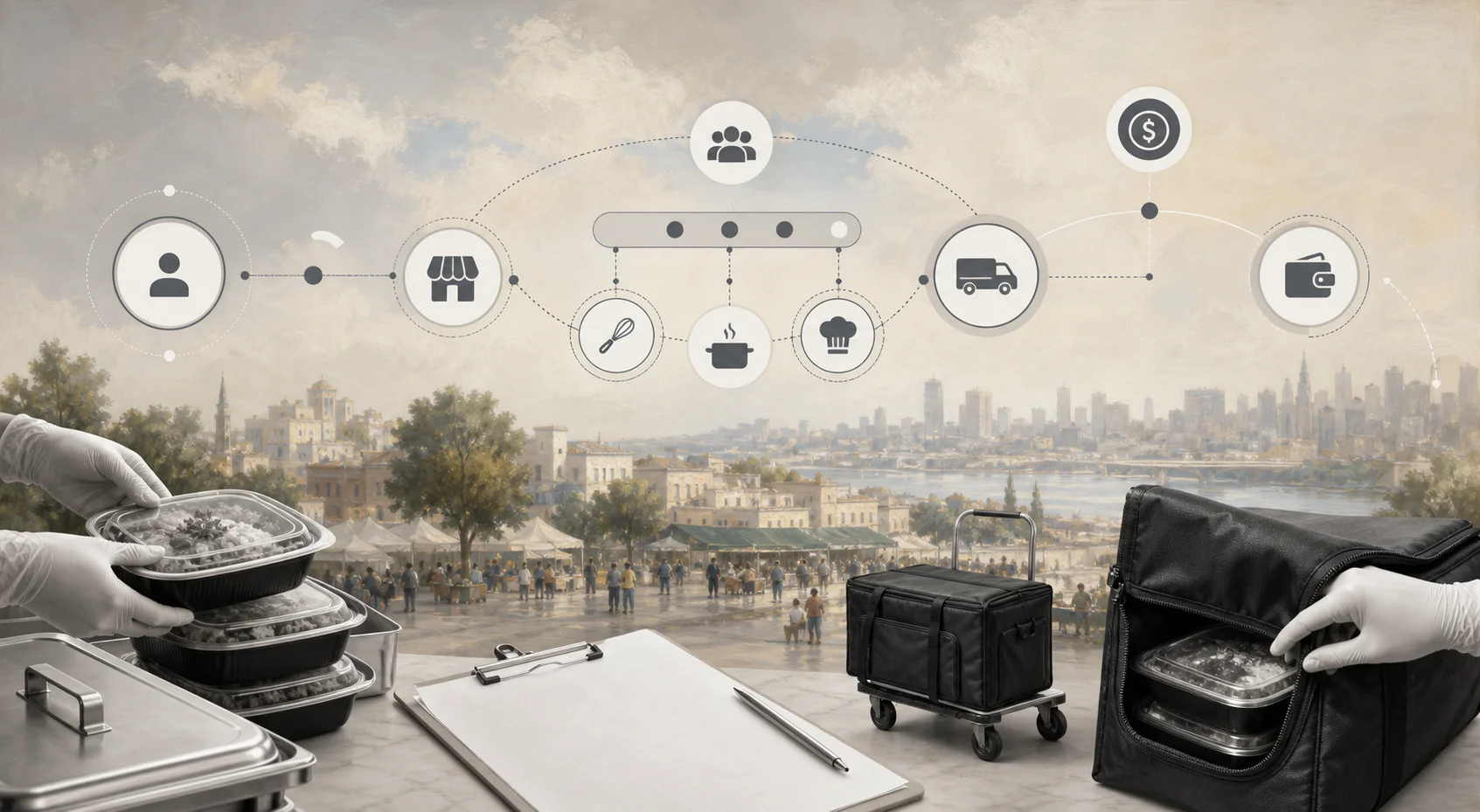
You can validate a catering business before hiring servers, leasing a kitchen full-time, or buying equipment you may not need.
If you want to start a catering business, the fastest path is not a giant menu, a full staff, or a long lease. It is a focused drop-off catering offer that proves people will buy before you invest heavily.
Drop-off catering works well for office lunches, workshops, team meetings, open houses, small parties, and community events. Customers want reliable food, clear pricing, simple ordering, and on-time delivery. They usually do not need a large event team on-site for the first version of the business.
The modern launch model is simple: build a branded customer platform, use compliant shared kitchen or food provider capacity, recruit independent cooks, delivery partners, or event helpers where allowed, and manage each order through a clear operating system. Workhint can become that foundation so you can sell, coordinate, and validate demand before building a traditional catering company.
What’s in this article?
- Why drop-off catering is a practical first offer
- What you need before accepting orders
- How to price catering packages
- How to find the first customers
- How Workhint helps launch the business
- A 7-day launch plan and final checklist
Why this business works
Catering has a clear buyer problem: groups need food for meetings and events, but they do not want to coordinate menus, dietary needs, timing, delivery, setup, payment, and follow-up manually.
A drop-off model keeps the first version narrow. Instead of trying to serve weddings, plated dinners, cocktail events, and corporate meals at once, start with one repeatable offer such as boxed lunches, breakfast trays, sandwich platters, healthy office meals, or small-event buffets.
This business also fits a provider-network model. You do not need to employ a full kitchen team on day one if you can legally work with licensed kitchens, independent food providers, delivery partners, and event helpers. The owner focuses on brand, demand, quality control, customer intake, pricing, and fulfillment coordination.
Customers buy because they want convenience and reliability. Providers join because you can bring them recurring demand without forcing them to build the customer platform, sales process, scheduling system, and payment infrastructure themselves.
What you need to launch
The first version should be compliant, simple, and sellable. Start by checking local food-service rules before accepting orders. Requirements vary by city and state, but catering commonly involves business registration, food safety certification, health department approval, liability insurance, and approved kitchen access.
Avoid signing a full kitchen lease before you have orders. Many first-time operators can test demand through a shared commercial kitchen, commissary kitchen, restaurant partnership, licensed food partner, or narrow menu that fits local rules. Verify what is allowed in your area before using any kitchen or provider.
| Launch item | Lean budget range | Why it matters |
|---|---|---|
| Business registration and basic setup | $100 to $800 | Creates the legal foundation for contracts, banking, taxes, and insurance. |
| Food safety certification and permits | $100 to $1,500+ | Depends on local rules, menu, kitchen setup, and event type. |
| Shared kitchen or licensed provider access | $300 to $2,000 initial | Lets you validate demand without building or leasing a kitchen. |
| Insurance | $500 to $1,500 | Protects against food, venue, delivery, and general liability risks. |
| Brand, platform, intake, payments, and local marketing | $500 to $2,500 | Turns the idea into a customer-ready business before heavy spending. |
Your first offer should be boring in the best way: easy to quote, easy to produce, easy to deliver, and easy to repeat. A simple corporate lunch package can teach you more than a complex event menu that requires too many moving parts.
How to price it
Pricing should reflect food cost, kitchen time, packaging, delivery, setup, provider compensation, platform fees, customer support, and profit. Do not copy competitors blindly. Know your cost per order and set a minimum order size so small jobs do not consume the day.
| Offer | Example price | Best first customer |
|---|---|---|
| Boxed lunch package | $14 to $22 per person | Offices, workshops, schools, nonprofits |
| Breakfast tray package | $10 to $18 per person | Morning meetings, training days, real estate offices |
| Casual buffet drop-off | $18 to $35 per person | Team lunches, local events, small celebrations |
| Premium event drop-off | $35 to $60+ per person | Executive meetings, client events, private gatherings |
A practical early rule is to sell one or two packages with clear minimums. For example, a 20-person boxed lunch order at $18 per person creates $360 in revenue. If food, packaging, kitchen, delivery, and provider costs total $230, the order leaves $130 before overhead and owner time. That is enough to test demand, but not enough to justify complexity.
How to get first customers
Start with buyers who order food repeatedly: office managers, coworking spaces, clinics, schools, real estate teams, nonprofits, churches, training companies, and local event venues. The first goal is not brand awareness. It is booked orders, customer feedback, and proof that the offer is priced correctly.
Use direct local outreach. Send a simple menu, minimum order size, delivery area, dietary options, and ordering link. Ask venues and shared kitchens which customers regularly need reliable drop-off catering. Offer a limited launch menu instead of a custom proposal for every inquiry.
Once a few orders go well, turn every customer into a review, referral, recurring lunch option, or preferred-vendor conversation. Catering compounds through reliability.
How Workhint helps launch it
Workhint can help you launch the catering business as a branded operating platform before you build custom software, hire staff, or commit to a full kitchen lease.
A customer can visit your branded portal, choose a package, enter the date, location, headcount, budget, dietary needs, delivery instructions, and setup preferences. The request flows into your internal dashboard, where you review availability, match the job to an approved kitchen or independent provider, send a quote, collect approval, schedule preparation and delivery, and track completion.
Provider onboarding can also happen inside the platform. You can invite licensed kitchens, independent cooks, delivery partners, and event helpers, collect documents, store certifications, define service areas, set payout rules, and assign only the jobs they are approved to handle.
After the order is delivered, Workhint can support customer follow-up, invoice records, payment tracking, provider payout, issue notes, reviews, and reporting. That turns the business from a collection of forms, texts, spreadsheets, payment links, and calendar reminders into one operating system.
The important point is not that Workhint manages a catering company later. It lets you create the branded platform and operating backbone at the beginning, so you can validate orders and providers before spending like a traditional caterer.
First 7-day launch plan
- Day 1: Choose one niche, one market, and one offer. Corporate boxed lunches or breakfast trays are easier to validate than broad event catering.
- Day 2: Confirm local licensing, food safety, insurance, and kitchen requirements. Identify shared kitchens, commissaries, or licensed provider partners.
- Day 3: Set up the branded Workhint platform with intake, menu packages, quote approvals, scheduling, payment, and provider payout flow.
- Day 4: Recruit the first approved providers or kitchen partners. Collect documents, define delivery areas, and agree on payout terms.
- Day 5: Contact 30 local buyers with the launch offer, menu, minimum order size, and ordering link.
- Day 6: Follow up, route every inquiry through the platform, and quote only orders you can fulfill cleanly.
- Day 7: Review demand, pricing, provider readiness, delivery timing, and feedback before adding menu complexity or fixed costs.
Final launch checklist
- Pick one catering niche and one simple launch menu.
- Verify local food-service, kitchen, permit, and insurance requirements.
- Secure compliant shared kitchen access or approved provider capacity.
- Create package pricing with minimum order sizes.
- Configure branded customer intake, quote approval, scheduling, payment, and payout workflows in Workhint.
- Recruit the first independent providers, delivery partners, or resource partners.
- Prepare outreach for offices, venues, schools, clinics, and community organizations.
- Book small orders first and validate demand before leasing space, buying equipment, or hiring staff.
FAQ
How much does it cost to start a catering business?
A traditional catering launch can cost tens of thousands of dollars, especially with kitchen leases, equipment, vehicles, and staff. A lean drop-off model can start with a smaller test budget by using shared kitchen access, a narrow menu, local marketing, insurance, permits, and a branded ordering platform.
Can I start a catering business without employees?
Yes, if your local rules and business model allow you to work with independent providers, licensed kitchen partners, delivery partners, or temporary event help. You still need clear agreements, compliance checks, quality standards, and a system for scheduling and payouts.
Do I need a commercial kitchen?
Usually, some form of approved kitchen access is required for catering, but rules vary by location and menu. Many founders start with a shared commercial kitchen, commissary kitchen, licensed restaurant partner, or another approved facility instead of leasing their own space.
What permits do I need for catering?
Common requirements may include business registration, food handler or food manager certification, health department permits, approved kitchen documentation, liability insurance, and special permits for alcohol or temporary events. Verify requirements with your local city, county, and state agencies.
What is the best first catering niche?
Corporate drop-off catering is often a strong first niche because offices, workshops, trainings, and local organizations order repeatedly. The best niche is one with clear local demand, simple fulfillment, predictable pricing, and customers you can reach directly.
How should I price drop-off catering?
Start with per-person packages and minimum order sizes. Build pricing from food cost, packaging, kitchen time, delivery, provider compensation, admin time, payment fees, and profit. Raise prices when custom menus, tight deadlines, setup, or complex dietary needs increase work.
How do I get my first catering customers?
Begin with direct outreach to office managers, coworking spaces, clinics, schools, nonprofits, venues, and community groups. Send a simple menu, clear packages, delivery area, and ordering link. Follow up quickly and ask happy customers for reviews and referrals.
Conclusion
The best way to start a catering business is to prove demand before building a traditional operation. Choose a narrow drop-off offer, confirm compliance, use shared or partner capacity, recruit reliable providers, and sell to buyers who need food repeatedly.
Workhint gives that launch a branded platform and operational foundation from day one, so the business can coordinate customer requests, provider matching, scheduling, approvals, payments, and payouts before making expensive commitments.
Leave a Reply