


A reliable contractor payment is not just a bank transfer; it is the final step in a controlled record, invoice, approval, and reconciliation process.
To pay contractors in Slovenia, a business should confirm the working relationship, sign a clear agreement, collect the correct business and payment details, review each invoice, choose a suitable euro payment method, and preserve the approval and settlement record. Slovenia uses the euro and participates in SEPA, making euro bank transfers practical for many payers.
Quick answer
Most businesses pay Slovenian contractors in euros by SEPA credit transfer, an international bank transfer, or a regulated payment provider. Before releasing funds, verify the contractor, agreement, invoice, VAT treatment, bank details, currency, fees, and approver. After payment, record the transfer reference, settled amount, exchange cost if any, and invoice status. Get local advice for classification, withholding, tax, and social-security questions.
What do you need before paying a contractor?
Build the payment record before the invoice arrives. The exact requirements depend on where the hiring business is established, how the contractor operates, and what work is performed, but a useful baseline includes:
| Record | Control question | Typical owner |
|---|---|---|
| Contractor identity and business details | Are the legal name, address, and tax identifiers consistent? | Operations or vendor management |
| Signed agreement and scope | Are deliverables, currency, timing, fees, and payment terms clear? | Legal and project owner |
| Classification review | Does the actual relationship match independent contracting? | Legal, HR, or qualified adviser |
| Invoice | Does it match approved work, period, currency, and required tax information? | Finance and project owner |
| Bank or payout details | Were account details verified through an approved channel? | Finance |
| Tax and VAT decision | Was the treatment reviewed for both parties and the place of supply? | Tax or finance adviser |
How can businesses pay contractors in Slovenia?
Slovenia is an EU member that uses the euro. The European Central Bank explains that SEPA harmonizes cashless euro payments across participating countries. For a payer with a compatible account, a SEPA credit transfer is often the simplest route because it avoids an unnecessary currency conversion.
| Method | Best fit | Watch for |
|---|---|---|
| SEPA credit transfer | Routine euro invoices to an IBAN | Cutoff times, account verification, and bank fees |
| SEPA instant transfer | Urgent euro payments where both banks support it | Limits, availability, and irreversible release controls |
| International wire | Payers outside SEPA or non-euro funding | Intermediary fees, FX spreads, and slower settlement |
| Regulated payment provider | Batch payouts, multi-currency funding, or centralized tracking | Provider coverage, pricing, settlement model, and data requirements |
Do not select a method only by the advertised transfer fee. Compare the amount the contractor receives, foreign-exchange markup, intermediary deductions, delivery time, approval controls, payment evidence, and reconciliation workload.
Contractor payment workflow for Slovenia
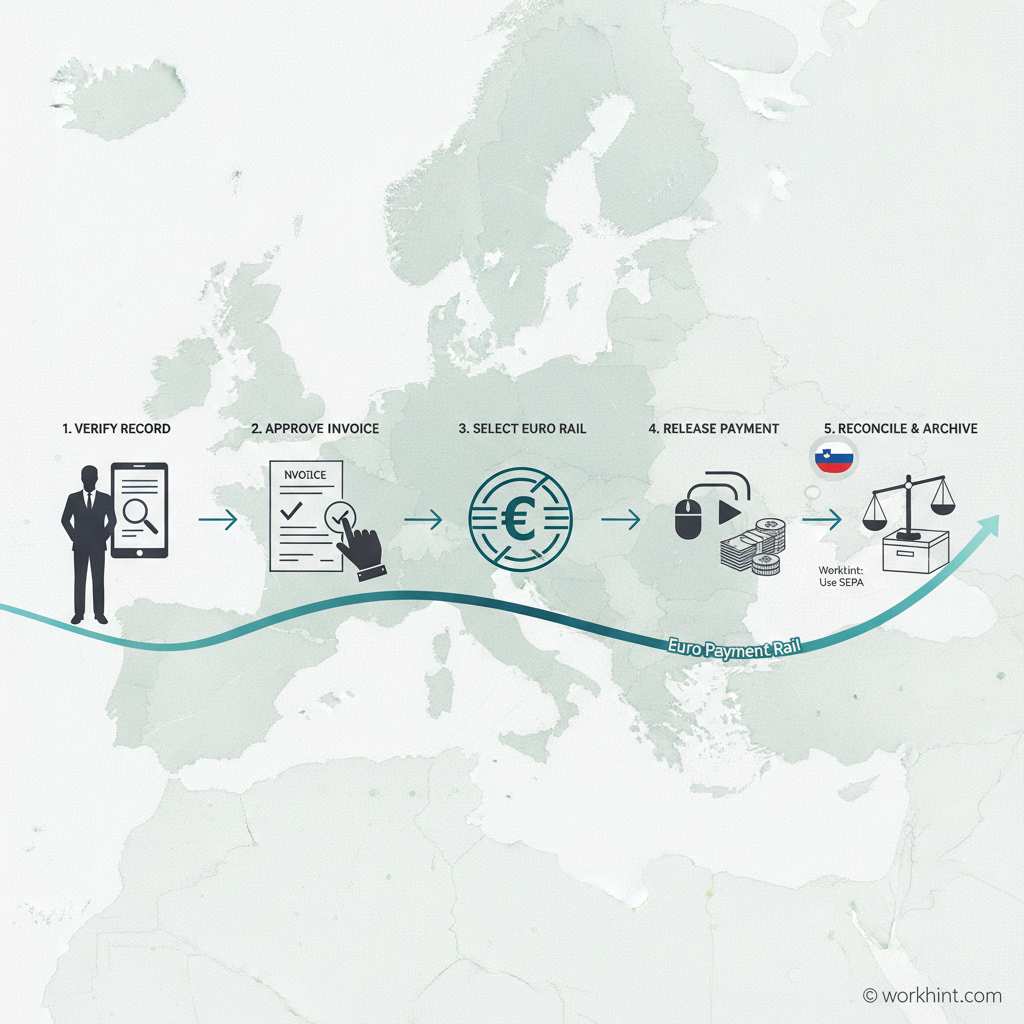
- Verify the contractor record. Confirm legal identity, tax and business details, agreement, approved scope, invoice currency, and payment account.
- Review the invoice. Match it to accepted work, milestones, rates, expenses, and payment terms. Resolve differences before approval.
- Confirm tax and VAT treatment. Record the review and obtain qualified advice when the parties, work location, or services create uncertainty.
- Approve the payment. Use role-based thresholds and separation between invoice review, bank-detail changes, and final release.
- Send and reconcile. Store the transfer reference, settlement date, amount sent, amount received when available, fees, and final invoice status.
How should VAT be handled?
VAT depends on the supplier, customer, type of service, and where each party is established. The EU’s cross-border VAT guidance explains that, for many business-to-business services within the EU, the customer accounts for VAT through the reverse-charge procedure, while exceptions exist. Businesses outside the EU and specialized services may face different rules.
Do not assume that every Slovenian contractor invoice should include VAT, or that every cross-border invoice should omit it. Verify the contractor’s status, VAT identification where relevant, place-of-supply rule, invoice wording, and the hiring company’s reporting obligation with a qualified adviser. The Financial Administration of the Republic of Slovenia is the official starting point for current Slovenian tax information.
How do you reduce payment errors and fraud?
- Verify new bank details independently before the first payment.
- Use a second channel to confirm any bank-account change.
- Separate the person editing payment details from the person releasing funds.
- Match the beneficiary name, invoice, contract, and contractor record.
- Use a unique invoice number and payment reference.
- Define approval thresholds for large, unusual, or early payments.
- Reconcile rejected, returned, partial, and duplicate transfers promptly.
Payment controls should apply consistently even when a trusted contractor requests an urgent change. Business email compromise and invoice fraud often exploit urgency, familiarity, and informal approval channels.
What records should finance retain?
Keep the signed agreement, scope changes, invoices, approvals, bank-detail verification, tax or VAT decision, transfer confirmation, fee record, reconciliation, and contractor communication required by policy. Retention periods depend on applicable law and the hiring company’s obligations, so document the rule rather than using an arbitrary period.
How Workhint fits
Workhint can turn this guide into a live contractor payment workflow. Teams can connect contractor onboarding, invoice intake, project-owner acceptance, finance review, role-based approvals, payout status, exceptions, and reconciliation. That makes it easier to see why a payment is ready, who approved it, what remains blocked, and which evidence supports the final transfer.
FAQ
What currency should businesses use to pay contractors in Slovenia?
Slovenia uses the euro, so EUR is often the most practical invoice and settlement currency. If the payer funds from another currency, compare the exchange rate, markup, and who bears conversion costs.
Can a U.S. company use SEPA to pay a Slovenian contractor?
It can if its bank or payment provider gives it access to SEPA euro transfers. Otherwise, an international wire or regulated cross-border payment provider may be used.
How long does a payment take?
Timing depends on the method, provider, cutoff time, compliance review, weekends, and recipient bank. Confirm the expected settlement window before promising a payment date.
Should a Slovenian contractor charge VAT?
It depends on the contractor’s status, the customer’s location and status, and the service. Do not guess; verify the invoice treatment with current official guidance or a qualified adviser.
Is an invoice enough to approve payment?
No. Finance should also confirm the contractor record, agreement, accepted work, bank details, tax or VAT review, and required approval.
Conclusion
To pay contractors in Slovenia reliably, connect the payment rail to a controlled operating process. Verify the relationship and account, approve a complete invoice, document the VAT decision, release funds through an appropriate euro payment method, and reconcile the result. That discipline matters more than any single transfer provider.
Leave a Reply