

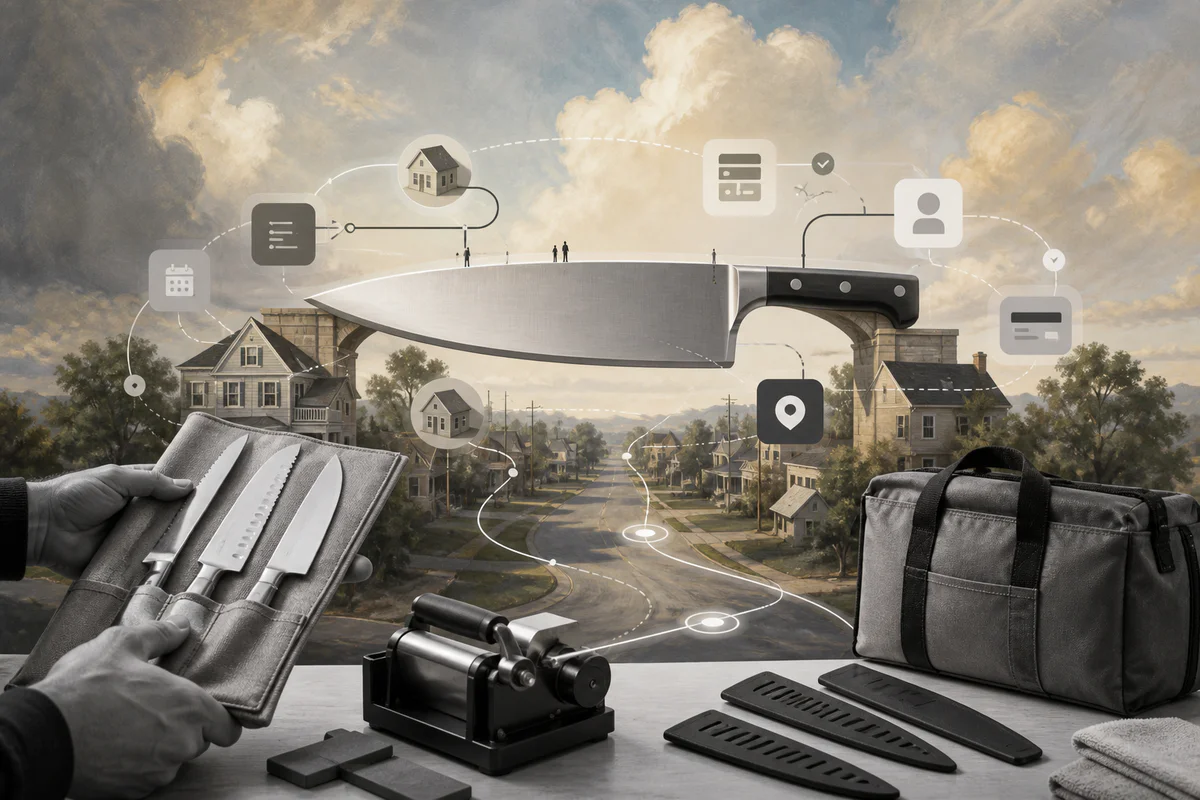
A knife sharpening business can start small, earn locally, and grow through routes, reviews, and repeat customers.
Learning how to start a knife sharpening business is attractive because the first version does not need a storefront, employees, or a large equipment budget. The business can begin as a focused local service for households, chefs, caterers, salons, woodworkers, and small food businesses that need sharp tools on a recurring basis.
The best low-risk path is not to open a shop first. It is to validate demand with a branded booking platform, simple drop-off or pickup rules, a basic sharpening setup, and a clear operating process. Once customers prove they will pay, you can add route days, restaurant accounts, or trained independent sharpeners.
What’s in this article?
- Why knife sharpening works as a small local business
- What you need before taking paid orders
- How to price sharpening services
- How to find your first customers
- How Workhint can power the business from day one
- A practical seven-day launch plan
Why this business works
Knife sharpening has a simple demand pattern: blades get dull, customers delay fixing them, and a convenient local service solves a real annoyance. Home cooks want safer, sharper kitchen knives. Restaurants need production knives that work every day. Barbers, groomers, landscapers, and hobbyists may need scissors, clipper blades, chisels, or tools sharpened depending on your skill set.
The model also has recurring revenue. A household may return every few months. A restaurant can create a predictable route account. A chef referral can lead to multiple customers in the same neighborhood. The business rewards quality, speed, review collection, and operational discipline more than expensive assets.
Competitor content often explains equipment, technique, pricing, and Google reviews. The gap is operations: how to capture requests, quote clearly, batch orders, manage pickup windows, track blade counts, collect approvals, process payment, and later coordinate other sharpeners without becoming buried in texts and spreadsheets.
What you need to launch
Start with the smallest version that can produce a safe, professional result. You need sharpening skill before volume. Practice on thrift-store knives, learn edge angles, understand steel types, and create a quality standard before taking paid work.
You also need a simple branded platform where customers can request service, choose pickup or drop-off, list the number of knives, approve a quote, pay, and receive status updates. That platform makes a small operation feel organized before you spend money on a storefront.
| Launch item | Lean starting range | Why it matters |
|---|---|---|
| Business registration | $50 to $500 | Creates a legal operating identity; exact cost depends on location. |
| Starter sharpening equipment | $400 to $1,200 | Covers a grinder or sharpening system, belts or stones, strop, and basic accessories. |
| Safety gear and supplies | $75 to $250 | Includes eye protection, mask, gloves where appropriate, blade sleeves, cloths, oil, and packaging. |
| Insurance | $300 to $1,000 per year | Protects against property damage, injury, and customer claims. |
| Branded platform and local marketing | $200 to $1,000 | Supports booking, quoting, payment, route coordination, reviews, and first customer acquisition. |
You do not need a van, retail lease, employees, or a full commercial workshop to test demand. Use your existing vehicle, porch drop-off, farmers markets, restaurant pickup windows, or neighborhood route days. Invest in better equipment only when order volume justifies it.
How to price it
Most beginners should avoid hourly pricing. Customers understand per-knife pricing, minimum orders, and package pricing more easily. Price should reflect blade length, condition, pickup convenience, and whether the job is residential or commercial.
| Offer | Example price | Best use |
|---|---|---|
| Standard kitchen knife | $8 to $18 per knife | Household orders and market-day sharpening. |
| Large or damaged blade | $15 to $30+ | Knives with chips, heavy dullness, or more time required. |
| Residential pickup minimum | $60 to $150 | Keeps pickup routes profitable. |
| Restaurant route account | $150 to $600 per visit | Recurring commercial work with larger batch sizes. |
Your first pricing goal is not to be the cheapest sharpener in town. It is to make every job worth handling, protect quality, and build enough margin to cover materials, travel, payment fees, insurance, and customer support.
How to get first customers
Start where dull knives already create frustration. Visit local restaurants during slow hours, talk to caterers, post before-and-after results in neighborhood groups, and ask home cooks to try a small batch. Farmers markets, food communities, culinary schools, barbers, groomers, and makerspaces can also create early demand.
Set up a complete local search presence before you need it. Your Google Business Profile, service area, photos, reviews, and simple booking link can become the engine of the business. Ask every satisfied customer for a review immediately after delivery.
The first goal is demand validation. Can you get five paid orders? Can you get customers to repeat? Can you batch orders into profitable pickup windows? Can you land one recurring commercial account? Answer those questions before buying more equipment.
How Workhint helps launch it
Workhint can become the branded operating foundation for the knife sharpening business before you build custom software or stitch together forms, calendars, payment tools, spreadsheets, and text threads.
A customer visits your branded portal, chooses household, restaurant, salon, or tool sharpening, lists the items, uploads notes or photos if needed, selects pickup, drop-off, or route service, and submits the request. The platform can route that request into an internal dashboard where you review the blade count, send a quote, collect approval, schedule the pickup window, and take payment.
As the business grows, Workhint can support provider onboarding for independent sharpeners, service-area rules, route assignments, quality checklists, customer updates, invoice generation, online payments, contractor payouts, and review requests. Instead of hiring employees early, you can validate the market, build repeat demand, then invite trained independent providers into a controlled operating system.
This is the real advantage: you can launch the business as a professional branded service platform while keeping the physical operation lean.
First 7-day launch plan
- Day 1: Choose your market, first customer type, and initial offer. Start with household kitchen knives or restaurant batch sharpening.
- Day 2: Configure the branded Workhint platform with service requests, quote approval, booking windows, payment, and customer updates.
- Day 3: Finalize pricing, pickup rules, blade intake forms, safety disclaimers, and a simple quality checklist.
- Day 4: Practice, photograph results, and prepare packaging for finished knives.
- Day 5: Contact restaurants, caterers, neighborhood groups, culinary communities, and friends who cook often.
- Day 6: Book the first paid orders through the platform and batch them into one pickup or drop-off window.
- Day 7: Review demand, quality, pricing, turnaround time, and repeat potential before buying more equipment.
Final launch checklist
- Choose a business name and service area.
- Register the business and check local licensing rules.
- Buy only the starter equipment and safety supplies needed to validate demand.
- Practice until the sharpening result is consistent and safe.
- Create a branded Workhint customer portal and internal operations dashboard.
- Set per-knife pricing, pickup minimums, and commercial account packages.
- Build intake, quote approval, scheduling, payment, and review flows.
- Sell to first customers before investing in a storefront, van, or employees.
FAQ
How much does it cost to start a knife sharpening business?
A lean launch can often start around $1,000 to $3,000 if you already have transportation and avoid a storefront. Costs rise if you buy commercial-grade equipment, rent space, or build a full mobile setup before validating demand.
Do I need employees to start?
No. Start as the operator or coordinate a small provider network only after you understand demand, pricing, quality control, and turnaround times. Employees are not necessary for the first version.
Do I need a license to sharpen knives?
Requirements vary by location. Most founders should register the business, check local business license rules, review sales tax obligations, and carry insurance before serving customers.
How should I price knife sharpening?
Use per-knife pricing with a pickup minimum. Add higher prices for damaged blades, large knives, rush service, or commercial route accounts that require predictable turnaround.
Who are the best first customers?
Home cooks, restaurants, caterers, chefs, barbers, groomers, woodworkers, and local makers can all be strong early customers depending on your sharpening skill and equipment.
Can this become recurring revenue?
Yes. Restaurants, salons, groomers, and serious home cooks need regular sharpening. The business becomes stronger when you turn one-off jobs into scheduled route accounts.
Conclusion
A knife sharpening business is a practical local service because it can start lean, prove demand quickly, and grow through repeat customers. The mistake is overbuilding too early. Start with skill, a clear offer, a branded platform, and a simple operating process. Then use revenue and customer feedback to decide where to invest next.
Leave a Reply