

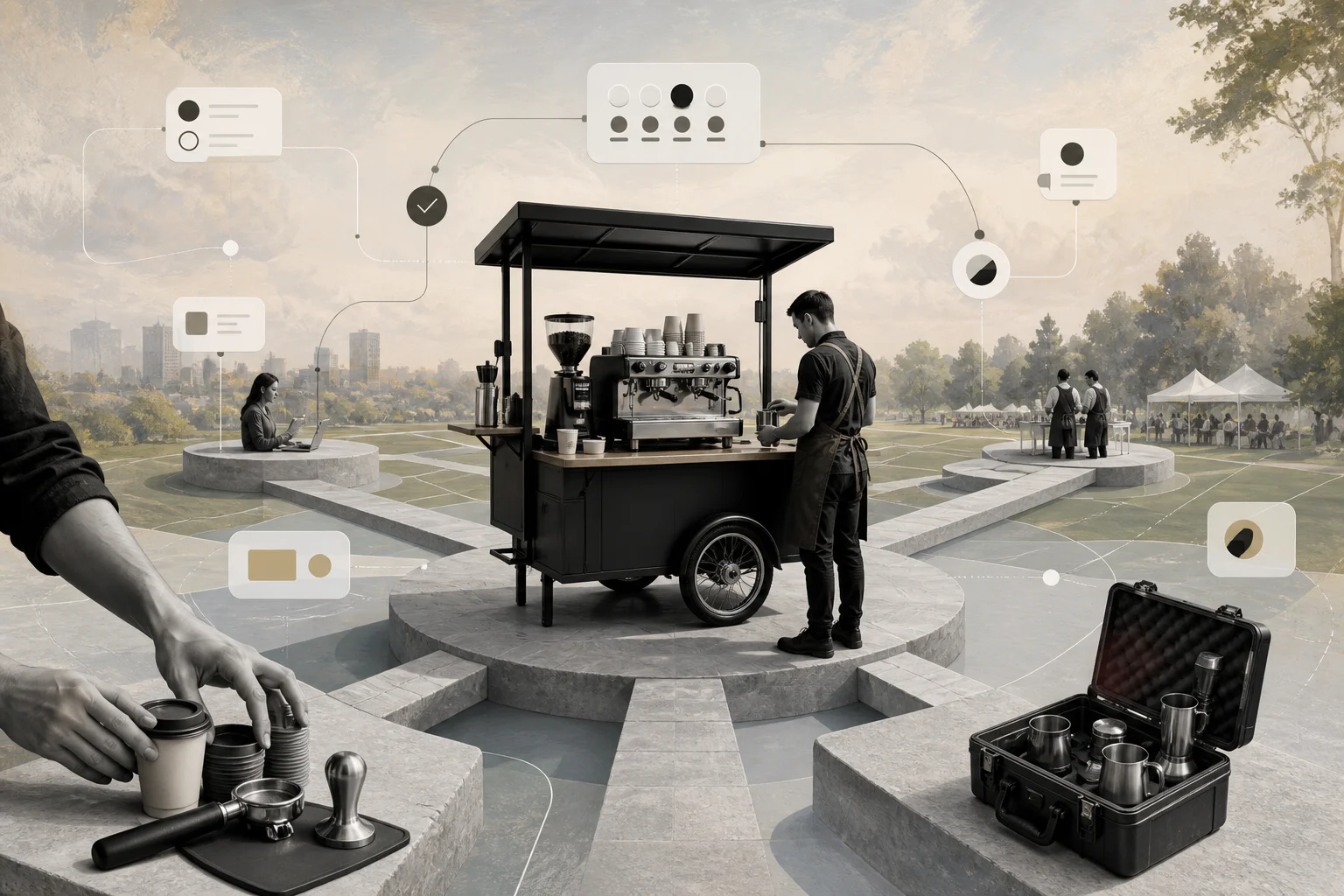
You can sell coffee service before you open a cafe, lease a shop, or hire a full team.
If you want to start a mobile coffee cart, the old path is to buy equipment first and hope enough events, offices, and markets appear later. A safer path is to validate demand first, build a branded booking platform, and coordinate a small network of trained independent baristas or coffee partners.
A mobile coffee cart can serve weddings, offices, conferences, apartment communities, farmers markets, private parties, and brand activations. It gives customers a cafe-style experience without requiring you to sign a lease, build a storefront, or operate seven days a week before the demand is proven.
This article shows how to launch a platform-first version: sell focused coffee service packages, book the first paid events, use Workhint to manage requests and fulfillment, and invest in owned equipment only after real demand supports it.
What’s in this article?
- Why a mobile coffee cart business works
- What you need before taking bookings
- How to price coffee cart services
- How to get first customers
- How Workhint helps launch the operating platform
- A 7-day launch plan, checklist, and FAQ
Why This Business Works
A mobile coffee cart works because coffee is already a familiar purchase, but the setting changes the value. At a wedding, office event, open house, or conference, customers are not just buying coffee. They are buying convenience, guest experience, and a polished service moment.
The first version does not need to be a full cafe on wheels. Start with one offer that is easy to explain and fulfill, such as a two-hour espresso bar for offices, a wedding coffee cart, a corporate pop-up, or a neighborhood event package.
The business is attractive because demand can be tested event by event. You can start with a simple brand, clear packages, and trusted independent baristas. You can rent equipment, partner with a local roaster, or use a shared cart arrangement before buying a custom build-out.
Customers buy because they want a professional coffee experience at their location. Providers join because they can earn paid event work without building the brand, selling the client, or managing the whole operation.
What You Need To Launch
The lean launch version needs an offer, a compliant setup, a booking process, and a fulfillment network. It does not need a cafe lease, a large staff, or a custom truck on day one.
Check local rules before accepting bookings. Coffee carts often involve health permits, food handler requirements, commissary rules, mobile vending rules, fire or electrical requirements, business registration, insurance, and location permission. Requirements vary by city and county, so verify them locally.
| Launch item | Lean approach | Typical timing |
|---|---|---|
| Brand and booking page | Create a simple branded platform with packages, request forms, deposits, and service area | Before outreach |
| Permits and insurance | Confirm business license, health rules, food handling, liability insurance, and venue requirements | Before paid events |
| Equipment | Rent, partner, or start with a compact setup before buying a custom cart | After demand tests |
| Provider network | Recruit independent baristas, roasters, and event helpers with clear standards | Before first booking |
| Operations | Set up quotes, schedules, menus, prep checklists, payment, and provider payout | Before launch |
Startup costs vary widely. Some guides place simple coffee cart setups around several thousand dollars, while more complete branded carts with commercial equipment, permits, insurance, working capital, and marketing can move much higher. The practical lesson is simple: sell and validate the format before you buy the most expensive setup.
How To Price It
Price the business around events, not single cups. A per-drink model works at public markets, but private events usually need a package that covers setup time, barista time, travel, ingredients, insurance, equipment, and profit.
| Package | Best for | Pricing logic |
|---|---|---|
| Office pop-up | Team breakfasts, employee events, coworking spaces | Flat setup fee plus guest count or drink allowance |
| Wedding coffee bar | Receptions, brunches, rehearsal events | Premium event fee based on hours, menu, travel, and guest count |
| Market cart | Farmers markets, festivals, outdoor events | Per-drink sales with vendor fees and minimum sales targets |
| Subscription route | Apartment communities and offices | Recurring monthly package for scheduled visits |
A good first pricing model is a minimum event fee plus add-ons. That keeps small events from consuming a full day at low margin. Add-ons can include extra hours, specialty drinks, branded cups, pastries through a partner, travel beyond the service zone, or an additional barista.
How To Get First Customers
Start where the value is obvious. Offices want employee experience. Wedding planners want memorable guest service. Apartment communities want resident events. Real estate teams want open house hospitality. Local brands want pop-up activations.
Create one short offer and sell it directly: a two-hour espresso bar for 50 to 100 guests with setup, barista service, standard menu, and cleanup included. Then contact office managers, event planners, coworking spaces, apartment managers, wedding venues, real estate brokers, and local business groups.
The first goal is not to look huge. The first goal is to book enough paid requests to prove which customer segment, package, location, and price point are worth repeating.
How Workhint Helps Launch It
Workhint can become the branded platform behind the mobile coffee cart business before you build custom software, hire an office team, or buy a full fleet of equipment.
A customer lands on your branded portal, chooses an office pop-up, wedding coffee bar, or private event package, enters the event address, guest count, preferred menu, timing, power access, parking notes, and special requirements. Workhint turns that request into an internal job, quote, approval flow, deposit request, event checklist, and schedule.
Once the booking is approved, Workhint helps you assign the right independent barista, coffee partner, or setup helper. Each provider gets the event details they need: arrival time, menu, equipment list, venue notes, service standards, cleanup checklist, and payment terms. After the event, Workhint can support completion proof, customer feedback, invoice collection, and provider payout.
That operating foundation lets you sell the business before you overbuild it. You can validate demand through real bookings, learn which events create margin, and decide later whether to buy a permanent cart, add more equipment, or expand into new neighborhoods.
First 7-Day Launch Plan
- Day 1: Choose one launch offer, one service area, and one buyer group such as offices, weddings, or apartment communities.
- Day 2: Set up the branded Workhint platform with request forms, packages, customer intake, and booking status.
- Day 3: Build the quote, deposit, event checklist, scheduling, payment, and provider payout process.
- Day 4: Recruit independent baristas, a local roaster, and backup event helpers. Verify experience, availability, standards, and legal requirements.
- Day 5: Contact 30 local demand sources with one clear offer and a simple booking link.
- Day 6: Route every reply, quote, objection, and booking through the platform so the process becomes repeatable.
- Day 7: Review demand, pricing, provider readiness, and permit requirements before investing in owned equipment.
Final Launch Checklist
- Choose a focused customer segment and launch market.
- Define one simple coffee cart package.
- Confirm local permits, health rules, venue rules, insurance, and food handling requirements.
- Create the branded Workhint booking platform.
- Set up customer intake, quote approval, deposits, scheduling, payments, and provider payouts.
- Recruit the first independent baristas or operating partners.
- Create event setup, menu, equipment, safety, and cleanup checklists.
- Contact offices, venues, planners, apartments, and local event hosts.
- Validate paid demand before buying expensive carts, trucks, or cafe equipment.
FAQ
How much does it cost to start a mobile coffee cart?
Costs vary by equipment, cart format, permits, and market. A lean validation model can start by renting, partnering, or using a compact setup, while a full branded cart with commercial equipment can require a much larger budget. Validate demand before buying the expensive version.
Do I need permits for a mobile coffee cart?
Usually yes. You may need business registration, health department approval, food handler certification, mobile vending permits, commissary arrangements, insurance, and venue permission. Check your city, county, and event requirements before taking paid bookings.
Can I start a mobile coffee cart with no staff?
Yes, if you start with a small provider network instead of employees. Use independent baristas or operating partners carefully, with written agreements, clear standards, compliant classification, scheduling rules, and documented payout terms.
How do mobile coffee carts make money?
They can earn through private event packages, office pop-ups, weddings, apartment events, market sales, recurring location routes, add-ons, and catering partnerships. Private packages are often easier to plan than relying only on walk-up drink sales.
What equipment do I need at the beginning?
Start with the minimum setup needed to deliver the offer legally and professionally: coffee equipment, grinder, water and power plan, cups, ingredients, cleaning supplies, menu, POS or payment setup, and transportation. Rent or partner before buying more than demand supports.
How do I get the first coffee cart customers?
Contact office managers, apartment communities, coworking spaces, wedding planners, event venues, real estate teams, farmers markets, and local business groups. Lead with one clear package and an easy request form.
Is a mobile coffee cart profitable?
It can be profitable when event pricing, ingredient cost, provider pay, travel time, permits, insurance, and equipment utilization are managed carefully. Profit depends less on coffee popularity and more on booking quality and operational discipline.
Conclusion
A mobile coffee cart is attractive because it lets you sell a real hospitality experience without opening a cafe first. The smart launch path is to start small, validate paid demand, coordinate capable providers, and invest only after the bookings justify it.
Workhint gives the business a branded operating foundation from the first request through quote approval, scheduling, service delivery, payment, and provider payout. That lets you launch faster, learn from real customers, and scale the coffee cart business only when the operation is ready.
Leave a Reply