

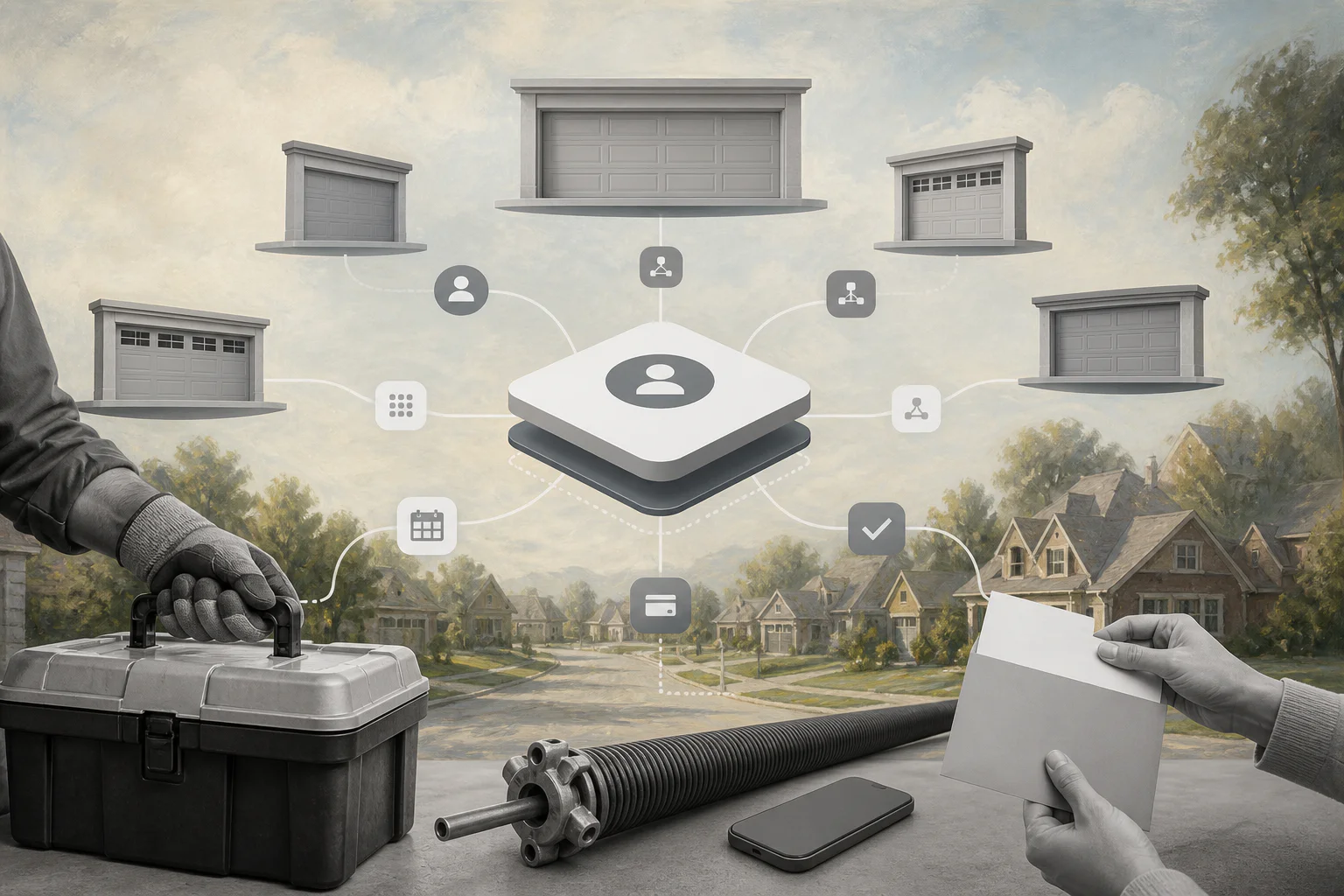
You can test a garage door service business before buying trucks, stocking doors, or putting technicians on payroll.
Introduction
A garage door business solves urgent, visible problems: stuck doors, broken springs, noisy openers, damaged tracks, and homeowners who need help quickly. The search demand is practical because people want to know what it costs, what tools are required, whether licensing applies, and how to find the first customers.
The fastest low-risk path is not to open a traditional garage door company on day one. It is to launch a branded service platform, recruit experienced independent garage door technicians, validate demand in one local market, and coordinate jobs through a clean operating system. That lets you sell, quote, schedule, collect payment, and manage contractor payouts before you invest heavily in vehicles, inventory, or employees.
What’s in this article?
- Why a garage door business can work as a local service platform
- What you need to launch without staff
- How to price tune-ups, repairs, and installation leads
- How to get the first customers
- How Workhint helps launch and operate the business
- A first 7-day launch plan, checklist, and FAQ
Why This Business Works
Garage doors are heavy, mechanical, and used constantly. When a spring breaks or a door will not close, the customer usually wants a fast local answer, not a long buying process. That creates strong demand for service calls, emergency repair, maintenance, opener troubleshooting, roller replacement, cable work, and replacement quotes.
The business also has a useful provider-network model. Many experienced technicians already own tools, know the safety risks, and can complete jobs independently. Instead of hiring employees immediately, you can build a private network of vetted technicians and route customer requests to the right provider based on location, availability, license requirements, job type, and service standards.
The key is to start with a narrow first offer. A garage door safety check, tune-up, opener diagnostic, or repair request intake is easier to sell than every possible installation project. Use that first offer to learn which neighborhoods respond, which jobs are profitable, which technicians are reliable, and what customers expect before you buy inventory or expand the service menu.
What You Need To Launch
You do not need a warehouse, showroom, truck fleet, or full-time crew to validate demand. You do need a legal business entity, insurance, a simple brand, a customer intake process, a provider onboarding process, and clear rules for quotes, approvals, scheduling, payments, and contractor payouts.
Licensing rules vary by state and city. Some areas treat garage door work as general home service work, while others may require contractor registration, home improvement registration, specialty licensing, or permits for certain installation work. Verify local rules before accepting jobs, and only route regulated work to properly qualified providers.
| Launch Item | Lean Budget | Notes |
|---|---|---|
| Business registration | $50 to $500 | LLC, local registration, and tax setup vary by state. |
| Insurance | $800 to $2,500 per year | General liability is the baseline; discuss garage door risk with a broker. |
| Brand and domain | $50 to $300 | Keep the brand local, clear, and trustworthy. |
| Workhint platform setup | Lean subscription budget | Use it for intake, scheduling, approvals, payments, provider onboarding, and reporting. |
| Local marketing tests | $300 to $1,500 | Google Business Profile, local service pages, flyers, referral partners, and small ad tests. |
| Provider onboarding | $100 to $500 | Background checks, documentation, service standards, and onboarding materials. |
| Tools and inventory | $0 to $1,000 initially | Use independent providers with their own tools while demand is still unproven. |
The main early investment is operational readiness. You need the branded customer experience and the provider network before you need expensive assets. Once job volume is predictable, you can decide whether to buy parts inventory, wrap a vehicle, hire a lead technician, or specialize in installation.
How To Price It
Pricing should be simple enough for a customer to act quickly and flexible enough for technicians to quote safely. Start with a diagnostic or tune-up price, then quote repairs after inspection. Avoid promising fixed prices for spring, cable, track, or opener work until the provider can verify the door type, part requirements, risk, and local labor norms.
| Offer | Example Price | Best Use |
|---|---|---|
| Safety check or tune-up | $49 to $99 | Entry offer that gets a technician on site and builds trust. |
| Diagnostic service call | $75 to $150 | Useful for opener, noise, track, remote, or unknown issues. |
| Common repairs | $150 to $600+ | Quote after inspection based on parts, labor, and urgency. |
| Emergency visit | Premium fee | Use only when fast dispatch is truly available. |
| Installation quote | Free or paid estimate | Best once you have qualified installers and supplier relationships. |
Your margin depends on how you structure provider compensation. A simple model is to collect from the customer through the platform, pay the independent technician an agreed job amount or percentage, and keep a coordination margin for marketing, intake, quoting support, quality control, payment processing, and customer service.
How To Get First Customers
Start in one service area. Build a Google Business Profile, create neighborhood landing pages, ask real estate agents and property managers for referrals, and offer a simple garage door safety check to homeowners after storms, move-ins, or seasonal changes.
Property managers are especially useful because one relationship can produce repeat work across multiple doors. Realtors, home inspectors, movers, handyman companies, and local renovation contractors can also send jobs when they do not want to handle specialized garage door work themselves.
The goal for the first month is not to look large. It is to prove that homeowners will request service through your branded platform, that your providers can respond reliably, and that your pricing produces enough margin to keep marketing.
How Workhint Helps Launch It
Workhint can become the branded operating foundation for the garage door business before you build custom software or hire a back office. A customer submits a repair request through your branded portal, adds door details and photos, chooses availability, and receives a confirmation. Your internal dashboard routes the job to an approved technician based on location, work type, insurance or licensing requirements, availability, and service history.
For a tune-up, Workhint can send the customer a fixed-price approval and schedule the job. For a repair, it can collect inspection notes, photos, parts needed, quote approvals, and payment authorization before work begins. When the technician completes the job, the platform can collect completion forms, customer confirmation, invoice payment, review requests, and contractor payout details in the same workflow.
This matters because the hard part of launching a garage door business is not only finding technicians. It is coordinating urgent requests, customer expectations, technician calendars, quote approvals, payments, documentation, and quality control without losing track of the job. Workhint lets you operate the business like a real local service brand while staying asset-light until demand is proven.
First 7-Day Launch Plan
- Day 1: Choose one market, one customer type, and one first offer such as safety checks, diagnostics, or opener troubleshooting.
- Day 2: Set up the branded Workhint customer portal, intake form, quote flow, service area, and basic operating dashboard.
- Day 3: Define pricing rules, provider payout terms, quote approval steps, payment collection, and job completion forms.
- Day 4: Recruit three to five independent garage door technicians or small service partners and verify insurance, experience, tools, and local compliance.
- Day 5: Contact property managers, realtors, home inspectors, local homeowner groups, and renovation companies with the first offer.
- Day 6: Route every request through the platform, test response time, confirm provider reliability, and capture customer feedback.
- Day 7: Review demand, margins, job quality, provider capacity, and whether the market is worth a second marketing test.
Final Launch Checklist
- Choose a local brand name and domain.
- Register the business and check local contractor rules.
- Buy appropriate insurance before accepting jobs.
- Set up a branded Workhint customer portal and intake flow.
- Create tune-up, diagnostic, repair quote, and installation inquiry workflows.
- Recruit and vet independent garage door technicians or service partners.
- Set provider payout terms and customer payment rules.
- Launch one local marketing test before buying trucks or inventory.
- Track every job, quote, approval, payment, review, and payout in one system.
FAQ
How much does it cost to start a garage door business?
A lean platform-first launch can start with business registration, insurance, branding, Workhint setup, provider onboarding, and a local marketing test. That may be far lower than a traditional truck-and-inventory launch, but regulated work and insurance can raise the budget.
Can I start a garage door business with no staff?
Yes, if you operate as a branded service platform and route work to qualified independent technicians or service partners. You still need clear agreements, insurance, local compliance, quality standards, and customer support.
Do I need a license to repair garage doors?
It depends on the location and the type of work. Some markets require contractor registration or licensing for installation, home improvement, or certain repairs. Check state, county, and city rules before selling regulated services.
What garage door services should I offer first?
Start with diagnostic visits, safety checks, tune-ups, opener troubleshooting, and repair quote intake. Add spring repair, cable repair, panel replacement, and full installation only when you have qualified providers and clear pricing rules.
How do I find the first garage door customers?
Use a Google Business Profile, local landing pages, referrals from property managers and realtors, neighborhood groups, home inspectors, and simple tune-up offers that make it easy for homeowners to say yes.
Should I buy a truck before launching?
Not if your goal is to validate demand first. Use vetted independent providers who already have tools and vehicles, then invest in owned assets only after customer volume and job economics justify it.
Is a garage door business profitable?
It can be profitable because repairs are urgent, local, and service-heavy. Profit depends on lead cost, provider reliability, parts costs, quote accuracy, response time, and how much margin you retain after contractor payouts.
Conclusion
A garage door business is attractive because customers need fast help and many jobs can be coordinated through a local provider network. The smart first move is to validate demand with a branded platform, a narrow offer, and qualified independent technicians before committing to payroll, vehicles, inventory, or a showroom.
Workhint gives you the operating foundation to launch that model: customer intake, provider onboarding, scheduling, quote approvals, payments, documentation, reviews, and payouts in one branded system. Start with one market, prove the workflow, then expand only when the numbers are real.
Leave a Reply