

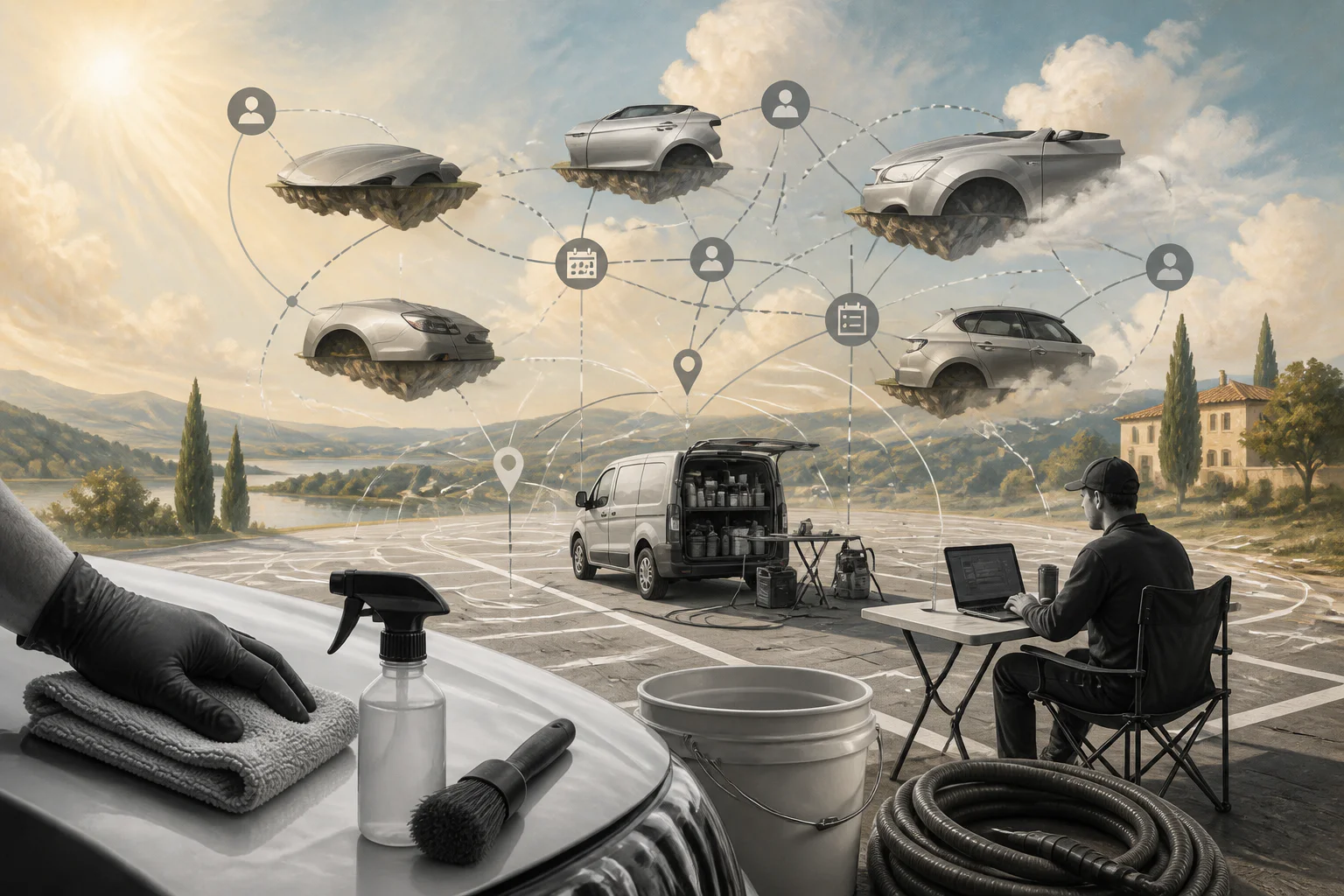
You can validate mobile detailing demand before buying a van, hiring employees, or opening a shop.
If you want to start mobile detailing business operations quickly, the mistake is treating equipment as the business. Equipment matters, but the real business is a system for attracting customers, quoting jobs, scheduling service, coordinating detailers, collecting payment, and making sure every vehicle is handled consistently.
Mobile detailing is attractive because customers already understand the service. They want cleaner cars, protected paint, better interiors, and convenience. S&P Global Mobility reported that the average U.S. vehicle age reached 12.8 years in 2025, which means more people are maintaining vehicles they plan to keep longer. That creates steady demand for detailers who can come to the customer instead of requiring a shop visit.
The fastest path is not to buy a full detailing rig first. Start with a clear offer, a branded customer platform, a small network of independent detailers or partner providers, and a simple operating process. Then validate demand before investing in expensive equipment, dedicated vehicles, or staff.
What’s in this article?
- Why mobile detailing works as a low-overhead service business
- What you need before accepting the first booking
- How to price mobile detailing packages
- How to get first customers without overspending
- How Workhint helps launch the business as a branded platform
- A 7-day launch plan, checklist, and FAQ
Why This Business Works
Mobile detailing works because it sells convenience around a recurring need. Customers may not detail their cars every week, but families, commuters, real estate agents, rideshare drivers, small fleets, and busy professionals all have reasons to pay for cleaner vehicles without losing time at a shop.
The business can also start narrow. You do not need to offer ceramic coatings, paint correction, fleet contracts, and interior restoration on day one. A first version can offer three simple packages: maintenance wash, interior reset, and full detail. That is enough to test whether people in your service area will book and pay.
A provider-network model lowers the risk further. Instead of hiring employees immediately, recruit experienced independent detailers who already have skill, basic tools, or availability. Your job is to own the brand, customer experience, booking process, quality standards, and local demand generation.
What You Need To Launch
Start with the operational foundation before the expensive setup. You need a brand, service area, booking flow, pricing menu, customer intake form, insurance research, local license check, and fulfillment plan. Depending on your city, you may also need to understand wastewater rules, mobile vendor requirements, and where water and power can be used legally.
If you personally deliver the first jobs, buy only the essential equipment for your first packages. If you launch with independent providers, confirm what equipment each provider brings and define the standard they must meet. Do not promise services your provider network cannot deliver consistently.
| Launch item | Lean starting range | Notes |
|---|---|---|
| Business registration and local permits | $100-$600 | Varies by state, city, and business structure. |
| Insurance | $100-$300 first month | Ask about general liability, garagekeepers coverage, and mobile operations. |
| Brand and domain | $50-$250 | Keep it local, clear, and easy to remember. |
| Branded booking and operations platform | Low monthly platform cost | Use this before building custom software or stitching tools together. |
| Essential equipment and chemicals | $700-$2,500 | Pressure washer, vacuum, towels, brushes, buckets, sprayers, and core products. |
| Local marketing | $100-$500 | Google Business Profile, neighborhood groups, referrals, flyers, and test ads. |
The lean launch goal is simple: prove that customers will book, providers can fulfill, and pricing supports profit. Upgrade equipment only after the calendar and revenue justify it.
How To Price It
Mobile detailing pricing should reflect service depth, travel time, supplies, provider payout, and the customer segment. Do not price only against cheap car washes. You are selling convenience, time savings, and a better result.
| Package | Example price | Best for | Operational note |
|---|---|---|---|
| Maintenance wash | $60-$100 | Repeat local customers | Keep service radius tight so travel time does not erase margin. |
| Interior reset | $100-$180 | Families, commuters, rideshare drivers | Use intake questions to flag pet hair, stains, or heavy soil. |
| Full detail | $175-$350 | Customers preparing to sell, protect, or refresh a vehicle | Require photos or condition questions before quoting. |
| Fleet maintenance | Custom recurring price | Small businesses with multiple vehicles | Schedule blocks by location to reduce drive time. |
Build margin into every job. If an independent provider fulfills the work, decide the payout before accepting bookings. If you do the first jobs yourself, still price as if the business must eventually pay a provider. That keeps the model scalable.
How To Get First Customers
Start close to where trust already exists. Ask friends, neighbors, coworkers, apartment managers, real estate agents, rideshare drivers, and local business owners whether they would book a mobile detail at your published price. The goal is not compliments. The goal is paid bookings.
Create a Google Business Profile, collect before-and-after photos with permission, ask every satisfied customer for a review, and build referral offers for recurring customers. Neighborhood Facebook groups, Nextdoor, local office parks, gyms, and apartment communities can work well because mobile detailing is location-sensitive.
Keep the first offer simple: one service area, three packages, limited weekly slots, and clear booking rules. Complexity makes a new service business look less reliable.
How Workhint Helps Launch It
Workhint helps you launch mobile detailing as a branded service platform, not just as a calendar and payment form. A customer can land on your branded portal, choose a package, answer vehicle condition questions, upload photos, select a location, request a time, approve a quote, and pay online.
Behind the scenes, Workhint can route the request to your operations dashboard, match it to an available independent detailer, show the provider the job checklist, collect pre-service and post-service photos, track completion, send the customer an invoice or receipt, and handle provider payout steps. That gives you the operating foundation before you buy a dedicated van, open a shop, or hire employees.
For mobile detailing, this matters because the hard part is coordination. Jobs happen in driveways, office parking lots, apartment garages, and fleet yards. Workhint helps standardize the intake, scheduling, customer communication, quality checks, reviews, and reporting so each job feels consistent even when different providers fulfill the work.
First 7-Day Launch Plan
- Day 1: Choose the service area, first customer type, and three launch packages. Avoid complex add-ons until demand is proven.
- Day 2: Set up the branded Workhint customer portal, intake form, customer dashboard, and internal operations view.
- Day 3: Configure quote approvals, booking windows, payment collection, provider payout rules, job checklists, and photo requirements.
- Day 4: Recruit two to five independent detailers or partner providers. Confirm skill, equipment, insurance expectations, service radius, and availability.
- Day 5: Contact first demand sources: neighbors, apartment managers, local fleets, real estate agents, rideshare groups, and office managers.
- Day 6: Route every serious request through the platform. Test whether customers complete the form, accept the quote, and book.
- Day 7: Review demand, pricing, provider readiness, travel time, quality issues, and customer feedback before investing more.
Final Launch Checklist
- Choose a clear mobile detailing brand and service area.
- Check local business registration, licensing, insurance, zoning, and wastewater requirements.
- Create three simple service packages with clear prices and boundaries.
- Configure a branded Workhint portal for intake, quotes, scheduling, payment, and customer updates.
- Recruit independent detailers or providers before selling more capacity than you can fulfill.
- Define job checklists, photo proof, customer review steps, and provider payout rules.
- Launch local outreach before buying a full rig or dedicated vehicle.
- Use paid bookings and completed jobs to decide what equipment or providers to add next.
FAQ
How much does it cost to start mobile detailing?
A lean launch can often start around $1,000 to $3,000 if you use an existing vehicle, buy essential equipment only, and validate demand before upgrading. Costs rise quickly if you buy a dedicated van, high-end equipment, or a shop setup before bookings justify it.
Do I need a license to start mobile detailing?
Requirements vary by city and state. Check business registration, local permits, sales tax rules, zoning, and wastewater regulations before accepting jobs. Insurance is also important because you are working on customer vehicles.
Can I start mobile detailing with no staff?
Yes. You can start solo or with independent detailers instead of employees. If you use providers, set clear service standards, scheduling rules, insurance expectations, checklists, and payout terms before sending them to customer jobs.
What equipment do I need first?
For basic services, focus on a pressure washer or rinseless wash setup, wet/dry vacuum, towels, brushes, buckets, sprayers, core chemicals, and safety supplies. Add polishers, extractors, tanks, generators, and specialty tools only when your packages require them.
How do mobile detailers get first customers?
Start with local outreach, referrals, Google Business Profile, neighborhood groups, apartment communities, office parks, and small fleets. Before spending heavily on ads, test whether people near you will book at profitable prices.
Is mobile detailing profitable?
It can be profitable when pricing accounts for travel time, supplies, insurance, marketing, provider payouts, and rework. Profit usually depends less on equipment and more on tight service areas, clear packages, repeat customers, and consistent job quality.
Conclusion
Mobile detailing is a practical service business because it can start small, sell a service people understand, and grow through repeat customers and local reputation. The smart path is to validate demand first, build a branded platform, coordinate a reliable provider network, and invest in equipment only when bookings prove the opportunity.
With Workhint as the operating foundation, you can launch the customer experience, provider workflow, scheduling, approvals, payments, and quality checks before building a traditional company around the service.
Leave a Reply