


Use service level expectations to forecast work honestly before missed deadlines become the operating rhythm.
Service level expectations for business workflows help teams set realistic timing expectations for requests, approvals, reviews, handoffs, and delivery work. Instead of promising that every item will finish by an arbitrary deadline, the team defines what usually happens, where exceptions appear, and when an item deserves attention.
This matters because most operational workflows are not perfectly repeatable. A vendor request may need legal review. A customer onboarding case may wait on missing documents. A finance approval may depend on budget owner availability. If every workflow target is treated like a fixed promise, teams either overcommit or water the target down until it means nothing.
What service level expectations mean
A service level expectation, often shortened to SLE, is a forecast for how long a work item is expected to take from a defined start point to a defined finish point. The Kanban Guide places service level expectation inside the definition of workflow, alongside work item types, workflow states, WIP control, and explicit policies.
In practical terms, an SLE might say: 85 percent of standard vendor profile updates are completed within three business days after complete intake. That statement is more useful than “vendor updates should be fast” because it defines the item type, start point, finish point, confidence level, and time window.
What’s in this article?
- How SLEs differ from SLAs and ordinary due dates
- A practical workflow for setting service level expectations
- A table operations teams can adapt for common workflow types
- Common mistakes that make SLEs misleading
- Where Workhint fits when expectations need to become live workflow rules
SLE vs SLA vs due date
An SLE is not the same as a service level agreement. An SLA is usually an agreement between parties, often with formal service commitments, escalation terms, remedies, or commercial consequences. NIST describes a service level agreement as a service contract that defines a level of service. An SLE is lighter: it is an operational forecast used to manage flow and expectations.
A due date is also different. A due date says when one item is needed. An SLE says what timing is normally realistic for a class of work. A customer implementation may still have a fixed launch date, but the SLE helps the team understand which requests, approvals, or readiness tasks are aging beyond the normal range before the launch date is at risk.
How to set service level expectations
Start with one workflow, not the whole company. Good candidates include software requests, vendor onboarding, invoice exceptions, customer implementation steps, legal reviews, employee onboarding tasks, content approvals, or field service scheduling. Pick a workflow where timing matters and the team already has some history.
- Define the work item. Decide what counts as one item. A “vendor request” may be too broad if new supplier approval, profile update, contract review, and payment change all behave differently.
- Define start and finish. Start when the request is complete enough for the team to act. Finish when the business outcome is done, not when someone sends a vague update.
- Separate work types. Standard requests, urgent exceptions, high-risk approvals, and incomplete intake should not share one expectation.
- Use historical cycle time. Review completed items and look at how long they actually took. Scrum.org’s SLE guidance frames the expectation as a forecast for elapsed time through the workflow.
- Choose a confidence level. Many teams use a percentile such as 70, 85, or 95 percent. Higher confidence creates a wider window but fewer surprises.
- Define the response policy. Decide what happens when an item approaches or exceeds the SLE. That may trigger review, escalation, reprioritization, or a customer update.
- Review the expectation regularly. Recalculate after volume, staffing, intake quality, tooling, or approval rules change.
A practical SLE table for operations teams
| Workflow | Start point | Finish point | Example SLE | Action when aging |
|---|---|---|---|---|
| Vendor profile update | Complete request submitted | Vendor record updated and confirmed | 85% within 3 business days | Check missing data or owner availability |
| Invoice exception | Exception assigned to AP owner | Exception resolved or escalated | 80% within 2 business days | Escalate to budget owner after day 2 |
| Legal review | Complete packet accepted | Review decision returned | 75% within 5 business days | Confirm priority and required decision date |
| Customer onboarding task | Task enters ready state | Task verified complete | 90% within 4 business days | Flag blocker before customer status review |
The numbers above are examples, not benchmarks. Use them to understand the format. Real SLEs should come from your workflow data, customer expectations, risk tolerance, and team capacity.
What the visual should show
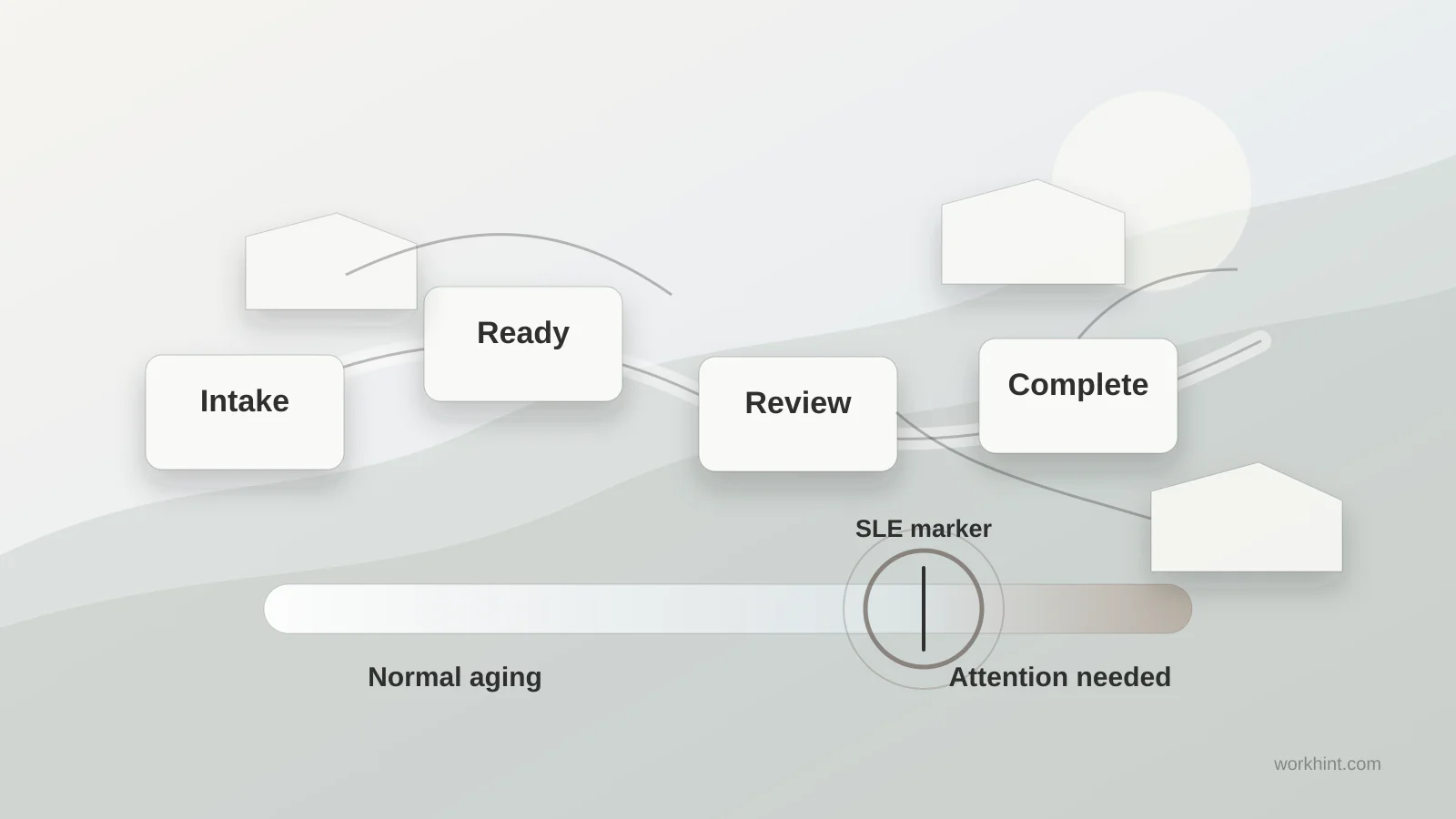
The most useful visual for this topic is a workflow aging map: intake, ready, review, waiting, completed, with an SLE marker showing when an item moves from normal aging to attention needed. It should help the reader see that an SLE is not a deadline pasted on top of work. It is a signal inside the workflow.
Common mistakes
- Using one SLE for all work. Simple requests and complex exceptions behave differently. Blend them together and the forecast becomes noisy.
- Starting the clock too early. If the clock starts before intake is complete, the SLE punishes the delivery team for missing information.
- Confusing SLEs with promises. Kanban Tool’s SLE guidance emphasizes probability and historical cycle time. Treating the number as a guarantee changes the conversation from learning to blame.
- Ignoring blocked time. Waiting on a customer, manager, vendor, or approver is still part of operational reality. Track it separately, but do not pretend it does not exist.
- No response policy. An SLE without an action rule is just reporting. Define who reviews aging work and what choices they can make.
Where Workhint fits
Workhint fits when service level expectations need to become part of the way work actually moves. A team can use workflow automation software to structure intake fields, define work types, assign owners, route approvals, track aging, trigger reminders, escalate exceptions, and report whether SLEs are improving over time.
That is especially useful when work crosses functions. For example, a vendor onboarding request may involve operations, procurement, finance, legal, IT, and the vendor. The SLE should not live only in a spreadsheet. It should appear in the workflow where each owner can see what is waiting, what is aging normally, what is blocked, and what needs intervention.
FAQ
What is a service level expectation?
A service level expectation is a forecast for how long a defined type of work item is expected to take through a defined workflow. It is usually based on historical cycle time and expressed with a confidence level.
How is an SLE different from an SLA?
An SLE is an internal operating forecast. An SLA is usually an agreement or service commitment between parties. An SLE helps a team manage flow; an SLA defines a promise that may have formal consequences.
What confidence level should a team use?
Use a confidence level that matches the workflow risk. A routine internal request may use 70 or 80 percent. A customer-facing or compliance-sensitive workflow may need 85 or 95 percent, with clearer escalation before the threshold is crossed.
Can business teams use SLEs without Kanban?
Yes. Kanban gives SLEs a strong operating context, but any team with defined work items, start and finish points, status tracking, and completion history can use SLEs to improve expectations.
Conclusion
Service level expectations make workflow timing more honest. Define the work item, use real history, separate work types, choose a confidence level, and create a response policy for aging work. The goal is not to make every request look predictable. The goal is to understand what normal looks like, see exceptions earlier, and improve the system behind the work.
Leave a Reply