


A project should not enter delivery until its value, ownership, funding, risks, and decision conditions are visible in one record.
A project approval form template gives a business a consistent way to evaluate proposed work before people, budget, or vendors are committed. The copy-ready resource below captures the request, business case, scope, cost, risks, reviewers, and final decision without turning approval into unnecessary bureaucracy.
Quick answer
A useful project approval form should record the problem, proposed outcome, sponsor, owner, scope, deliverables, estimated cost, resource needs, timeline, dependencies, risks, approval criteria, reviewer comments, and final decision. Use it after initial intake but before kickoff. An approval should state any conditions, funding limits, review date, and who can authorize changes.
What is included in this template?
- A project request summary and business case
- Scope, deliverables, timeline, budget, and resource fields
- A practical approval-criteria matrix
- Risk, dependency, and compliance checks
- Approve, conditionally approve, defer, or reject decisions
- A worked example and implementation checklist
The Association for Project Management describes governance as the framework of authority and accountability controlling project outputs, outcomes, and benefits. The form is therefore more than a signature page: it should make authority, evidence, and conditions explicit.
How to use the project approval form template
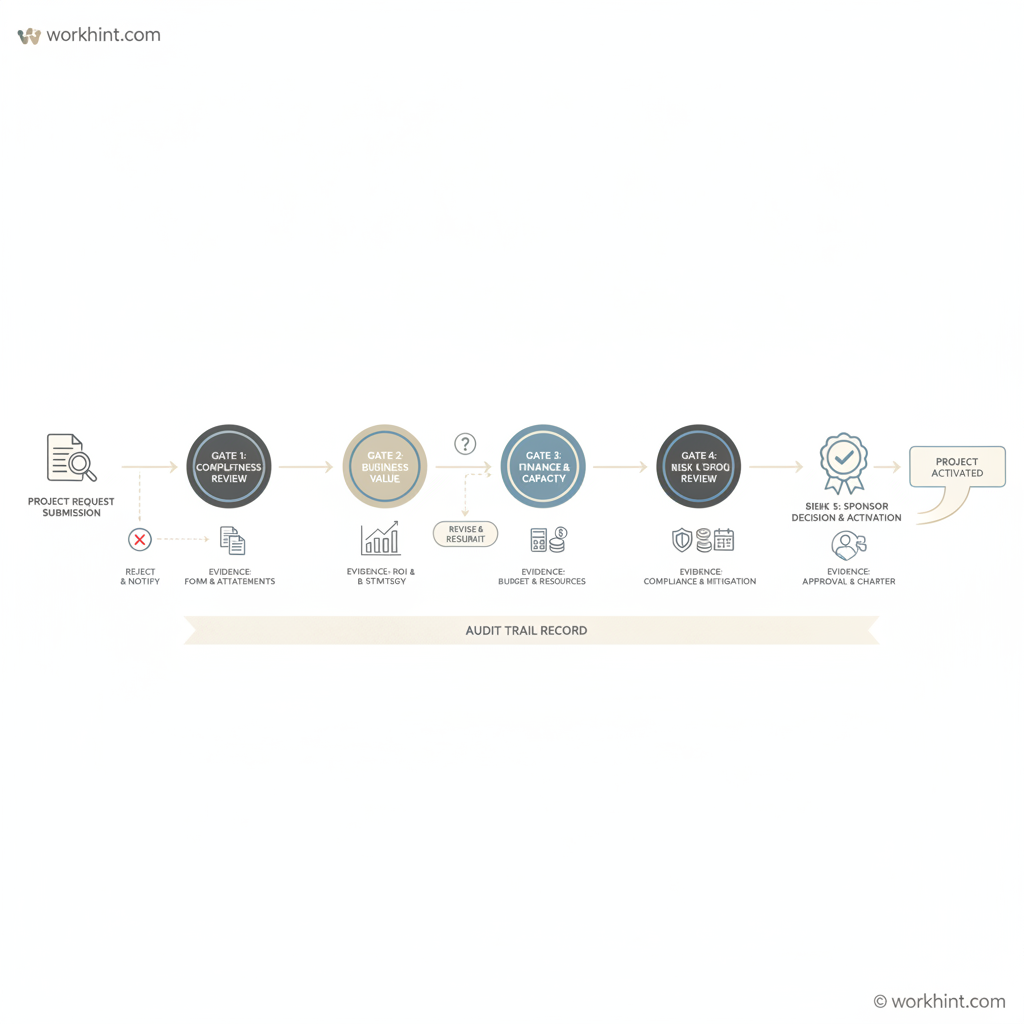
- Submit one complete request. The requester provides the business problem, proposed outcome, scope, cost range, dates, and supporting evidence.
- Check completeness before review. A project coordinator or PMO returns incomplete requests instead of asking approvers to fill gaps during the meeting.
- Route by decision rights. Send financial, security, legal, procurement, or operational reviews only when the request crosses defined thresholds.
- Record a reasoned decision. Approvers choose a decision, explain why, name conditions, and set any expiry or review date.
- Activate approved work. Create the project record, assign the owner, release authorized resources, and schedule the kickoff.
Approval should be proportional. A two-week internal improvement should not follow the same route as a regulated, customer-facing implementation. The UK Government Project Delivery Functional Standard is a useful reference for connecting governance, roles, controls, and decision points across a project lifecycle.
Project approval form template
1. Request and ownership
| Field | What to enter |
|---|---|
| Project name | A short, unique working title |
| Requester | Name, team, and contact details |
| Executive sponsor | Person accountable for value and continued support |
| Proposed owner | Person accountable for delivery |
| Problem or opportunity | Current condition, affected group, and evidence |
| Desired outcome | Observable result and target measure |
A sponsor should do more than sign. APM’s guidance on project sponsorship connects the role with the business case, governance, stakeholder support, and continued project viability.
2. Scope and delivery assumptions
- In scope: processes, teams, locations, systems, and deliverables included.
- Out of scope: adjacent work the project will not deliver.
- Milestones: expected start, key decision dates, launch, and close.
- Resources: named roles, estimated effort, vendors, and specialist support.
- Dependencies: approvals, data, contracts, systems, or other projects required.
- Success measures: baseline, target, measurement owner, and review date.
3. Financial and control review
| Review area | Required evidence | Reviewer |
|---|---|---|
| Business value | Benefits, urgency, strategic fit, and alternatives considered | Sponsor or portfolio lead |
| Budget | Cost range, funding source, contingency, and ongoing cost | Finance or budget owner |
| Capacity | Available roles, workload impact, and backfill needs | Functional leaders |
| Risk | Top risks, impact, owner, and response | Risk or operational owner |
| Security and privacy | Data types, access, retention, integrations, and assessment need | Security or privacy owner |
| Procurement | Vendor need, sourcing route, contract status, and lead time | Procurement or legal |
4. Approval criteria
- The outcome is specific and connected to a documented business need.
- A sponsor and delivery owner have accepted their responsibilities.
- Scope, exclusions, assumptions, and dependencies are understandable.
- Funding and required capacity are available or conditionally reserved.
- Material risks have owners and acceptable responses.
- Success can be measured at a defined checkpoint.
5. Decision record
Decision: Approve / Conditionally approve / Defer / Reject
Reason: [Evidence-based explanation]
Conditions: [Required actions, limits, or evidence]
Decision owner: [Name and role]
Decision date: [Date]
Valid until or review date: [Date]
Next step: [Kickoff, revision, escalation, or closure]
Project approval example
A customer operations team proposes a self-service returns portal. The form names the operations VP as sponsor, a product manager as owner, and a target of reducing return-handling time by 30%. The request estimates $45,000 in implementation cost, identifies customer-data access and warehouse integration as risks, and requires security and finance review.
The sponsor conditionally approves the project with two conditions: security must approve the data flow, and finance must confirm the integration budget by October 15. The approval expires if those conditions are not met within 30 days. The team can now distinguish authorization from open prerequisites instead of treating a meeting comment as permission to start.
Common project approval mistakes
- Asking for a signature without documenting the evidence reviewed
- Approving an idea before confirming an accountable sponsor and owner
- Using vague outcomes such as “improve efficiency” without a baseline
- Leaving conditions in email instead of the formal decision record
- Routing every request to every function regardless of risk or value
- Failing to define what happens after approval, deferral, or rejection
Where Workhint fits
A static form captures the proposal, but the approval still needs routing, ownership, reminders, conditions, and a reliable handoff into delivery. Workhint can turn this template into a live process: validate intake, route reviews by budget or risk, collect evidence, record decisions, assign conditional actions, and activate the approved project.
Teams can use Workhint’s project workflow software to connect the approval record with roles, permissions, milestones, deliverables, status reporting, and change control. The form remains the decision asset; the system keeps the work moving and auditable.
FAQ
When should a project approval form be used?
Use it after a request is developed enough to evaluate but before kickoff, purchasing, vendor commitments, or substantial staff allocation.
Who should approve a project?
The decision owner should have authority over the required budget, risk, and capacity. Specialist reviewers may advise or clear controls without owning the final business decision.
What is the difference between project intake and project approval?
Intake captures and triages a request. Approval evaluates a sufficiently developed proposal and authorizes, conditions, defers, or rejects it.
Can a project be approved with conditions?
Yes. State each condition, owner, due date, evidence required, and whether work may begin before the condition is closed.
How long should project approval remain valid?
Set an expiry or review date when costs, capacity, assumptions, or risks may change. Revalidate the decision if a material condition changes.
Conclusion
A strong project approval form creates a defensible starting decision. Capture the business need, owner, scope, funding, resources, risks, criteria, conditions, and next step in one place. Then route the record through the right reviewers and convert an approved proposal into controlled delivery.
Leave a Reply