


Paying a Finnish contractor is simple only after finance has settled classification, tax, invoice, and bank-control questions.
To pay contractors in Finland reliably, a business needs more than a bank account and an approved invoice. The payment process should confirm the engagement is genuinely independent, capture the right supplier and tax records, define euro and fee terms, validate each invoice, and preserve evidence from approval through reconciliation.
Quick answer
Businesses can usually pay a properly classified Finnish contractor against an invoice by SEPA credit transfer or a contractor payment platform. Before paying, verify the contractor’s identity and business details, review Finland’s Prepayment Register where relevant, document VAT treatment, approve completed work, confirm beneficiary data independently, and reconcile the payment to the contract and invoice.
What’s in this article?
- The checks to complete before the first payment
- How Finnish tax and VAT details affect invoice review
- Which payment methods fit euro and cross-border payments
- A seven-step operational workflow for finance teams
- Common controls that prevent delays and payment errors
Why paying contractors in Finland needs a defined process
Finland uses the euro, and ordinary euro bank payments can move through the Single Euro Payments Area. The European Payments Council explains that SEPA Credit Transfer supports one-off, recurring, single, and bulk euro payments. That makes the transfer itself straightforward. The harder part is deciding whether the payee should be treated as a contractor, what tax or VAT evidence belongs in the file, and who may approve changes to payment instructions.
A contractor label in an agreement does not settle employment status. The practical relationship matters. Finance should escalate engagements that look like employment, especially when the company controls how, when, and where the person works. Finland’s Occupational Safety and Health Administration describes the characteristics used to identify an employment relationship. Local legal or tax advice is appropriate when the facts are mixed.
What should you collect before the first payment?
Create one contractor record rather than spreading evidence across email, procurement, and accounting systems. At minimum, collect:
- Legal name, address, and Finnish Business ID when the contractor operates through a registered business
- Signed services agreement, scope, rates, deliverables, and payment schedule
- Invoice requirements, currency, fee allocation, and approved payment method
- Tax and VAT identifiers applicable to the engagement
- Bank account holder name, IBAN, and any required BIC
- Independent confirmation of beneficiary details, especially after a change request
- Evidence of work acceptance and the named business approver
For Finnish suppliers, check the Finnish Tax Administration’s Prepayment Register guidance. Registration generally shows that the business or self-employed person handles its own prepayments. The guidance also explains when a Finnish customer may need to withhold tax if a provider is not registered. A foreign payer should confirm its own obligations rather than assume the Finnish domestic rule applies identically.
How should VAT and tax records be handled?
VAT treatment depends on the parties, service, and place-of-supply rules. Do not automatically add or remove Finnish VAT because the contractor is located in Finland. Review the supplier’s VAT status and invoice wording, then document why domestic VAT, a reverse charge, or another treatment applies. The Finnish Tax Administration maintains current international VAT guidance.
A US business may also need documentation establishing the foreign payee’s status, commonly an appropriate Form W-8. The IRS instructions for Form W-8BEN explain the form’s use for foreign individuals. Tax forms are not substitutes for classification analysis, and requirements vary by payer country, contractor entity type, and service location.
This article is operational guidance, not legal or tax advice. Confirm classification, withholding, reporting, and VAT treatment for the actual engagement.
A seven-step Finland contractor payment workflow
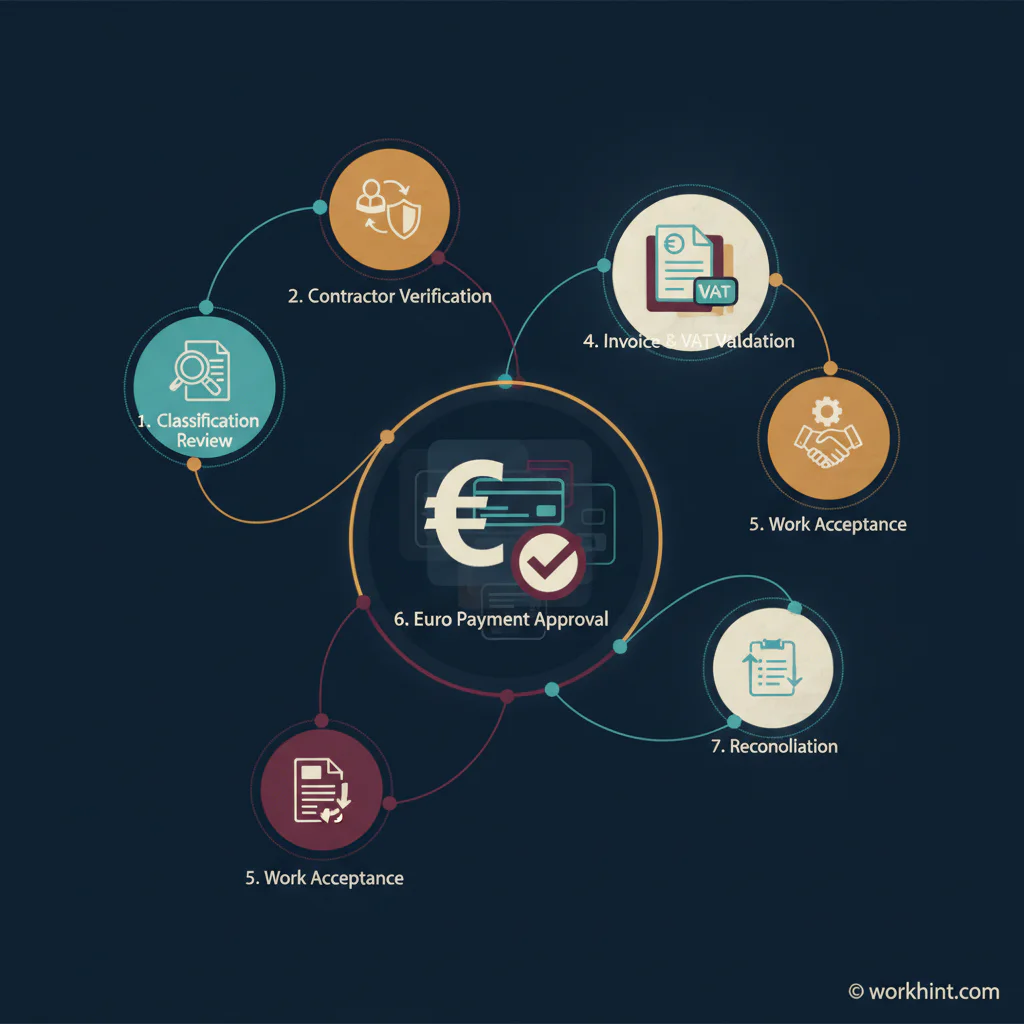
- Review classification. Record why the relationship is independent and route ambiguous cases to legal or tax review.
- Verify the contractor. Match the legal name, Business ID where applicable, tax details, and account holder. Check the Prepayment Register when relevant.
- Set payment terms. Define rates, milestones, invoice timing, euro or another agreed currency, FX responsibility, transfer fees, and dispute handling.
- Validate the invoice. Match the invoice to the agreement, accepted work, VAT treatment, purchase order or project code, and beneficiary record.
- Approve the payment. Separate work acceptance from payment release. Use thresholds and a second approver for material amounts or changed bank details.
- Execute through the right rail. Use SEPA for eligible euro payments; use a platform or international transfer when multi-currency handling, consolidated payouts, or additional tracking is needed.
- Reconcile and retain evidence. Attach the payment reference, bank confirmation, exchange rate and fees, accounting entry, and exception notes to the contractor record.
Which payment method should a business use?
| Method | Best fit | Main control |
|---|---|---|
| SEPA credit transfer | Routine euro payments to a Finnish IBAN | Verify beneficiary data and use a consistent remittance reference |
| International wire | Non-euro payments or banks outside SEPA | Document FX rate, intermediary fees, and who absorbs charges |
| Contractor payment platform | Many contractors, currencies, entities, or approval paths | Reconcile platform status and fees to the ledger |
| Card or wallet | Limited exceptions where the contractor accepts it | Confirm limits, ownership, fees, and refund handling |
Avoid choosing a method on speed alone. Finance should compare total cost, settlement certainty, payment traceability, contractor preference, and the effort required to reconcile exceptions.
Common mistakes that delay Finland contractor payments
- Treating the contract label as proof of independent status
- Skipping the Prepayment Register or business-detail review
- Using inconsistent VAT treatment across similar invoices
- Leaving currency and transfer-fee responsibility undefined
- Accepting a bank-change request through the same email channel that requested it
- Paying before the business owner records work acceptance
- Recording one bulk debit without contractor-level reconciliation
Where Workhint fits
Workhint can turn this policy into a controlled operating flow: contractor intake, document collection, role-based review, invoice routing, work acceptance, payment approval, exception handling, and status reporting. For teams managing repeat or multi-country payouts, a connected approach to contractor payment operations helps keep the agreement, approval evidence, payment status, and reconciliation record together without making the article’s tax decisions for the business.
FAQ
Can a foreign company pay a contractor in Finland?
Generally yes. The company should first confirm that the engagement is genuinely independent and identify any registration, tax, VAT, withholding, or reporting obligations in the countries involved.
Should Finnish contractors be paid in euros?
Euros are usually operationally efficient for a contractor with a Finnish euro account, particularly through SEPA. Another currency can be agreed, but the contract should state the conversion source, timing, spread, and fee responsibility.
Does a Finnish contractor need to be in the Prepayment Register?
Registration is not universally mandatory, but it affects how Finnish customers handle payments for work. Check the current register and obtain advice on whether the payer has a withholding obligation.
How often should beneficiary details be verified?
Verify them before the first payment and independently confirm every change. Higher-risk businesses may also schedule periodic revalidation for inactive or high-value contractor records.
Conclusion
The safest way to pay contractors in Finland is to make the payment the final step of a documented workflow. Confirm status, verify the supplier, settle tax and VAT treatment, validate the invoice, approve the work, protect beneficiary changes, and reconcile the transfer. That discipline reduces delays without turning every routine euro payment into a manual investigation.
Leave a Reply