


An AP SLA works only when every handoff, exception, and clock rule is explicit.
An accounts payable service level agreement defines what the AP team, approvers, requesters, and vendors can expect from the invoice-to-payment process. The useful version is not a promise to pay every invoice in a fixed number of days. It sets measurable response targets while preserving approval, fraud, tax, and duplicate-payment controls.
Quick answer
An accounts payable SLA should define the service covered, required invoice inputs, when measurement starts and pauses, targets for validation and approval, exception priorities, owner responsibilities, escalation rules, and reporting metrics. Targets should separate AP processing time from requester and approver delays, so the team can improve the actual bottleneck without weakening financial controls.
What is in this guide?
- The difference between a useful SLA and a vague turnaround promise
- A practical framework for invoice intake, review, approval, and exceptions
- Sample measures finance teams can adapt to their risk and payment calendar
- Common design mistakes and a quarterly review process
Why an accounts payable service level agreement matters
Without shared service levels, every delay looks like an AP problem. In reality, an invoice may arrive without a purchase order, sit with an approver, fail a bank-detail check, or miss a scheduled payment run. One end-to-end target hides those causes.
A well-designed SLA separates controllable processing time from waiting time. That creates better vendor communication, more predictable cash planning, and evidence for fixing broken handoffs. It also prevents speed from overriding control. The COSO internal control framework emphasizes that controls support reliable operations and information; an SLA should operate inside those controls, not around them.
What should an accounts payable SLA include?
1. Service scope and entry criteria
Define which invoices are covered: purchase-order invoices, non-PO invoices, contractor invoices, credit memos, or urgent payment requests. State the minimum complete package for each type. Typical inputs include the legal vendor name, invoice number and date, PO or cost owner, tax information, payment terms, remittance details, and evidence of receipt.
The service clock should begin only when the required package reaches the designated channel. If the package is incomplete, record the missing item, return it to the owner, and pause the relevant clock.
2. Clock rules and service targets
Use targets for each stage rather than one promise for the entire process. Define business hours, holidays, cutoff times, and whether a target means first response, completed review, approved status, or payment release. A target such as “review within two business days” is more auditable than “process promptly.”
3. Priority and exception classes
Not every exception deserves the same queue position. Separate routine missing information from high-risk changes, possible duplicates, sanctions concerns, disputed amounts, and payment failures. High-value or bank-detail-change requests may need additional verification even when a discount or due date is approaching.
4. Ownership and escalation
Name the owner for intake, coding, matching, business approval, vendor master changes, treasury release, and vendor communication. Then define escalation by elapsed time and risk. Escalation should identify who decides, not merely who receives another notification.
A practical accounts payable SLA framework
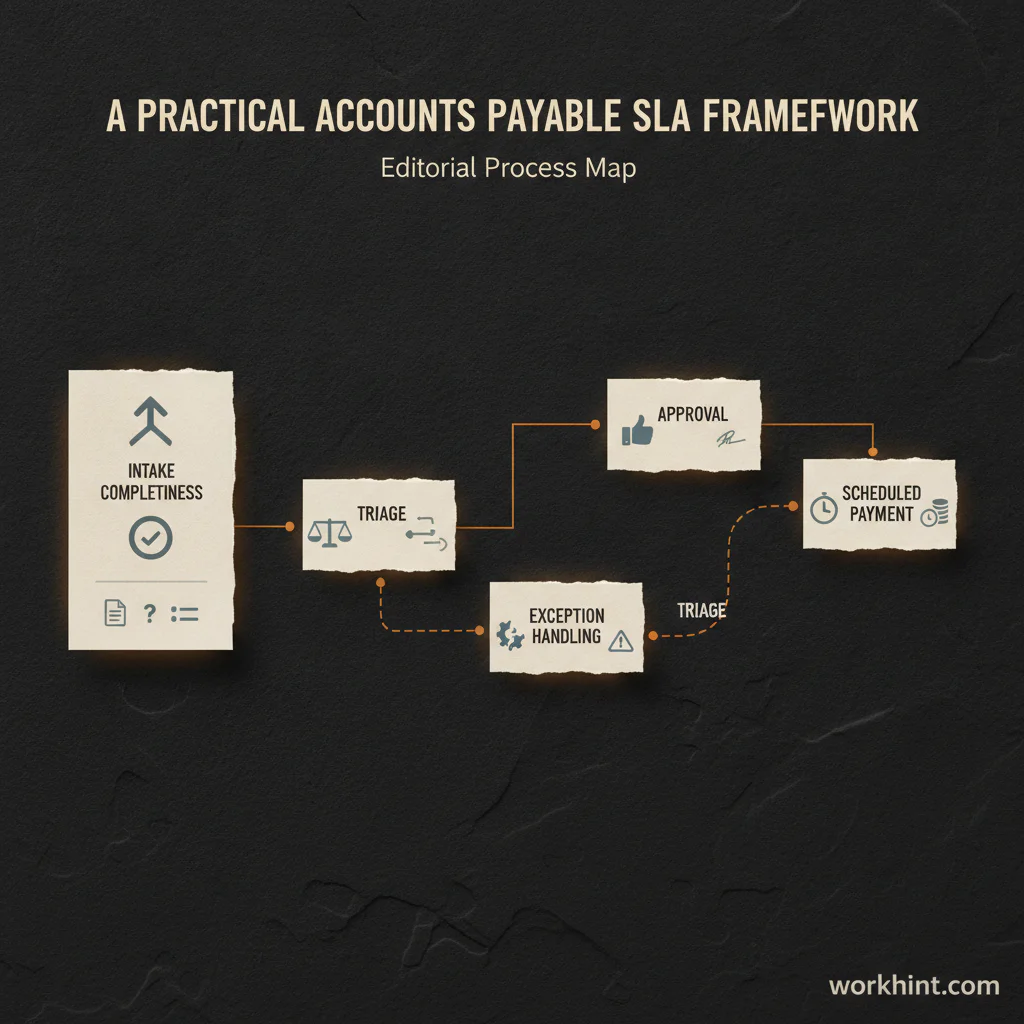
| Stage | Example service target | Clock rule | Primary owner |
|---|---|---|---|
| Intake validation | One business day | Starts when required fields and documents arrive | AP intake |
| Coding or matching | Two business days | Pauses while documented information is missing | AP processor |
| Business approval | Two business days | Measured separately from AP handling time | Budget owner |
| Risk exception | Same-day triage | Resolution time depends on verification needed | AP control owner |
| Payment scheduling | Next eligible payment run | Requires approved, control-cleared status | Treasury or payments |
These are design examples, not universal benchmarks. Compare performance with peer data such as APQC accounts payable benchmarks, but set targets around your invoice mix, approval model, risk tolerance, staffing, and payment calendar.
How to implement the SLA
- Map the current workflow. Record every queue, handoff, approval, control check, and external dependency.
- Define complete intake. Agree on required fields and documents for each invoice class.
- Measure a baseline. Track stage-level cycle time, waiting time, exception rate, and rework before choosing targets.
- Set targets by risk. Give routine work predictable targets while preserving enhanced review for sensitive changes.
- Configure alerts and escalations. Notify the current owner before a target is missed and escalate unresolved high-risk items sooner.
- Publish a service catalog. Tell requesters what to submit, where to submit it, and what status updates mean.
- Review quarterly. Adjust targets when volume, staffing, controls, systems, or payment calendars change.
Metrics that make the SLA useful
- Percentage of invoices complete at first submission
- Median AP touch time by invoice class
- Approval waiting time by owner or department
- Exception rate and first-pass resolution rate
- Percentage completed within the stage-level target
- Late payments caused by AP, approver, vendor, or payment-channel delay
- Reopened cases and repeat exception causes
Report medians and distributions, not only averages. Averages can conceal a small group of severely delayed invoices. Pair service metrics with control outcomes such as duplicate attempts caught, bank changes verified, and approvals completed with evidence.
Common SLA mistakes
Promising payment by the due date regardless of intake. Finance cannot meet a reliable target when an invoice arrives late or incomplete. Define the dependency.
Counting all waiting time as AP time. Separate processing, approval, requester, and vendor clocks so accountability is fair.
Rewarding speed without quality. A short cycle time is not a success if it increases duplicate payments, coding errors, or unauthorized releases.
Using one target for every invoice. PO matches, non-PO invoices, international contractors, and bank-detail changes have different work and risk.
Where Workhint fits
An SLA becomes operational when the system knows the current owner, required evidence, timer state, approval path, and escalation rule. Workhint can turn the design into role-based intake, validation steps, approvals, exception queues, reminders, and reporting. Teams evaluating approval workflow software can use the SLA as the specification for what should be routed, measured, and audited.
FAQ
What is an SLA in accounts payable?
It is a documented agreement that defines AP services, required inputs, stage-level response or completion targets, owner responsibilities, exceptions, and reporting rules.
When should the AP SLA clock start?
Start it when the invoice reaches the approved intake channel with the required information. Define how the clock pauses when the team is waiting for documented input or verification.
Should the SLA guarantee a payment date?
Usually it should guarantee processing and response standards, then link approved invoices to the next eligible payment run. A payment date still depends on complete documentation, approval, controls, terms, and banking execution.
How often should an AP SLA be reviewed?
Review it at least quarterly and whenever invoice volume, staffing, payment calendars, controls, or systems materially change.
Conclusion
A strong accounts payable SLA is a control-aware operating agreement. Define complete intake, measure each stage separately, route exceptions by risk, and make ownership visible. The result is not simply faster invoices; it is a process finance can explain, improve, and audit.
Leave a Reply