


Reliable AI automation starts when every model response arrives in a shape the rest of the business can safely use.
LLM structured outputs let teams replace brittle prose parsing with responses that follow a defined data contract. That matters when an AI result must create a record, route a request, calculate a priority, or trigger an approval. A valid structure is only the first control, however. Production workflows also need semantic checks, policy rules, failure handling, and clear human ownership.
Quick answer
Use LLM structured outputs when a model response will feed software or move business work. Define a narrow JSON Schema, require explicit fields and enums, validate the response again in your application, and route refusals, missing evidence, policy exceptions, and low-confidence cases to review. Treat the schema as a versioned interface rather than a formatting prompt.
What’s in this article?
- What structured outputs solve and what they do not
- How to design a schema for operational work
- A production control model for validation and routing
- A practical implementation sequence and business example
- Failure modes, governance, and where Workhint fits
What are LLM structured outputs?
Structured outputs constrain a model response to a machine-readable schema instead of asking for “JSON” and hoping the fields remain consistent. The OpenAI structured outputs guide distinguishes schema adherence from JSON mode: valid JSON can still omit a required key or return an invalid category, while schema-conforming output must satisfy the supported contract. Google’s Gemini documentation similarly describes schema-based JSON responses and notes that applications should still validate business values.
This improves interface reliability, but it does not prove the answer is correct. A model can return a perfectly valid object with the wrong supplier ID, an unsupported recommendation, or a plausible but ungrounded explanation. Structure controls syntax; the workflow must control meaning and consequences.
Why structured output design matters to business automation
Free-form text forces downstream systems to guess. A changed label can break a parser, an omitted field can stall a handoff, and an unexpected value can send work to the wrong queue. A schema creates a stable boundary between probabilistic reasoning and deterministic operations.
| Control | What it prevents | Owner |
|---|---|---|
| Schema validation | Missing fields, wrong types, invalid enums | Engineering |
| Semantic validation | Unknown IDs, impossible dates, unsupported totals | Application service |
| Policy rules | Unauthorized actions or threshold violations | Operations or compliance |
| Human review | High-impact or ambiguous decisions moving automatically | Named approver |
| Audit record | Untraceable prompts, decisions, edits, and actions | System owner |
How to design an LLM structured output schema
- Begin with the downstream decision. Define what the next system needs to route, approve, or store. Do not expose every model observation simply because it is available.
- Use explicit types and bounded values. Prefer enums such as `approve`, `review`, and `reject` over open-ended status text. The JSON Schema guide explains how required properties, types, arrays, and constraints describe valid data.
- Separate evidence from judgment. Store source references or extracted facts separately from a recommended action. Reviewers should see why the model reached the result.
- Represent uncertainty operationally. Add fields such as `review_required`, `reason_code`, or `missing_information`. Avoid treating a self-reported confidence score as proof.
- Design for refusal and incomplete output. Your application needs a safe state when the provider refuses, the response is truncated, or the requested schema cannot be satisfied.
- Version the contract. Record a schema version with every result. Test consumers before adding required fields or changing enum meanings.
A production control model for structured outputs
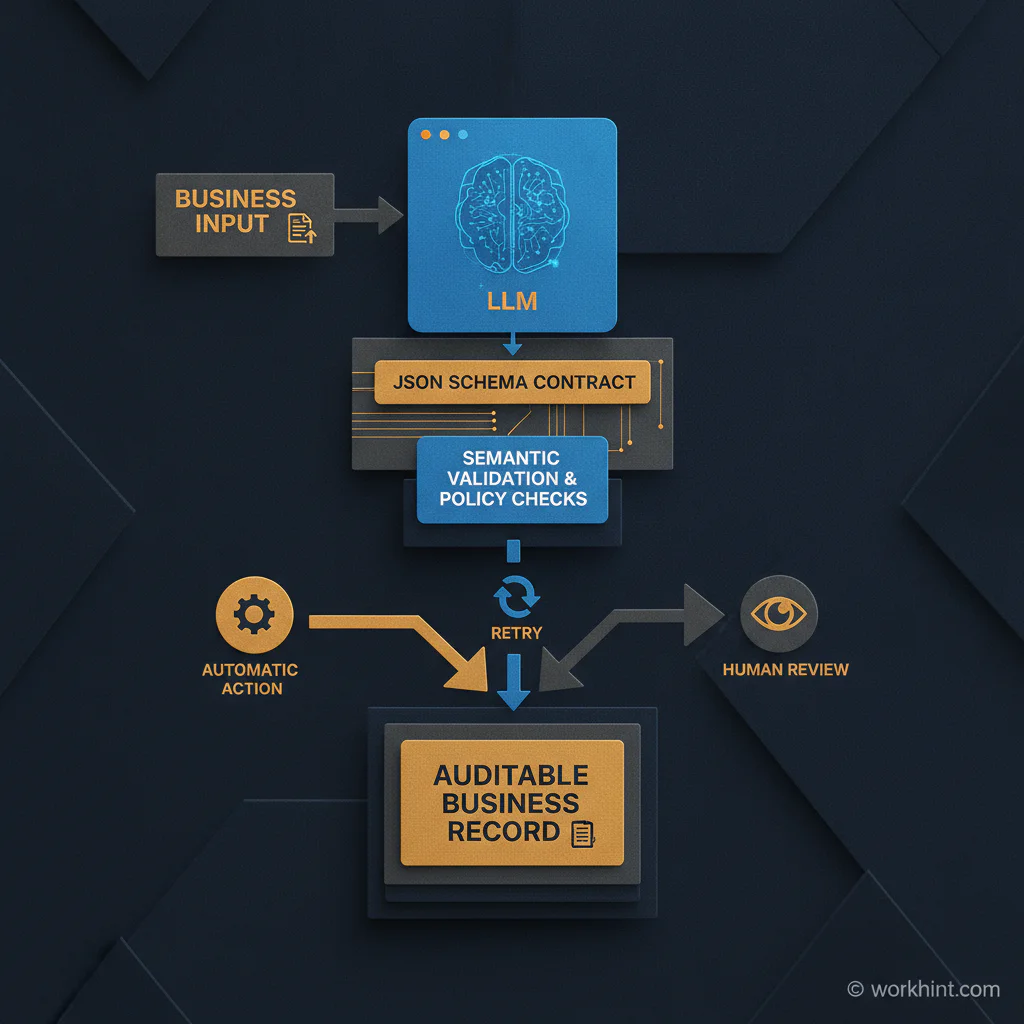
Place the model inside a controlled pipeline: input validation, model call, schema validation, semantic validation, policy evaluation, routing, and audit logging. Only low-risk results that pass every gate should move automatically. Everything else should enter a retry, exception, or human-review path.
This layered approach aligns with the NIST AI Risk Management Framework, which treats risk management as part of designing, using, and evaluating AI systems. In practice, that means defining who owns the schema, who may change routing rules, what is logged, and which decisions require human authority.
Practical example: routing a vendor request
Suppose an operations team receives vendor requests by email and form. An LLM extracts `vendor_name`, `request_type`, `requested_amount`, `country`, `evidence`, and `recommended_route`. The schema requires every field and limits the route to approved values.
The workflow then checks the vendor against the master record, validates the amount, confirms that evidence links exist, and applies policy. A renewal below a defined threshold with a known vendor can move to the standard approval queue. A new vendor, missing tax document, conflicting amount, or restricted country goes to a specialist. The model proposes structure and context; deterministic controls decide whether work can advance.
Common structured output mistakes
- Using valid JSON as the success test. Syntax does not establish factual or policy correctness.
- Building one giant schema. Large, deeply nested contracts are harder to test and more expensive to change. Use task-specific interfaces.
- Allowing arbitrary labels. Unbounded strings create silent routing variants such as `needs-review`, `review_needed`, and `manual check`.
- Retrying every failure unchanged. Separate transient provider errors from invalid input, policy exceptions, and genuine ambiguity.
- Letting the model authorize its own action. High-impact permissions, payment releases, access changes, and external messages need deterministic rules or human approval.
- Changing schemas without consumer tests. A seemingly harmless field change can break integrations, reports, and historical comparisons.
Where Workhint fits
The LLM produces the structured analysis; Workhint coordinates what happens around it. Teams can use Workhint as a configurable workflow automation platform to capture intake, apply role-based permissions, assign review, route approvals, collect missing documents, schedule follow-ups, track exceptions, and preserve operational records. This keeps model output connected to accountable work rather than treating the model as the system of record.
FAQ
Are structured outputs the same as JSON mode?
No. JSON mode aims to return syntactically valid JSON. Structured outputs add a supplied schema and, where supported, enforce that contract. Your application should still validate the result and its business meaning.
Do structured outputs prevent hallucinations?
No. They prevent many formatting failures, not factual errors. Ground important fields in source data, verify identifiers and calculations, and require review for consequential decisions.
Should every LLM response use a schema?
Use a schema when software will consume the response or the result will move work. Free-form text can remain appropriate for brainstorming, explanation, or low-risk drafting.
What should trigger human review?
Use review for missing evidence, conflicting data, policy exceptions, novel cases, high-value actions, sensitive data, or decisions that affect access, money, employment, safety, or external communication.
How should teams test a structured output workflow?
Test normal, missing, contradictory, malicious, oversized, and out-of-policy inputs. Measure schema failures, semantic failures, retries, review rates, routing accuracy, and downstream completion.
Conclusion
LLM structured outputs make AI responses easier to integrate, but production reliability comes from the full control system. Start with a narrow schema, validate meaning after structure, separate evidence from recommendations, route risky cases to people, and preserve a versioned audit trail. That is how a model response becomes dependable business work.
Leave a Reply