


A good tolerance policy clears harmless variances automatically while forcing risky invoice differences into a documented review.
Invoice matching tolerance determines how much an invoice may differ from a purchase order or receipt before accounts payable stops it for review. Set the threshold too tightly and small freight, tax, rounding, or quantity differences create a queue. Set it too loosely and overbilling can pass without scrutiny. The right policy balances processing speed with financial control.
Quick answer
Set invoice matching tolerances by variance type, transaction value, supplier risk, and evidence quality. Use both percentage and absolute caps, apply tighter rules to high-risk spend, route exceptions to a named owner, and log every override. Review thresholds quarterly using exception volume, approval time, recovered value, and post-payment error data.
What’s in this article?
- How invoice tolerance works in two-way and three-way matching
- A practical method for setting thresholds
- A risk-based tolerance matrix
- Controls for exceptions and overrides
- Metrics for improving the policy over time
What is invoice matching tolerance?
An invoice matching tolerance is an approved variance between the supplier invoice and the documents used to validate it. In two-way matching, the invoice is compared with the purchase order. In three-way matching, the receiving record is added, so the team can test what was ordered, what arrived, and what was billed.
Microsoft’s invoice matching documentation describes common checks at the invoice-total, line, price, and quantity levels. Oracle’s invoice tolerance guidance likewise shows that systems can evaluate several variance types and place invoices outside policy on hold. The software setting matters, but the finance policy behind it matters more.
A threshold should never mean that every variance below it is acceptable. It means the variance may follow a lower-friction path when the supplier, order, receipt, coding, and documentation meet the policy’s other conditions.
How should accounts payable set invoice tolerance rules?
- Map the variance types. Separate unit-price, quantity, freight, tax, currency, and total-value differences. Each has a different cause and control owner.
- Analyze actual exceptions. Review three to six months of invoices. Identify recurring harmless differences, genuine errors, supplier-specific patterns, and amounts recovered through review.
- Use dual thresholds. Combine a percentage limit with an absolute currency cap. A 2% variance may be immaterial on a small invoice but unacceptable on a $500,000 order.
- Segment by risk. Consider spend category, supplier history, contract structure, payment method, fraud exposure, and whether a receipt is reliable.
- Assign decision owners. AP can resolve document issues, but price changes may require procurement and quantity differences may require the receiver or project owner.
- Test before automating. Run proposed thresholds against historical invoices to estimate straight-through processing, review volume, and financial leakage.
- Document the rule. Record the threshold, scope, exclusions, owner, effective date, approval authority, and review date.
Invoice matching tolerance matrix
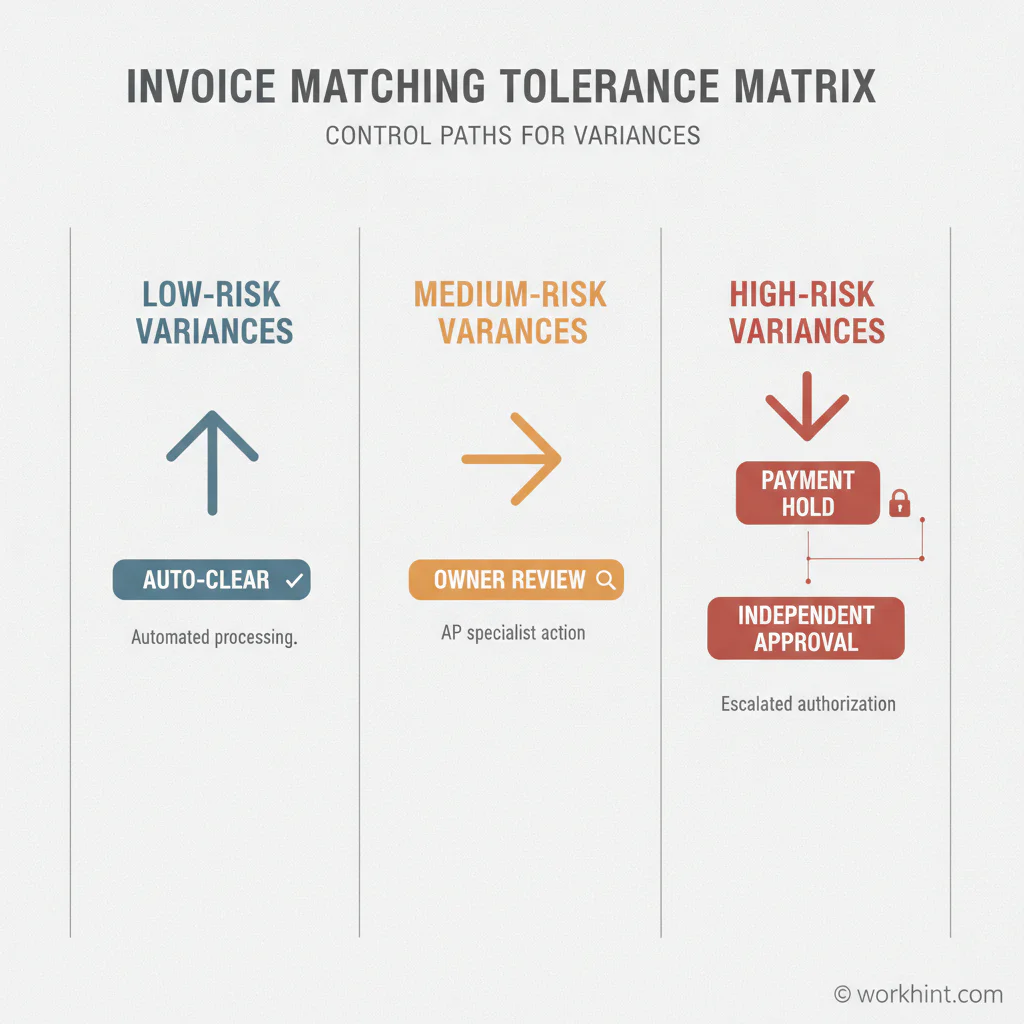
| Risk level | Typical situation | Suggested treatment | Required evidence |
|---|---|---|---|
| Low | Established supplier, low-value purchase, consistent receipts | Auto-clear within both percentage and amount caps | Approved PO, receipt, valid invoice |
| Medium | Recurring services, freight differences, moderate spend | Route to budget or procurement owner | Contract or rate card plus owner confirmation |
| High | New supplier, sensitive bank change, large or unusual variance | Block payment pending independent approval | PO, receipt, contract, change evidence, approval log |
These are decision patterns, not universal limits. A company should choose actual percentages and currency amounts from its transaction data, materiality policy, audit requirements, and risk appetite. Separate thresholds may also be needed by legal entity and currency.
What should happen when an invoice exceeds tolerance?
The exception path should preserve context. The reviewer needs the invoice, purchase order, receipt, contract, variance calculation, supplier history, and prior decisions in one place. Routing only an email saying “please approve” creates delay and weak evidence.
- Classify the variance automatically.
- Place the invoice on a payment hold.
- Route it to the correct owner with a due date.
- Require a coded decision: correct the invoice, change the PO, accept the variance, request a credit, or reject payment.
- Escalate overdue reviews based on payment date and materiality.
- Release the hold only after the required evidence and approval are captured.
Keep exception authority separate from payment-release authority where practical. That makes it harder for one person to approve a variance and move the same payment without independent review.
How should tolerance overrides be controlled?
An override is a policy decision, not a shortcut. Limit override permissions by role and amount. Require a reason code, free-text explanation, supporting document, approver identity, and timestamp. Temporary supplier-specific rules should expire automatically instead of becoming permanent through neglect.
Review override reports for repeated behavior. If one supplier repeatedly bills just inside the limit, or one buyer routinely changes purchase orders after invoicing, the apparent efficiency may be hiding contract, procurement, or control failures.
Which invoice tolerance metrics should teams track?
- Straight-through match rate: invoices cleared without manual review
- Exception rate by variance type: where mismatches originate
- Median resolution time: how long held invoices wait
- Override rate by user and supplier: concentration of discretionary decisions
- Recovered or avoided value: credits, corrections, and blocked overpayments
- Post-payment error rate: problems discovered after release
Do not optimize only for touchless processing. A rising auto-match rate is not progress if credits, duplicate payments, or supplier disputes also rise. Finance should review the combined control and efficiency picture each quarter.
Where Workhint fits
Workhint can turn a tolerance policy into an operating workflow: collect invoice and order context, calculate routing conditions, assign the right reviewer, enforce approval limits, escalate overdue exceptions, and keep a decision history. Teams can automate the approval and exception workflow while their ERP or accounting system remains the financial system of record.
Frequently asked questions
Should invoice tolerance be a percentage or an amount?
Use both. The invoice should pass only when it stays within the percentage limit and the absolute currency cap. This prevents a small percentage on a large invoice from creating a material overpayment.
Can different suppliers have different tolerances?
Yes, when the difference is risk-based and documented. Supplier history, spend type, contract terms, receipt quality, and fraud exposure can justify different treatment. Avoid informal exceptions that have no owner or expiry date.
How often should invoice tolerance rules be reviewed?
Quarterly is a practical operating rhythm, with immediate review after a control failure, audit finding, acquisition, ERP change, or material shift in transaction mix.
Does a tolerance replace invoice approval?
No. Tolerance determines how matching variances are handled. Approval still confirms that the purchase was authorized, coded correctly, supported by evidence, and ready for payment.
Conclusion
Effective invoice matching tolerance rules are specific, risk-based, and measurable. Start with historical exceptions, combine percentage and amount caps, route each mismatch to a named owner, control overrides, and review outcomes regularly. That approach removes unnecessary manual work without weakening payment controls.
Leave a Reply