


The wrong choice leaves either capable software without an operator or an outsourced team without a reliable system of record.
Comparing MSP vs VMS in staffing starts with one distinction: a managed service provider is a team that operates a contingent workforce program, while a vendor management system is the software used to run and record that program. Businesses may use either one independently, but complex programs often need both.
Quick answer
Choose a VMS when your internal team can manage staffing suppliers and needs consistent workflows, approvals, and reporting. Choose an MSP when you need outside specialists to run the program. Use both when the program requires dedicated operational ownership and a shared system of record. The decision depends less on worker count than on process maturity, supplier complexity, and internal capacity.
What is included in this article?
- The practical difference between an MSP and a VMS
- A responsibility comparison for business teams
- A five-step selection process
- Governance questions to resolve before implementation
MSP vs VMS in staffing at a glance
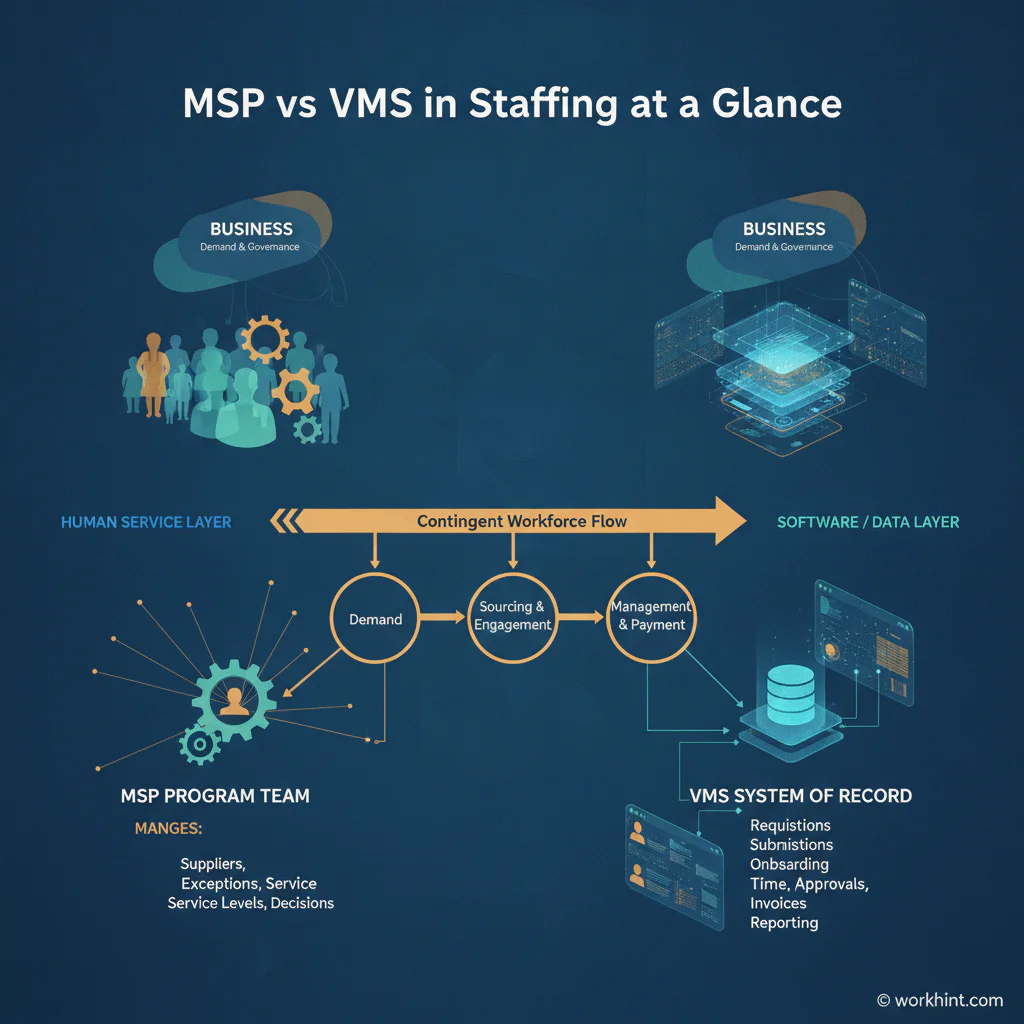
A VMS standardizes transactions. It can route requisitions to approved suppliers, receive candidate submissions, collect documents, record rates, approve time, match invoices, and report spend. The business still needs people to define rules, handle exceptions, review supplier performance, and drive adoption.
An MSP provides that operating capacity. Its program team may manage supplier onboarding, requisition distribution, rate-card administration, service levels, escalations, reporting, and continuous improvement. The MSP usually works inside a VMS, whether the technology is contracted by the client or bundled with the service.
| Decision area | VMS | MSP |
|---|---|---|
| What you buy | Software and configured workflows | People, process, and program management |
| Primary value | Control, data consistency, and automation | Operational ownership and specialist capacity |
| Supplier decisions | Recorded and routed by the system | Managed by the program team under client rules |
| Internal effort | Higher ongoing operating responsibility | Lower daily effort but active governance remains |
| Best fit | Mature internal program that needs infrastructure | Program that lacks capacity or specialist expertise |
How do MSP and VMS responsibilities differ?
The clearest test is to separate system actions from management decisions. A VMS can enforce an approved rate ceiling, but someone must decide the rate policy. It can calculate response times, but someone must address a supplier that repeatedly misses the target. It can hold classification documents, but it cannot determine whether the working relationship follows the approved model.
That last point matters because outsourcing administration does not erase legal responsibility. The U.S. Department of Labor’s misclassification guidance emphasizes that worker status depends on the real economic relationship, not only a contract label. Employment and tax questions should be reviewed with qualified advisers for the relevant jurisdiction.
Both models also require third-party controls. NIST supply chain risk guidance treats supplier risk as an ongoing management discipline, while the OCC’s third-party risk principles illustrate the importance of planning, due diligence, contracting, monitoring, and termination. Even outside regulated banking, that lifecycle is a useful governance pattern.
How should a business choose between MSP and VMS?
- Map the current program. Count active suppliers, worker types, locations, approval paths, payment methods, and recurring exceptions. Complexity is a better signal than headcount alone.
- Name the internal owner. If no one can own supplier performance, process changes, escalations, and data quality, software alone will not close the gap.
- Separate visibility from execution. If the main problem is fragmented records, a VMS may be sufficient. If requisitions, suppliers, and exceptions are unmanaged, the problem is operational.
- Define retained decisions. Document what procurement, HR, legal, finance, security, and hiring managers will continue to approve. An MSP should not make policy by accident.
- Test the hybrid model. Larger or distributed programs often benefit from an MSP running the service layer while a VMS preserves workflows, records, and reporting.
What should you check before signing?
- Technology ownership: Can the business retain its data and change service providers without rebuilding the entire program?
- Supplier neutrality: Does the MSP also supply workers, and how are conflicts, tiering, and requisition access governed?
- Decision rights: Who approves suppliers, rates, exceptions, access, tenure extensions, and removals?
- Integration scope: Which HR, procurement, identity, time, finance, and payment systems must exchange data?
- Exit controls: Who owns records, configurations, open requisitions, worker files, and transition support?
Do not compare headline fees alone. Build a total operating model that includes licenses, program staff, implementation, integrations, change management, supplier funding, internal governance, and transition costs.
Where Workhint fits
Workhint can support the operational layer between demand, external workers, suppliers, approvers, and payments. Teams can use it to structure intake, onboarding, role-based access, assignments, approvals, documents, time, payment status, and reporting. That makes it useful when a business wants to build its own vendor management workflows or needs a shared operating system around an MSP relationship.
The starting point should be the process, not the product label: identify the roles, decisions, handoffs, evidence, and exceptions the program must manage, then configure the system and service responsibilities around them.
FAQ
Can a company use a VMS without an MSP?
Yes. A capable internal program team can operate the VMS directly. The company must still own supplier management, policy, exceptions, adoption, and performance reviews.
Does an MSP replace staffing agencies?
Usually not. An MSP commonly manages the supplier network and program rules, while staffing agencies source and employ or engage workers under the program’s model.
Is an MSP the same as a VMS provider?
No. The MSP provides a managed service; the VMS provider supplies software. One company may offer both, but the contracts, responsibilities, data rights, and exit terms should remain clear.
Which option gives the business more control?
A self-managed VMS gives the business more direct operational control but requires internal capacity. An MSP delegates daily management, so control depends on well-defined policies, approvals, service levels, and governance.
Conclusion
The practical MSP vs VMS decision is not service versus technology in isolation. It is a choice about who will run the contingent workforce program and what system will make the work consistent and auditable. Choose software when ownership already exists, managed service when operating capacity is missing, and both when the program needs a dedicated team plus reliable infrastructure.
Leave a Reply