


The wrong external delivery model can leave a team paying for flexibility while carrying more management work than expected.
Staff augmentation vs outsourcing is fundamentally a choice about ownership. Staff augmentation adds external specialists to a team you continue to manage. Outsourcing gives a provider responsibility for delivering a defined project, service, or business outcome. The better option depends less on headcount and more on who should direct the work, absorb delivery risk, and maintain the operating system around it.
Quick answer
Choose staff augmentation when you have capable internal leadership, need specific skills or temporary capacity, and want direct control over priorities and execution. Choose outsourcing when the work can be defined through outcomes or service levels and you want a provider to manage delivery. In either model, document ownership, access, quality, reporting, and exit responsibilities before work begins.
What’s in this article?
- The practical difference between the two models
- A side-by-side ownership and risk comparison
- A five-step selection process
- Common contracting and operating mistakes
- How to coordinate either model after selection
Why the delivery model matters
Both models give a business access to external capability without building every role permanently. But they create different management obligations. An augmented designer, analyst, or engineer usually enters the client’s meetings, tools, backlog, and reporting lines. An outsourcing provider usually organizes its own people and methods, then reports progress against a statement of work, milestone plan, or service-level agreement.
This distinction affects budget ownership, security reviews, performance management, knowledge transfer, and the amount of internal leadership required. It may also affect worker-classification analysis. The IRS explains that the right to control how work is performed is relevant when determining whether an individual is an independent contractor. The U.S. Department of Labor likewise warns that businesses remain responsible for evaluating the real working relationship. A contract label alone does not settle the question. This article is operational guidance, not legal advice.
Staff augmentation vs outsourcing comparison
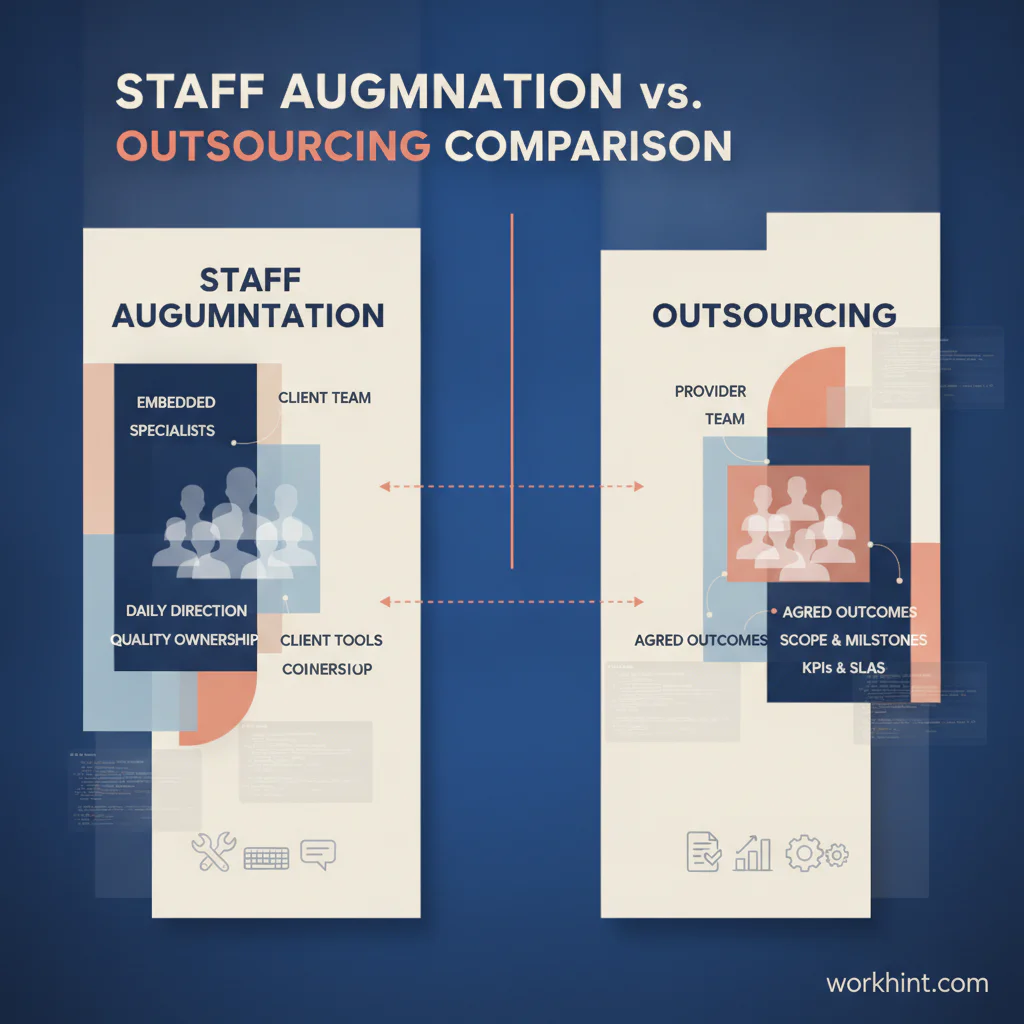
| Decision area | Staff augmentation | Outsourcing |
|---|---|---|
| Unit purchased | Skills and capacity | Project, process, or outcome |
| Daily direction | Client manager | Provider manager |
| Methods and tools | Mostly the client’s | Usually the provider’s, within agreed controls |
| Quality ownership | Client sets and manages the operating standard | Provider delivers to contracted acceptance criteria |
| Commercial structure | Often time-based by role or capacity | Often milestone, deliverable, transaction, or service based |
| Best fit | Changing priorities and embedded collaboration | Stable scope and transferable delivery ownership |
Neither column is automatically cheaper. Staff augmentation can look simple on an invoice while consuming substantial internal management time. Outsourcing can make delivery more predictable but introduce transition, governance, change-request, and vendor-dependency costs. Compare the total operating burden, not only the hourly or project rate.
How to choose between staff augmentation and outsourcing
- Define the unit of need. If the gap is a missing skill or temporary capacity, augmentation is usually the cleaner starting point. If the gap is ownership of an entire output, service, or process, outsourcing may fit better.
- Test internal management capacity. Augmented people still need priorities, decisions, feedback, and escalation support. Do not add five specialists to a team that lacks a clear product owner or operations lead.
- Measure scope stability. Rapidly changing work benefits from close client direction. Repeatable work with measurable acceptance criteria is easier to transfer to a provider.
- Map risk and access. List systems, customer data, intellectual property, regulatory obligations, subcontractors, and geographic restrictions. NIST’s cybersecurity supply chain guidance provides a useful reference for evaluating and governing supplier risk.
- Design the exit before entry. Specify documentation, access removal, asset return, final acceptance, data deletion, knowledge transfer, and replacement support. A model is not flexible if the business cannot unwind it safely.
When a hybrid model works
A business does not always need a binary choice. It might outsource a defined implementation while augmenting its internal team with a specialist who protects architecture, quality, or change management. Another company might outsource a repeatable back-office process but retain augmented analysts for exception handling and improvement work.
The hybrid model works only when boundaries are explicit. Name one owner for each decision, define which backlog belongs to whom, and avoid making an augmented specialist accountable for an outcome controlled by the provider. Use a single governance calendar for access reviews, delivery reviews, invoices, risks, and renewals.
Common mistakes to avoid
- Buying people when ownership is missing. More capacity will not repair unclear priorities or weak decision rights.
- Calling augmentation outsourcing. If internal managers direct every task, the operating reality remains augmentation even when the contract uses broader language.
- Using vague acceptance criteria. Outsourced work needs observable outcomes, quality thresholds, response times, and an escalation route.
- Ignoring transition work. Access, documentation, training, and knowledge transfer require named owners and dates.
- Managing only the contract. A signed agreement does not replace operational reviews, risk monitoring, and evidence of completed work.
Where Workhint fits
After choosing a model, the difficult part is making the operating relationship visible. Workhint helps businesses coordinate contractors and external specialists through structured intake, onboarding, role-based access, assignments, approvals, documents, schedules, payment status, and reporting. With staff augmentation, that can mean placing external specialists into the correct internal workflow. With outsourcing, it can mean giving provider contacts a controlled portal for milestones, evidence, approvals, exceptions, and invoices without exposing unrelated systems.
FAQ
Is staff augmentation a type of outsourcing?
It is often sold under the broad outsourcing umbrella, but operationally it is distinct. The client normally retains daily management and delivery ownership, while the provider supplies talent and handles commercial administration.
Which model gives the client more control?
Staff augmentation usually gives the client more direct control because external specialists work inside the client’s priorities, tools, and management structure. That control also creates more internal management responsibility.
Which model is better for a changing project?
Staff augmentation often fits changing priorities because the client can redirect capacity. Outsourcing can still work when the agreement includes flexible scope mechanisms, but frequent changes may create added governance and commercial friction.
Can outsourcing eliminate delivery risk?
No. It can transfer defined responsibilities, but the client still owns vendor selection, governance, security expectations, acceptance decisions, business continuity, and compliance oversight.
What should a business document before work starts?
Document scope, decision rights, reporting cadence, access, data handling, intellectual property, quality criteria, escalation, pricing, change control, subcontracting, knowledge transfer, and termination steps.
Conclusion
The clearest staff augmentation vs outsourcing decision starts with one question: do you need additional capability inside your operating model, or do you need another organization to own a defined result? Choose the model that matches that answer, then make ownership, controls, and exit requirements explicit. The contract matters, but the working system determines whether the relationship performs.
Leave a Reply