


When every request is important, a shared scoring matrix turns competing opinions into a decision the team can explain and execute.
A prioritization matrix template helps a business compare projects, requests, or improvements against the same criteria. Instead of rewarding the loudest stakeholder or the newest idea, the team records value, urgency, risk, effort, and confidence, then uses a visible score to decide what moves first.
Quick answer
List each option in a row, choose three to five decision criteria, assign weights that total 100%, and rate every option on the same 1-to-5 scale. Multiply each rating by its weight, total the results, and rank the options. Review the ranking for dependencies, mandatory work, and capacity before approving the final order.
What’s included
- A copy-ready weighted prioritization table
- Suggested criteria, definitions, and scoring rules
- A worked project example
- A meeting workflow for reaching and recording a decision
- Common mistakes, governance fields, and business FAQs
How to use this resource
Use the matrix when several viable options compete for limited people, budget, or time. It works best for comparable choices: projects within one portfolio, process improvements within one function, or feature requests for one product. Do not mix mandatory legal work with optional growth ideas unless the matrix explicitly treats mandatory status as a gate.
The Minnesota Department of Health’s prioritization matrix guidance recommends agreeing on the goal and criteria before comparing options. The American Society for Quality’s decision matrix guidance likewise frames the tool as a structured way to evaluate choices against criteria. That sequence matters: criteria chosen after seeing the options can quietly favor a preferred answer.
Prioritization matrix template
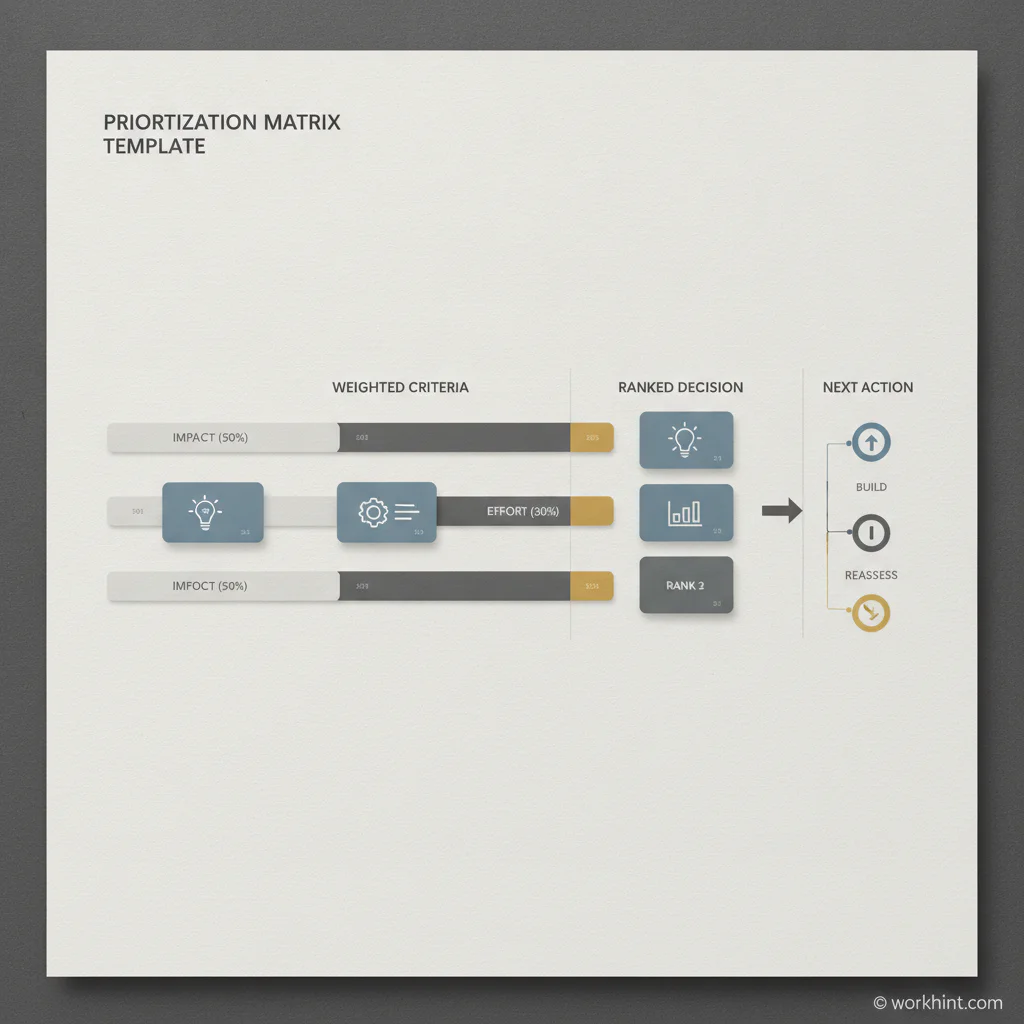
Copy this structure into a spreadsheet. Keep the original ratings, comments, and decision date so the outcome remains auditable.
| Option | Strategic value 30% | Customer impact 25% | Urgency 20% | Risk reduction 15% | Ease 10% | Weighted total | Owner |
|---|---|---|---|---|---|---|---|
| Option A | 1-5 | 1-5 | 1-5 | 1-5 | 1-5 | Calculate | Name |
| Option B | 1-5 | 1-5 | 1-5 | 1-5 | 1-5 | Calculate | Name |
| Option C | 1-5 | 1-5 | 1-5 | 1-5 | 1-5 | Calculate | Name |
Formula: weighted total = (strategic value × 0.30) + (customer impact × 0.25) + (urgency × 0.20) + (risk reduction × 0.15) + (ease × 0.10). A perfect score is 5. Replace the sample criteria and weights when the decision requires different tradeoffs.
Rating scale
| Rating | Shared meaning | Evidence expectation |
|---|---|---|
| 1 | Very low contribution | Little or no supporting evidence |
| 2 | Low contribution | Limited evidence or narrow benefit |
| 3 | Moderate contribution | Reasonable evidence and defined benefit |
| 4 | High contribution | Strong evidence across important users or goals |
| 5 | Very high contribution | Direct, measurable support for the decision goal |
Define what a 1, 3, and 5 mean for each criterion before scoring. For urgency, a 5 might mean a fixed deadline within 30 days; for customer impact, it might mean a verified problem affecting most active customers. Specific anchors reduce rating inflation.
Run the prioritization meeting in six steps
- State the decision. Write one sentence defining what is being prioritized, the planning horizon, and available capacity.
- Confirm eligibility. Remove duplicates, incomplete proposals, and options that fail nonnegotiable compliance or feasibility gates.
- Agree on criteria and weights. Keep the criteria distinct and make weights total 100%.
- Score independently. Ask participants to rate options before the group discussion to reduce anchoring.
- Discuss large differences. Compare evidence, not personalities. Update a rating only when the evidence changes the assessment.
- Approve the queue. Record the final rank, decision owner, next action, review date, and any dependency that can change the order.
A template library such as Smartsheet’s priority matrix examples shows that different decisions may need urgency-versus-importance, impact-versus-effort, or weighted criteria formats. Use the simple 2-by-2 version for quick triage; use weighted scoring when tradeoffs involve several business factors.
Worked business example
An operations team must choose among three improvements. Using the sample weights above, the team gives each option a 1-to-5 rating.
| Option | Value | Impact | Urgency | Risk | Ease | Total |
|---|---|---|---|---|---|---|
| Automate intake routing | 5 | 4 | 4 | 3 | 4 | 4.15 |
| Redesign weekly report | 3 | 3 | 2 | 2 | 5 | 2.85 |
| Add approval audit trail | 4 | 3 | 4 | 5 | 3 | 3.80 |
Intake routing ranks first, but the team still checks dependencies and mandatory controls. If the audit trail is required before an upcoming review, it may move first even with a lower score. The score informs judgment; it does not replace constraints.
Common prioritization mistakes
- Overlapping criteria: value, impact, and benefit can count the same advantage three times. Give each criterion a distinct definition.
- Scoring without evidence: require a metric, customer signal, deadline, cost estimate, or risk record for strong ratings.
- Using ease backward: if 5 means easiest, label the column “ease,” not “effort,” so a higher total always remains better.
- Ranking incomparable work: separate portfolios or use eligibility gates before scoring.
- Ignoring capacity: a ranked list is not a committed plan until owners and realistic start dates are assigned.
- Never revisiting the decision: add a review trigger for material changes in cost, deadlines, risk, or customer evidence.
Turn the matrix into a managed workflow
A spreadsheet can calculate a rank, but execution still needs intake rules, evidence, reviewers, approvals, ownership, and status updates. In Workhint, a team can turn the template into a live project workflow system: requests enter through a consistent form, assigned reviewers score them, approvals follow defined thresholds, and selected work moves to owners with due dates and reporting. The matrix remains useful on its own; digitizing it reduces chasing and preserves the decision trail.
FAQ
What criteria should a business use in a prioritization matrix?
Start with strategic value, customer or operational impact, urgency, risk reduction, and ease. Replace any criterion that does not match the decision goal. Three to five clearly defined criteria are usually easier to score consistently than a long list.
Should cost receive a positive or negative score?
Make every column point in the same direction. Use “affordability” or “ease” when a higher rating should improve the total. Alternatively, calculate cost separately as a constraint, but document that rule.
How often should project priorities be reviewed?
Review them at the planning cadence appropriate to the portfolio and whenever a material assumption changes. Stable quarterly initiatives may need monthly review; fast-moving operational requests may need weekly triage.
What should happen when two options tie?
Apply a predefined tie-breaker, such as higher strategic value, lower risk, earlier deadline, or lower resource requirement. If the tie remains, escalate it to the named decision owner and record the rationale.
Conclusion
A useful prioritization matrix makes tradeoffs visible, repeatable, and explainable. Define the goal first, use a shared scale, score with evidence, and finish by assigning owners and review dates. That turns a ranking exercise into a practical commitment about what the business will do next.
Leave a Reply