


A good contractor agreement defines the work, the money, the ownership, and what happens when plans change.
An independent contractor agreement template gives a business and a contractor one written source of truth before work begins. The useful version does more than label the relationship: it defines the deliverables, approval rules, payment trigger, ownership terms, risk allocation, and exit process that both sides will actually follow.
Quick answer
An independent contractor agreement should identify the parties, describe services and deliverables, set fees and payment timing, allocate expenses, address confidentiality and intellectual property, state the term and termination rules, record the intended contractor relationship, and include governing law and signatures. Customize the template for the work and jurisdiction, then have qualified counsel review material legal risks.
What is included in this contractor agreement template?
- A copy-ready agreement structure with prompts for each clause
- A table connecting contract sections to operational owners and evidence
- A five-step review process to use before signature
- Common mistakes that create scope, payment, or classification problems
This resource is a practical starting point, not legal advice. Worker classification is determined by the real working relationship and applicable law, not by a document title alone. The U.S. Department of Labor specifically notes that signing an independent contractor agreement does not by itself make a worker an independent contractor.
How should you use the independent contractor agreement template?
- Start with the actual operating model. Write down who requests work, who approves it, how deliverables are accepted, and what records support payment.
- Replace every bracketed prompt. Avoid vague entries such as “as needed” when a milestone, service window, or acceptance rule can be stated.
- Attach a statement of work when scope changes by project. Keep durable legal terms in the agreement and project-specific deliverables in the SOW.
- Review classification separately. Compare the written terms with day-to-day control, independence, investment, and the complete relationship.
- Route the final version for approval and signature. Store the signed agreement, tax documents, insurance evidence, and later amendments together.
Independent contractor agreement template
Parties and effective date. This Independent Contractor Agreement is effective [DATE] between [COMPANY LEGAL NAME AND ADDRESS] and [CONTRACTOR LEGAL NAME, ENTITY TYPE, AND ADDRESS].
Services and deliverables. Contractor will perform [SERVICES] and deliver [DELIVERABLES] according to [MILESTONES, SPECIFICATIONS, OR ATTACHED SOW]. [ROLE] may accept or reject a deliverable within [NUMBER] business days using [ACCEPTANCE CRITERIA].
Fees and payment. Company will pay [FIXED FEE, HOURLY RATE, OR MILESTONE FEE]. Contractor will submit [INVOICE/TIMESHEET/EVIDENCE] by [DATE OR EVENT]. Approved amounts are payable within [NUMBER] days by [METHOD/CURRENCY].
Expenses. [PARTY] is responsible for ordinary expenses. Any reimbursable expense must be approved in writing by [ROLE] before it is incurred and supported by [RECEIPT OR OTHER RECORD].
Independent business relationship. The parties intend an independent contractor relationship. Contractor controls the manner and means of performing the services, subject to the agreed results, deadlines, security requirements, and acceptance criteria, and remains responsible for applicable taxes and business obligations.
Confidentiality and data. Contractor will protect [CONFIDENTIAL INFORMATION], use it only for the services, follow [SECURITY/PRIVACY REQUIREMENTS], report incidents to [CONTACT] within [TIME], and return or delete information at termination as required.
Intellectual property. Ownership of pre-existing materials remains with [OWNER]. Rights in project deliverables will [TRANSFER TO COMPANY UPON PAYMENT / BE LICENSED UNDER TERMS]. Contractor will identify third-party materials and applicable license terms before use.
Term and termination. The agreement begins [DATE] and ends [DATE/EVENT] unless terminated earlier. Either party may terminate with [NUMBER] days’ notice. Immediate termination applies for [MATERIAL BREACH, SECURITY EVENT, OR OTHER CAUSE]. The company will pay approved fees for accepted work completed through termination.
Risk, insurance, and disputes. The parties will use the agreed limits for [INDEMNITY, LIABILITY, AND INSURANCE]. Notices go to [CONTACTS]. Governing law is [JURISDICTION], and disputes follow [NEGOTIATION/MEDIATION/COURT/ARBITRATION PROCESS].
Signatures. Authorized representatives sign and date the agreement. Attachments, amendments, and SOWs are effective only when approved under [CHANGE PROCESS].
Agreement anatomy and operating evidence
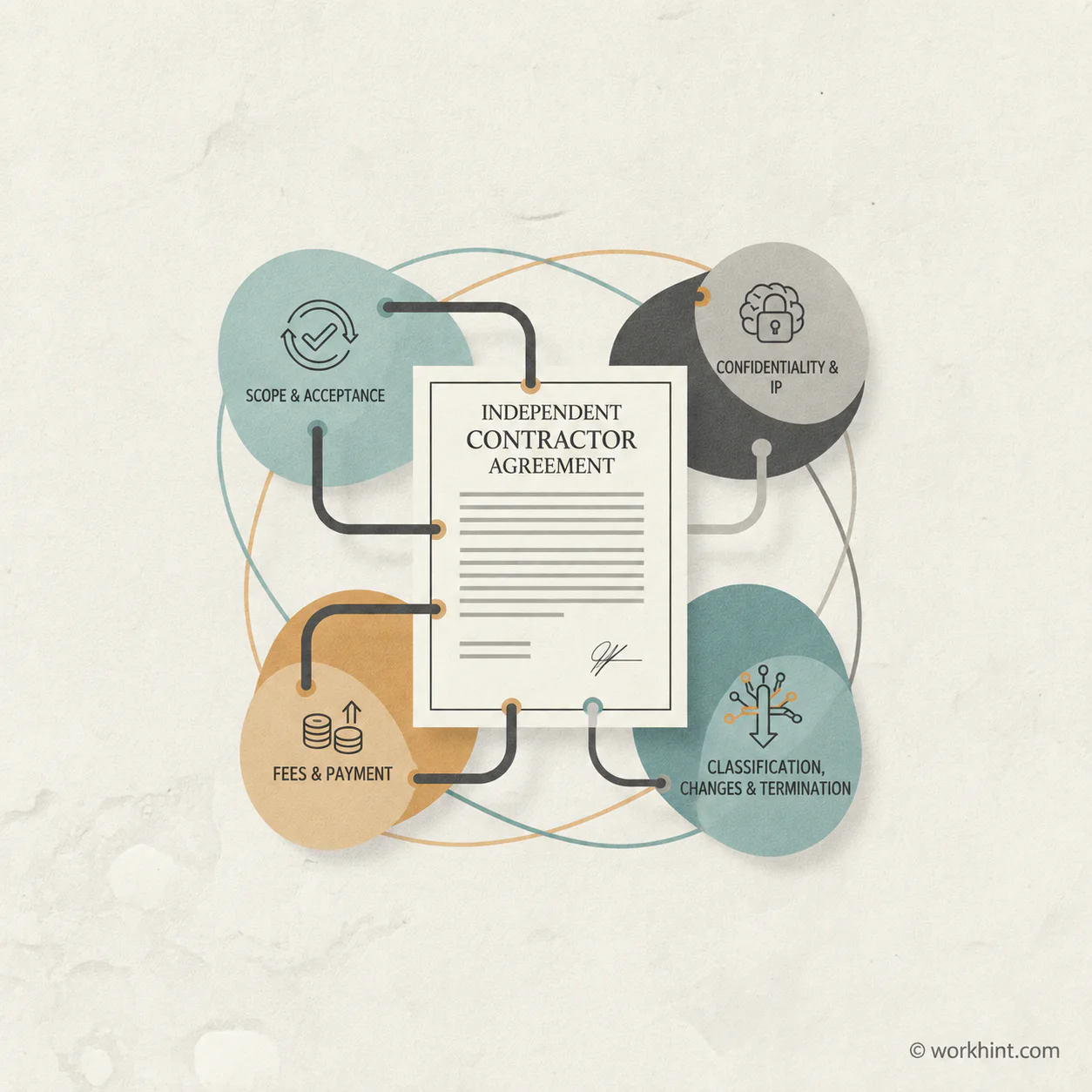
| Agreement area | Business owner | Evidence to retain |
|---|---|---|
| Scope and acceptance | Project or operations lead | SOW, briefs, approvals, accepted deliverables |
| Fees and payment | Finance | Rate approval, invoices, time or milestone evidence |
| Confidentiality and access | Security or data owner | NDA terms, access approval, incident records, offboarding proof |
| IP and licenses | Legal or business owner | Assignment, license list, third-party permissions |
| Classification and tax | Legal, HR, or compliance | Classification assessment, W-9 or applicable local records |
The IRS explains that contractor status depends on the facts of each case, including whether the hiring party controls only the result rather than what will be done and how. Review federal, state, local, and cross-border rules that apply to the engagement.
Common contractor agreement mistakes
- Using scope words without acceptance criteria. “Marketing support” is not a measurable deliverable.
- Leaving the payment trigger unclear. State whether payment follows time submission, milestone acceptance, or a calendar date.
- Copying an IP clause that conflicts with the work. Separate pre-existing tools from newly created deliverables.
- Treating the label as classification proof. Actual control and economic reality matter more than the heading.
- Forgetting operational changes. Rates, scope, systems access, and end dates should change through a recorded approval process.
Where Workhint fits
The agreement is the rulebook; the workflow is how those rules are enforced. A contractor management system can turn intake, classification review, document collection, access approvals, assignments, deliverable acceptance, invoice approval, renewals, and offboarding into one tracked process. The template remains useful on its own, while the system reduces the chance that signed terms and daily operations drift apart.
Frequently asked questions
Is an independent contractor agreement legally required?
Requirements vary by jurisdiction and engagement. Even when a written contract is not specifically required, it can clarify commercial terms and create useful evidence. Ask qualified counsel about the rules that apply to your location and work.
Can one agreement cover multiple projects?
Yes. Many businesses use a master agreement for durable terms and a separate SOW for each project’s scope, timeline, fee, and acceptance criteria.
Does the agreement prove a worker is a contractor?
No. Government agencies and courts look at the real relationship. The written agreement should match actual control, independence, investment, permanence, and other applicable factors.
Who should approve the agreement?
The operational owner should confirm scope, finance should confirm rates and payment terms, and legal or compliance should review classification and material risk. Security or privacy review may be needed when the contractor receives sensitive access.
Use the template as an operating document
Complete the agreement before access or work begins, keep project terms specific, and route every material change through approval. The strongest contractor agreement is not merely signed; it stays connected to the evidence, decisions, and payment workflow throughout the engagement.
Leave a Reply