

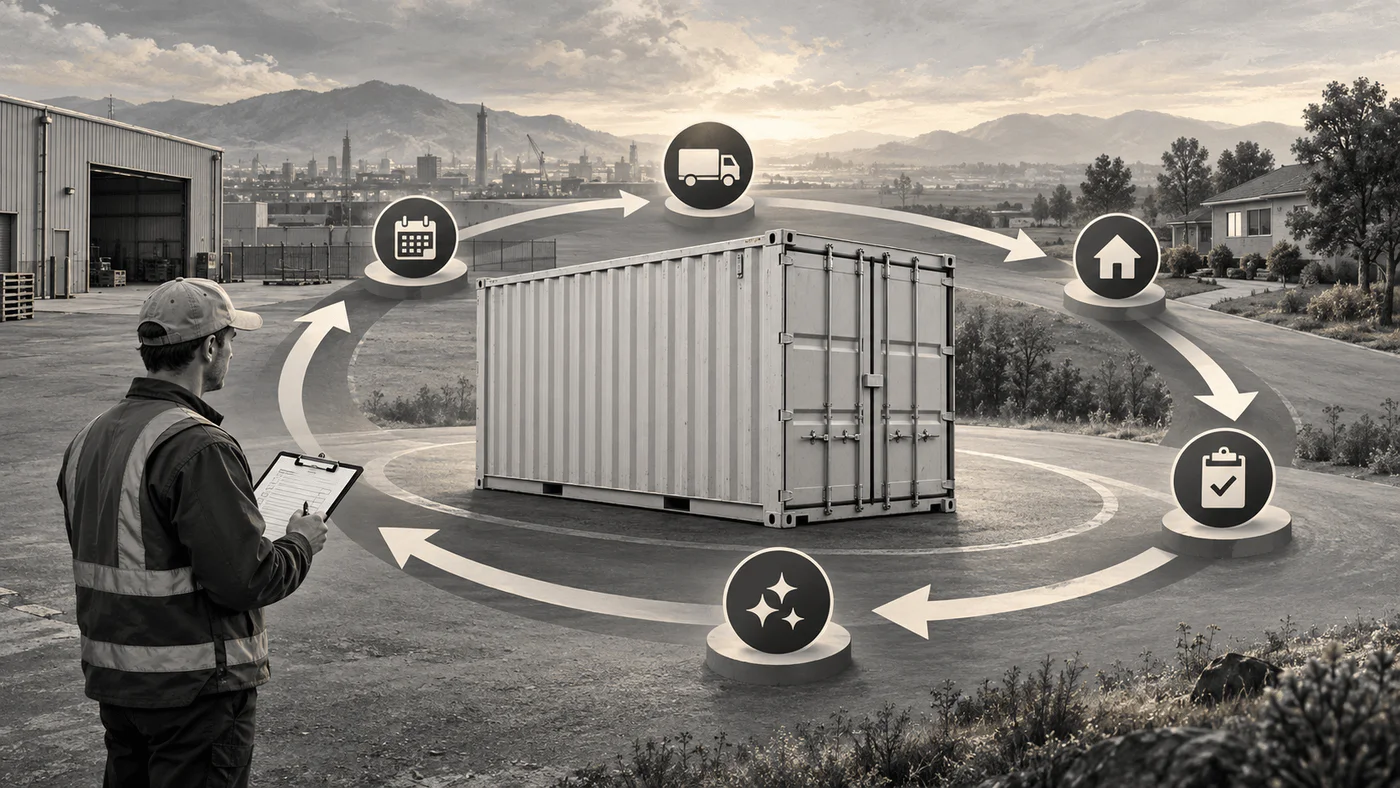
Portable storage looks like a simple rental business: place a container, collect rent, retrieve it later. The difficult part is making delivery capacity, yard access, unit condition, customer access, damage handling, and occupancy work as one system.
Quick answer
A portable storage rental business is worth testing only if a narrow local segment will reserve units before you commit to a fleet or yard. Start with one use case—such as contractor job-site storage—then prove that delivery and return leave a contribution margin after transport, handling, insurance, repairs, yard costs, and customer acquisition. A container is not passive income: utilization and movement discipline decide the model.
Choose the operating model before buying units
Portable storage includes different businesses. A residential move-and-store operator drops a unit, retrieves it, and may store it between addresses. A construction-storage operator keeps units at job sites for weeks or months. A restoration model needs short lead times and careful chain-of-custody. A commercial-overflow model often values predictable billing and scheduled swaps.
Pick one first. The guide to starting a moving company without trucks helps founders test labor-led moving services; this article is different: it tests whether a fleet-and-yard rental operation can earn enough from a physical-unit cycle.
Start with a narrow offer
- Customer: small general contractors running active remodels within a defined service radius.
- Offer: a clean, inspected storage unit delivered, placed, collected, and billed monthly.
- Boundary: no transport of customer goods and no promise that the unit suits hazardous, perishable, or regulated materials.
- Proof: placement photos, condition record, delivery acceptance, and access handoff.
Local rules can govern outdoor storage, site access, placement, business licensing, permits, and vehicle operations. Confirm requirements with relevant local planning, building, transport, and insurance advisers before accepting a job. Do not assume a container is exempt because it is movable.
Test demand before committing capital
The first question is not “How many containers can I buy?” It is “Can I win repeatable reservations in one zone at a price that survives delivery and retrieval?” Build a list of 30 local prospects in one segment, then run a paid-deposit test using a clearly labeled launch offer. Do not advertise same-day capacity you do not control.
| Hypothesis | Test | Signal and threshold | Decision |
|---|---|---|---|
| Remodelers will reserve secure on-site storage. | Interview 15 firms; offer a refundable reservation for a defined unit and radius. | Five paid or contract-backed reservations in 30 days. | Continue only if dates and locations are feasible. |
| Delivery economics work in one zone. | Quote jobs using partner-haulage or equipment bids. | Every committed job clears a planning contribution target. | Reprice, narrow the radius, or stop. |
| Units can turn without founder heroics. | Run placements with a documented handoff and inspection checklist. | Three completed cycles with no unresolved condition dispute. | Standardize before adding units. |
These thresholds are planning choices, not market facts. Adjust them to hauling quotes, yard constraints, and working-capital limits.
Build unit economics around a cycle, not monthly rent
Monthly rent is revenue, not margin. Use a unit-cycle worksheet that separates movement costs from recurring holding costs.
| Line item | How to model it |
|---|---|
| Rental revenue | Monthly rate × billable days ÷ days in billing period. |
| Placement and collection | Carrier or driver, fuel surcharge, equipment, permits if applicable, and failed-trip risk. |
| Unit holding cost | Financing or lease cost, depreciation planning, yard space, insurance, maintenance reserve, and security. |
| Job-level service cost | Inspection, cleaning, lock/access handoff, customer support, payment processing, and damage administration. |
| Contribution margin | Rental and authorized fees minus costs that vary with that unit and cycle. |
A model that looks attractive at 90% occupancy can fail when units wait for pickup, a delivery is rescheduled, or a yard cannot accept returns. Keep a separate cash view for deposits, repairs, and the time between buying a unit and its first paid day.
Design fulfillment before sales volume arrives
Every order needs a reliable state change: inquiry → site check → quote sent → reservation/deposit → delivery scheduled → placed and accepted → active rental → extension or collection requested → collection scheduled → returned inspection → ready to rent or repair.
Require photos at placement and return; record the unit ID, site contact, placement constraints, lock/access responsibility, and exceptions. Make cancellation, inaccessible-site, failed-delivery, damage, overdue, and emergency-access paths explicit.
Supply is the actual bottleneck
Before taking a reservation, verify an inspected available unit, a delivery partner or vehicle slot that can place it safely, and a compliant place to stage it if the customer delays. A supplier is not operational capacity. Qualify backup transport and repair providers before the first job.
Risk gates that should stop the launch
- The target yard or customer placements cannot be approved or insured.
- You cannot quote transport and handling before committing to a delivery date.
- Expected contribution margin is negative after realistic collection and maintenance costs.
- Every exception requires the founder to negotiate a bespoke solution.
- You cannot identify who may access the unit, report damage, and authorize pickup.
Venture canvas: contractor job-site storage
| Customer and job | Small contractors who need secure, temporary on-site storage during active projects. |
|---|---|
| Promise | A known-size unit, documented placement, clear rental terms, and scheduled retrieval. |
| Demand channel | Direct outreach to remodelers, trade partners, and project managers in one service zone. |
| Supply | Inspected units, a staging yard, delivery/collection capacity, repair capability, and defined access. |
| Money flow | Reservation/deposit and delivery fee as agreed; recurring rent; authorized extension, collection, or damage charges. |
| Quality evidence | Condition photos, placement acceptance, unit ID, issue log, and return inspection. |
| Scale trigger | Repeated profitable cycles in the same zone with reliable transport capacity—not one large quote. |
Build this business in Workhint
Once the model passes its first reservation and operations tests, the work system can connect the customer request, site review, delivery coordination, unit status, evidence, and exceptions. You can explore Workhint’s AI work-system builder when you are ready to map the operating model rather than manage the cycle across texts and spreadsheets.
Copy-ready builder prompt:
Build a portable storage rental operating system for contractor job-site storage in one local service zone. Create customer, operations manager, delivery partner, and yard-inspector roles. Capture project address, access details, unit size, dates, site contact, and placement constraints. Route requests through site review, quote approval, reservation, delivery scheduling, placed/accepted, active rental, extension request, collection scheduling, return inspection, ready-to-rent, and repair. Require delivery and return photos, a unit ID, acceptance evidence, condition notes, and a damage/exception path. Include cancellation, inaccessible site, failed delivery, overdue return, and unit-repair workflows. Give customers requests, dates, documents, and status; delivery partners only assigned jobs and proof requirements; administrators fleet availability, pending collection, exceptions, and cycle time. Track inquiry-to-reservation conversion, billable days, delivery completion, return-condition issues, and units unavailable for repair. Do not assume payments, banking, escrow, or integrations that are not configured.
FAQ
Is a portable storage business a good startup?
It can be conditionally viable when a local segment has repeatable need, delivery and collection capacity is dependable, and each cycle contributes after movement, holding, repair, and acquisition costs. It is difficult when utilization depends on unproven demand or a founder must resolve every placement.
What should a founder validate first?
Validate a narrow customer use case, willingness to reserve, placement feasibility, and a fully quoted delivery-and-return cycle before purchasing a fleet or signing a yard lease.
Can portable storage be run without owning trucks?
It may be possible to use qualified delivery partners, but that transfers neither operational responsibility nor local compliance work. Confirm insurance, scheduling, equipment compatibility, and applicable rules before selling a delivery date.
Sources and scope notes
- RentMy’s container-rental guide informed market-oriented considerations such as niche choice, yard/logistics, and pricing components.
- Boxwell’s portable-storage operator guide informed the distinction among moving, construction, restoration, and commercial-storage use cases.
Neither source substitutes for local legal, zoning, tax, transportation, or insurance advice. Costs, permissions, and operating requirements are market-dependent and must be verified locally.
Leave a Reply