


Use acceptance criteria to make finished work visible before a handoff, approval, or delivery turns into rework.
Acceptance criteria examples are useful because the phrase “done” is often too vague to run a business process. One team thinks the request is complete when a form is submitted. Another team thinks it is complete when the information is verified, approved, assigned, and ready for execution. The gap between those definitions creates delays, rework, and quiet conflict.
Acceptance criteria solve that problem by defining the conditions a piece of work must satisfy before it can be accepted. Atlassian describes acceptance criteria as predefined conditions a product or task must meet before it is considered complete, and Scrum Alliance emphasizes that strong criteria are clear, concise, and testable or verifiable. Those ideas started in agile product work, but they are just as useful for operations teams managing requests, approvals, vendors, onboarding, reporting, and service delivery.
What’s in this article?
- What acceptance criteria mean in business operations
- Acceptance criteria examples for common operational workflows
- A simple process for writing criteria before work starts
- Common mistakes that make criteria hard to use
- How to turn acceptance criteria into a live work system
Why acceptance criteria matter in operations
Operations work often moves across roles, tools, and departments. A vendor request might touch procurement, legal, finance, security, and the business owner. A client onboarding task might move from sales to implementation to support. A change request might need intake, risk review, approval, communication, rollout, and evidence that the change worked.
Without acceptance criteria, every handoff depends on interpretation. The receiving team has to ask follow-up questions, rebuild missing context, or accept incomplete work to keep momentum. Good criteria reduce that ambiguity. They make the completion standard visible before work begins, not after someone is disappointed with the output.
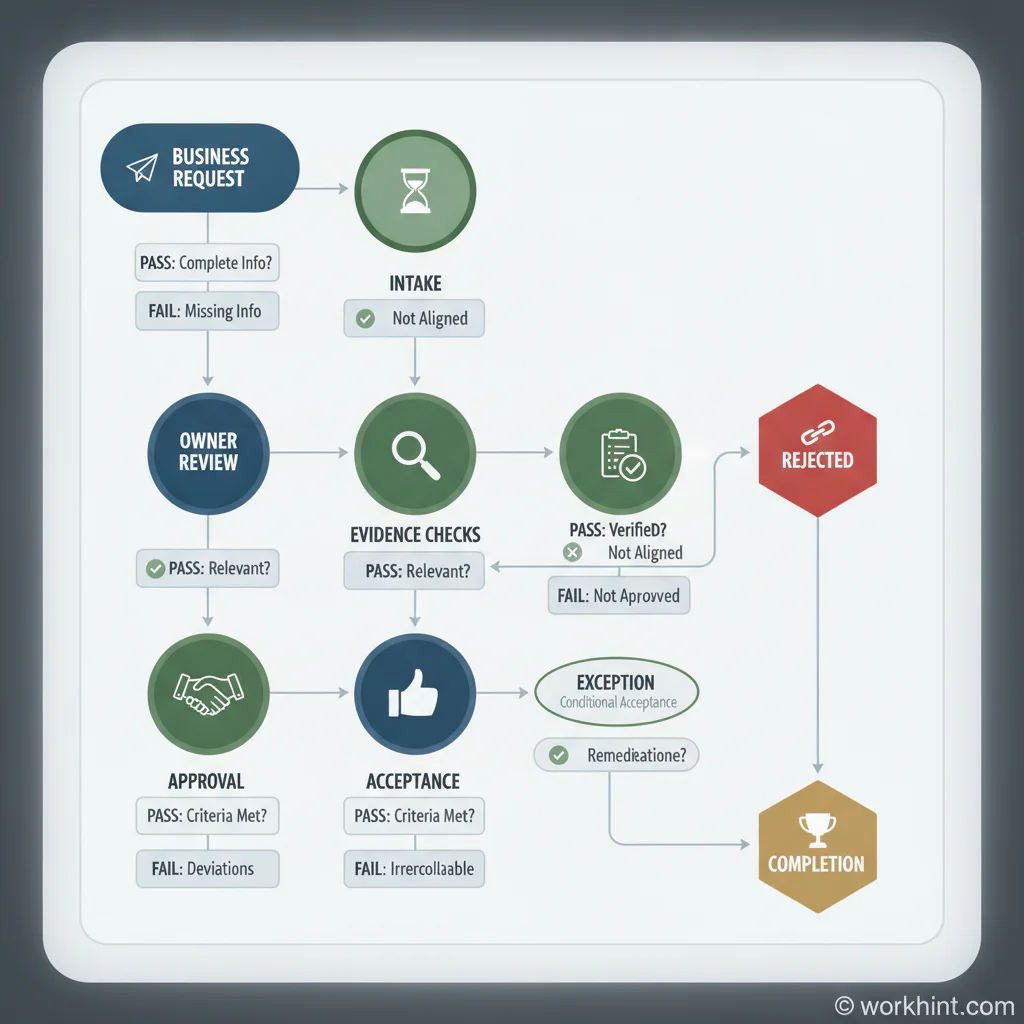
Acceptance criteria examples for operations teams
The best acceptance criteria are specific enough to test but not so prescriptive that they tell the worker exactly how to do the work. Lucidchart makes the same point for product teams: criteria should define the goal without becoming a narrow implementation manual. For business workflows, the same principle applies.
| Workflow | Weak completion rule | Better acceptance criteria |
|---|---|---|
| Vendor approval | Vendor request is reviewed | Business need is documented, required tax and insurance documents are attached, legal risk is marked low or approved, budget owner has approved spend, and vendor status is set to approved or rejected. |
| Client onboarding | Client setup is done | Kickoff date is confirmed, stakeholders are listed, access requirements are complete, scope exceptions are flagged, first milestone is assigned, and the client receives the onboarding summary. |
| Internal service request | Request is handled | Requester has selected a service type, priority is assigned, required inputs are complete, owner has accepted the work, target response time is visible, and closure reason is recorded. |
| Reporting workflow | Dashboard is ready | Data source is named, refresh cadence is documented, metric definitions are approved, owner has reviewed sample values, and decision actions tied to the dashboard are listed. |
| Change rollout | Change is launched | Impact assessment is complete, approver has signed off, affected teams are notified, rollback owner is named, launch checklist is complete, and post-change review date is scheduled. |
How to write acceptance criteria
Start with the work item, not the document format. A useful criterion answers one practical question: what must be true before the next person, customer, system, or manager should accept this work?
- Name the receiver. Acceptance only matters if someone can accept or reject the output. The receiver might be a customer, department, approver, workflow owner, or downstream system.
- Define the outcome. Describe what the work must enable. Avoid criteria that only prove activity happened, such as “meeting held” or “document updated.”
- List the minimum evidence. Include the fields, files, approvals, confirmations, decisions, or system updates required for the receiver to act.
- Make each item testable. The criterion should be visibly met or not met. If people can argue about whether it passed, rewrite it.
- Separate the what from the how. Say what condition must be true, but do not lock the team into unnecessary implementation details.
- Review before work starts. The owner, receiver, and approver should agree on the criteria before execution begins.
A simple acceptance criteria format
Software teams often use a Given, When, Then format. Business teams can use it too, especially when a workflow has a clear trigger and outcome.
Given a vendor request is submitted, when procurement reviews it, then the request can only move to approved if required documents, budget approval, risk status, and business owner confirmation are complete.
For operational work, a checklist format is often easier to maintain. Use one criterion per line, give each one an owner when needed, and attach it to the workflow step where acceptance happens.
Common mistakes
The first mistake is writing criteria after the work is already complete. That turns acceptance into negotiation. Write criteria before work starts so the team can design the work around the real completion standard.
The second mistake is using vague quality language. Words like ready, clean, complete, aligned, or reviewed need a visible test. Replace “handoff is complete” with the exact information, approvals, files, access, and ownership confirmation required.
The third mistake is copying software examples too literally. Operations criteria should fit operational reality. A procurement workflow needs spend limits, documents, risk states, and approval authority. A field service workflow needs location, schedule, assignment, materials, safety requirements, customer confirmation, and completion evidence.
Where Workhint fits
Acceptance criteria become more powerful when they live inside the system where work moves. Workhint can help an operations team turn a process description into roles, intake fields, required documents, approvals, assignments, permissions, reminders, dashboards, and escalation paths. Instead of storing criteria in a static document, the team can connect them to the exact step where work is accepted or rejected.
For example, a client onboarding workflow can require scope confirmation before implementation starts, trigger an exception when a required field is missing, route budget exceptions to the right approver, and show managers which handoffs are waiting for acceptance. The criteria become operating controls, not forgotten notes.
FAQ
What are acceptance criteria?
Acceptance criteria are the specific conditions a work item must satisfy before the receiver should consider it complete. They define what success looks like for that item.
What is an example of acceptance criteria?
For a vendor approval request, criteria might include completed business need, verified vendor documents, budget approval, risk review, named business owner, and final status recorded in the system.
How are acceptance criteria different from definition of done?
Acceptance criteria apply to a specific task, request, deliverable, or workflow step. A definition of done is a broader quality standard that applies across many work items.
Who should write acceptance criteria?
The owner and receiver should write or review them together. Input from approvers, subject matter experts, and downstream teams is useful when the work crosses functions.
Conclusion
Acceptance criteria help operations teams stop guessing what complete means. Use them to define the receiver, outcome, evidence, approval conditions, and pass/fail standard before work begins. The goal is not more documentation. The goal is a cleaner work system where handoffs are accepted with confidence, incomplete work is caught early, and teams can improve execution without relying on memory or repeated clarification.
Leave a Reply