
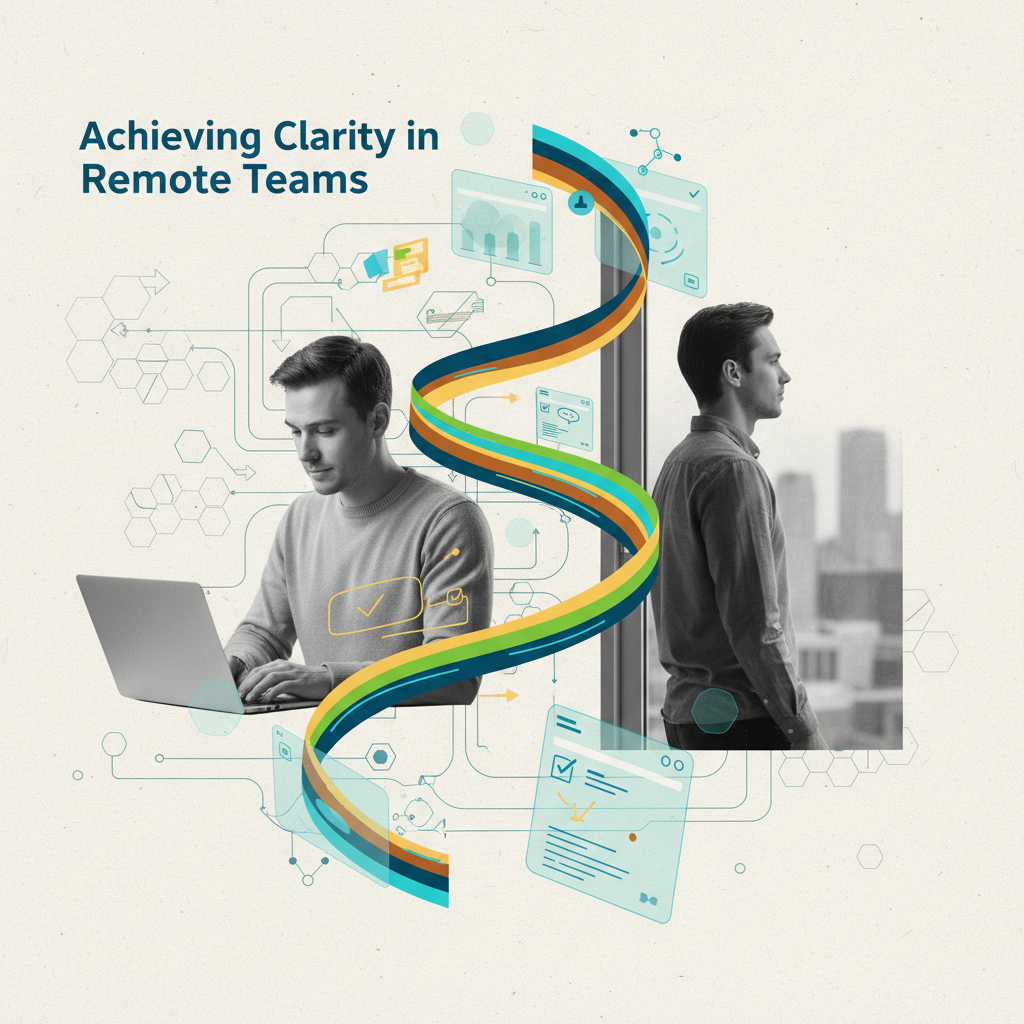
When remote work feels like guessing, clarity seems impossible. Discover what truly makes remote collaboration clear.
Imagine a team spread across continents, each person receiving a task that looks right in their inbox but feels disconnected from the larger purpose. The moment a handoff slips, the rhythm of the day stalls, and a simple question lingers: who really owns the next step? In many growing operations the answer hides behind assumptions, vague expectations and a lack of shared visibility. It is not the tools that fail but the way we design the flow of work, the moments we trust others to pick up the thread without a clear line of sight. I have watched projects stall because the person who should have been the bridge never knew they were needed, and I have felt the frustration of chasing a decision that was already made somewhere else. Naming that invisible gap gives us a chance to rebuild the process so that coordination feels like a conversation, not a guessing game. The first thing to examine is how we signal responsibility across the network.
Who owns the next step and how to see it clearly
When a task lands in an inbox the first question is often “who does this belong to?” Without a visual cue the answer stays hidden and the work stalls. A simple board that shows every piece of work, the person responsible and the next handoff can turn that mystery into a map. Imagine a design sprint where each stage is a card labeled with a name, a brief outcome and a due date. As soon as a card moves, the next owner receives a notification that includes the context of the previous step. The whole team watches the flow in real time, so no one has to guess whether they are still needed. This visibility does more than keep projects moving; it builds trust because each member can see how their contribution fits the larger story. The practice of naming the owner at the moment a task is created removes the silent assumption that someone will figure it out later.
Why old metrics hide the real work
Traditional performance numbers often count output without looking at impact. A remote developer may close many tickets, yet the product may still miss its market goal. The article from Human Performance Technology by DTS explains that metrics need to reflect strengths, values and career aspirations to inspire engagement. When a team aligns its measures with the purpose of the work, the numbers become a story rather than a scoreboard. For example, instead of tracking hours logged, a team might track how many customer problems were solved with a new feature. This shift surfaces the work that truly moves the business forward and gives each member a clear sense of why their effort matters. It also prevents the false comfort of high activity that does not translate into results, a common pitfall as organizations scale.
How to turn handoffs into conversations
A handoff is often treated as a static transfer of a document, which leaves the next owner with unanswered questions. The better approach is to treat each handoff as a brief dialogue that confirms intent and clarifies expectations. A quick video call or a recorded walkthrough can capture the nuance that a spreadsheet cannot. Quickly Hire notes that setting clear expectations and defining achievable goals at the handoff creates a sense of ownership. Likewise, Interim HR Consulting advises establishing performance checkpoints that verify the new owner understands the priority and has the resources needed. By embedding a short question and answer moment into every transition, teams replace uncertainty with confidence, and the rhythm of work stays smooth even across time zones.
Ownership gaps and invisible handoffs
When work moves through email threads, spreadsheets, or ad hoc messages, responsibility often remains implicit. The lack of a shared record means the next participant may not know they are needed, causing delays and duplicated effort. Informal coordination persists because each party assumes the other will fill the gap, and there is no single source of truth to surface the missing link. A centralized work system provides a structural anchor: it records who is assigned, what the expected outcome is, and when the handoff occurs, making the flow visible to everyone involved. By aligning execution data with a common platform, the system eliminates the need for guesswork and creates a consistent point of reference. In this context, Workhint serves as one example of such a centralized work system that is designed to address these coordination breakdowns.
When the day began with a question about who owns the next step, the answer now rests in a simple line of sight. You have seen how a visible map replaces guesswork with a shared rhythm that carries each contribution forward. The shift from counting tasks to measuring impact turns numbers into a story that guides purpose. Each handoff becomes a brief conversation, a moment that confirms intent and steadies the flow. That is the quiet power of clarity: it is not a tool but a habit of naming, showing and listening. Carry this habit into every inbox and watch the invisible gap dissolve.
Leave a Reply