


Agency onboarding works when the business treats kickoff as an operating handoff, not a welcome call.
An agency onboarding checklist helps a business bring a marketing, creative, recruiting, implementation, or operations agency into active work with clear scope, owners, access, approvals, reporting, and payment rules. Without that structure, the agency starts by chasing context, the business loses track of decisions, and the first deliverables become a test of memory instead of a managed workflow.
This is different from employee onboarding. An agency is an external partner with its own team, tools, methods, and commercial obligations. The business needs enough structure to protect scope, budget, data, brand, and delivery quality without turning the agency into an internal department.
What’s in this article?
- A practical agency onboarding workflow for business teams.
- The first-30-days checklist to use after agency selection.
- A role table for marketing, procurement, finance, legal, IT, and the agency lead.
- Common onboarding mistakes that create scope drift and slow delivery.
- Where Workhint fits when agency onboarding needs to become repeatable.
Why agency onboarding matters
Strong agency relationships usually begin before the first deliverable. The ANA’s agency onboarding resource reflects a simple reality: onboarding is part of agency management, not admin cleanup. The handoff between selection, contract, kickoff, access, and delivery sets the rhythm that follows.
The same point appears in client-agency relationship guidance. 4A’s client onboarding and project review guidance treats onboarding and review as part of managing the work. That matters because agencies often depend on context that sits across marketing, procurement, finance, legal, analytics, product, sales, and customer teams.
If onboarding is vague, the agency may still look busy. Meetings happen. Drafts appear. Reports get sent. But the business has not defined approvals, evidence, assets, access, feedback, or payment readiness.
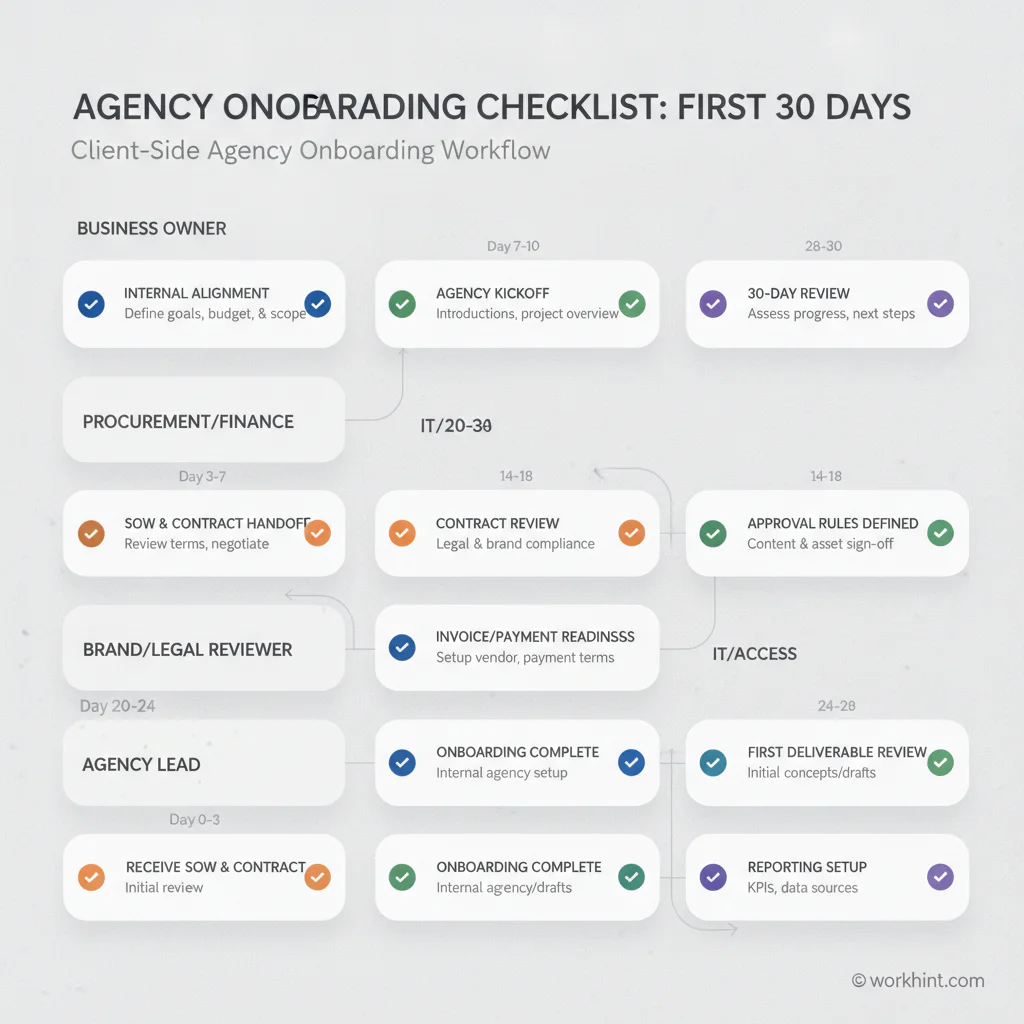
Agency onboarding checklist for the first 30 days
| Phase | Business action | Owner | Evidence to keep |
|---|---|---|---|
| Internal handoff | Confirm scope, budget, success metrics, contract status, and internal sponsor. | Business owner | Approved SOW, budget approval, sponsor name. |
| Agency kickoff | Review goals, deliverables, timeline, stakeholders, risks, and communication cadence. | Business owner and agency lead | Kickoff agenda, notes, decisions, action items. |
| Access and assets | Grant required tool access, brand assets, analytics, shared folders, and secure credentials. | IT, brand, or operations | Access log, asset request list, permission owner. |
| Approval rules | Name who reviews work, consolidates feedback, approves changes, and accepts deliverables. | Project owner | Approval matrix, feedback rules, escalation path. |
| First delivery cycle | Review the first deliverable against the brief, acceptance criteria, and reporting plan. | Business owner and agency lead | Accepted work, requested changes, issue log. |
| Payment readiness | Confirm invoice requirements, PO or cost center, milestone evidence, and payment terms. | Finance or procurement | Invoice instructions, approval owner, payable trigger. |
| 30-day review | Evaluate working rhythm, open risks, scope changes, reporting quality, and next priorities. | Business owner | Review notes, decisions, updated plan. |
Start with the internal handoff
Before the agency gets invited into channels or workspaces, the business should complete its own handoff. The internal sponsor should know why the agency was hired, what outcome the work supports, what the agency may do, what budget is approved, and which contract or statement of work governs the engagement.
This is where procurement, finance, legal, and the business owner need to be aligned. The ANA and 4A’s client-agency relationship tenure study points to trust and transparency as important ingredients in durable client-agency partnerships. Operationally, that starts when the agency receives one coherent version of the work.
Brief the agency before asking for output
A poor brief creates rework faster than almost any tool problem. The 4A’s guidance on briefing agencies emphasizes that a good brief needs strategic clarity, clear objectives, audience understanding, budget context, and evaluation criteria. For business teams, the useful rule is simple: do not ask the agency to deliver until the agency can explain back what success means.
The kickoff should confirm the brief, not replace it. Send the brief in advance. Use the meeting for questions, tradeoffs, constraints, and decision rights. After kickoff, send a recap with decisions, owners, dates, open issues, and the next checkpoint.
Set access, asset, and approval rules early
Agency onboarding usually stalls because access and approvals are treated as afterthoughts. Decide which files, dashboards, ad accounts, project boards, customer data, or brand assets the agency needs. Grant the least access required, set an owner for each permission, and decide when access should be reviewed or removed.
Approval rules are just as important. Name the final approver. Decide whether feedback must be consolidated by one business owner. Define review rounds, scope-change rules, and who can approve extra work. If finance pays invoices based on accepted milestones, make acceptance criteria visible before the first invoice arrives.
Run the first month as a controlled ramp
The first month should prove the operating rhythm. Keep the work narrow enough that the agency can deliver something meaningful and the business can evaluate the relationship. A strong first-month rhythm includes one kickoff, one shared work plan, one source of truth, one feedback owner, one reporting view, and one 30-day review.
Do not wait until quarterly review to fix basic friction. If the agency cannot get access, stakeholders do not respond, feedback conflicts, or reporting misses the outcome, correct the workflow immediately. Early process repair is cheaper than late relationship repair.
Common agency onboarding mistakes
- Starting before the SOW is operational. A signed document is not enough if the team does not know deliverables, exclusions, acceptance criteria, and change rules.
- Letting every stakeholder brief the agency separately. Multiple uncoordinated voices create priority drift and unclear accountability.
- Granting access casually. Agency access should be tied to scope, owner, start date, and review point.
- Leaving feedback in scattered channels. Consolidate feedback before it reaches the agency, or the agency will be forced to reconcile internal disagreement.
- Disconnecting invoices from accepted work. Payment should connect to the SOW, accepted deliverables, approved expenses, and invoice rules.
Where Workhint fits
Workhint fits when agency onboarding needs to become a repeatable external workforce workflow instead of a folder of documents and a kickoff call. A business can use Workhint to capture the agency request, assign owners, route contract and budget approvals, collect onboarding information, manage access, track assets, define deliverable approvals, connect invoices to accepted work, and keep the 30-day review visible.
The value is not replacing the agency relationship. It is giving both sides a clearer operating system. The business can see what is approved, what is blocked, who owns feedback, what access exists, and what evidence supports payment. The agency gets fewer mixed signals and a cleaner path to useful work.
FAQ
Who should own agency onboarding?
The business sponsor should own the overall agency onboarding process. Procurement, finance, legal, IT, brand, and analytics may own specific controls, but one sponsor should coordinate the handoff and decisions.
What should be included in an agency onboarding checklist?
Include scope, SOW status, budget, internal sponsor, agency lead, kickoff agenda, asset requests, access needs, approval rules, reporting cadence, invoice instructions, first deliverable checkpoint, and 30-day review.
How long should agency onboarding take?
Simple agency onboarding may take a few days. More complex work often needs one to two weeks before delivery begins, especially when legal review, analytics access, brand assets, security requirements, or multiple stakeholders are involved.
How do you avoid scope creep during agency onboarding?
Define deliverables, exclusions, acceptance criteria, review rounds, and change approval before work starts. Any new request that changes cost, timeline, access, or deliverables should move through a documented change path.
Conclusion
An agency onboarding checklist is useful only if it becomes the way work actually starts. Align internally first, brief the agency clearly, grant access deliberately, name approvers, connect delivery to payment, and review the rhythm after 30 days. That gives the agency room to work while giving the business control over scope, budget, access, and outcomes.
Leave a Reply