

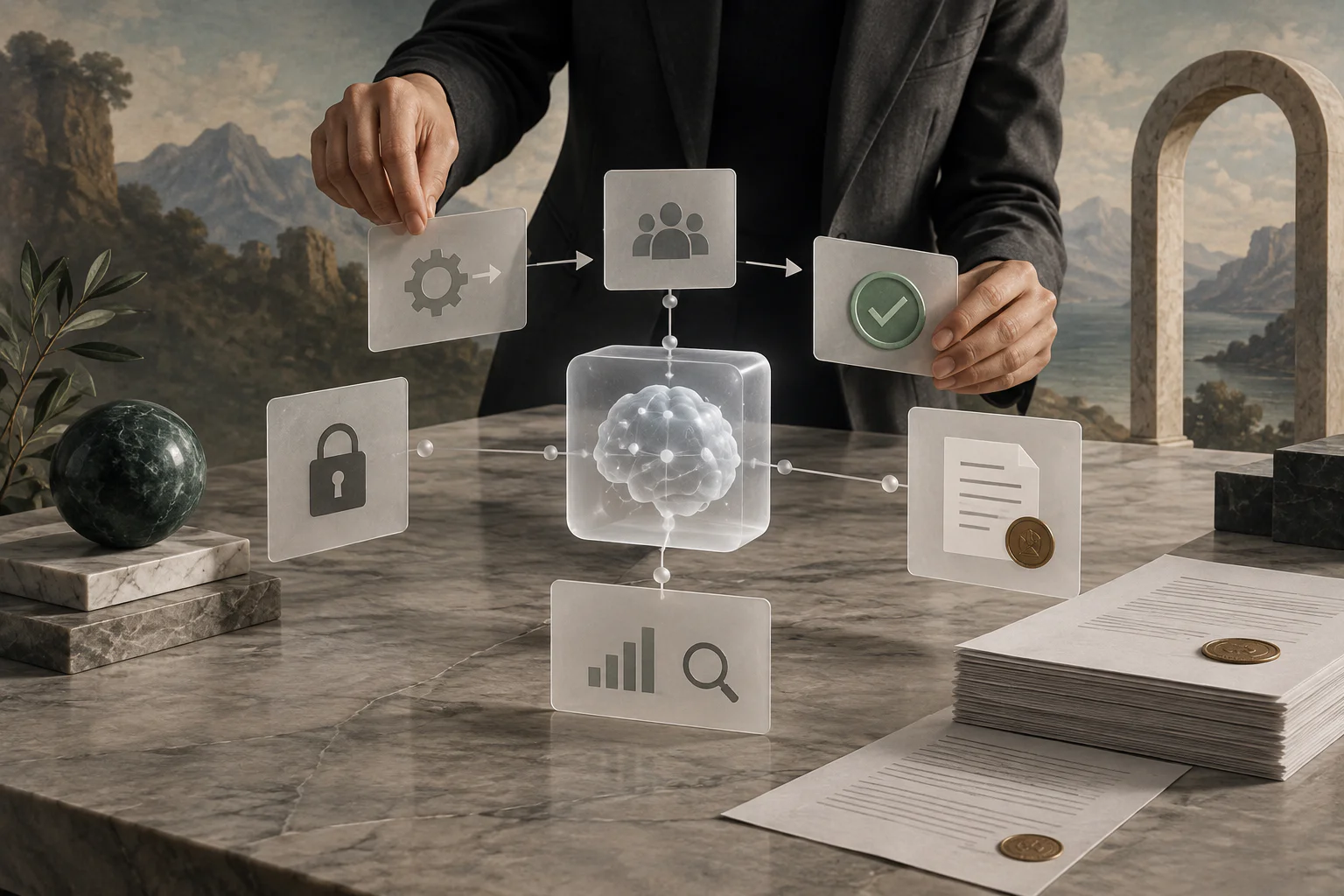
AI workflow governance works best when every automated action has an owner, a boundary, and a visible record.
An AI workflow governance checklist helps business teams move from experiments to production automation without losing control of decisions, data, approvals, or accountability. The point is to decide which AI actions can run automatically, which ones need human review, which systems the AI may touch, and what evidence must exist when someone asks, “Why did this happen?”
This matters because AI is no longer limited to drafting text. Teams are using AI to classify requests, summarize documents, recommend approvals, route cases, create tasks, trigger notifications, update records, and suggest next actions. Once AI touches a real workflow, governance becomes operational work, not just a policy document.
What’s in this article?
- A practical AI workflow governance checklist for business teams.
- A risk-tier model for deciding when human review is required.
- A table of controls that should exist before production launch.
- Common mistakes that make AI automation hard to audit.
- How Workhint fits as the orchestration layer around AI-enabled workflows.
Why AI Workflow Governance Matters
Good AI governance connects business intent, technical controls, and operating evidence. The NIST AI Risk Management Framework describes AI risk management as a way to improve the trustworthiness of AI systems across their design, development, use, and evaluation. NIST’s AI RMF Core also organizes work into Govern, Map, Measure, and Manage, which is a useful lens for workflow teams.
For business automation, those ideas need to become concrete. A policy that says “use human oversight” is not enough. The workflow needs a review queue, role-based permissions, escalation rules, audit logs, rollback paths, owner dashboards, and monitoring.
AI Workflow Governance Checklist
Use this checklist before launching an AI-enabled workflow into daily operations.
- Name the workflow owner. Assign one accountable business owner and one technical owner. Governance fails when everyone assumes someone else is watching the automation.
- Define the AI’s job. Write down whether AI is classifying, extracting, summarizing, recommending, deciding, routing, or executing. Each role carries a different risk level.
- List connected systems. Document every system the workflow can read from or write to, including CRM, HRIS, finance, ticketing, document storage, scheduling, messaging, and payment tools.
- Set permission boundaries. Limit the AI to the minimum data, tools, and actions required. If it should summarize invoices, it should not also approve payments unless that is explicitly governed.
- Create risk tiers. Separate low-risk suggestions from high-impact actions. A suggested tag may be low risk; a vendor approval, worker classification, refund, access change, or payment release is not.
- Define human review triggers. Require review for low confidence, policy exceptions, sensitive data, high-value transactions, ambiguous cases, and actions that affect access, money, employment, compliance, or customer commitments.
- Capture decision evidence. Store inputs, outputs, rule matches, reviewer notes, timestamps, source documents, and final disposition.
- Monitor quality and drift. Track accuracy, override rates, exception volume, escalation time, user feedback, and changes in the types of cases entering the workflow.
- Prepare incident response. Decide who pauses the workflow, who investigates, who communicates impact, and how corrected records are restored.
- Review governance regularly. Reassess rules after model changes, process changes, new integrations, or repeated exceptions.
Risk Tiers for AI Workflow Automation
The fastest way to make governance usable is to classify actions by consequence, not by how impressive the AI feels.
| Risk tier | AI action | Example | Governance control |
|---|---|---|---|
| Low | Suggests or summarizes | Summarizing a support request | Sampling review and user feedback |
| Medium | Routes or prioritizes work | Assigning an invoice exception to finance | Confidence thresholds and queue monitoring |
| High | Recommends a decision | Suggesting vendor approval or contractor eligibility | Mandatory human approval and evidence capture |
| Critical | Executes an irreversible or regulated action | Changing access, releasing payment, or rejecting a worker | Human approval, dual control, audit logs, rollback plan |
This tiering model keeps simple automation moving while protecting decisions that create financial, legal, privacy, compliance, employment, or customer risk.
Controls to Put in Production
Before a governed AI workflow goes live, confirm that these controls are implemented in the workflow, not just mentioned in a policy.
- Inventory: the workflow, AI model or service, tools, data sources, owners, and connected systems are recorded.
- Access control: roles and permissions determine who can configure, approve, override, view, and export workflow data.
- Data handling: sensitive fields, retention rules, and allowed data uses are documented.
- Prompt and rule versioning: prompts, schemas, routing rules, thresholds, and model settings are versioned before changes reach production.
- Human approvals: review queues exist for high-risk cases.
- Audit trail: each workflow decision has a record that a reviewer can inspect later.
- Security review: risks such as prompt injection, excessive permissions, data leakage, and unsafe tool use are checked against resources such as the OWASP Top 10 for LLM Applications.
- Management system: larger organizations can align controls with standards such as ISO/IEC 42001 when they need a formal AI management system.
Practical Example
Consider an AI-assisted vendor onboarding workflow. AI extracts vendor details from forms, checks for missing documents, summarizes risk notes, and recommends whether the vendor should move to legal, finance, security, or operations review. Governance should focus on what happens after AI touches the workflow.
A governed version keeps AI recommendations separate from approval authority. It routes incomplete cases back to the vendor, sends high-risk vendors to the right reviewer, requires finance approval before payment setup, logs each reviewer decision, and surfaces repeated exceptions to the operations owner.
Common Governance Mistakes
- Governance starts after launch. Controls are harder to retrofit once teams depend on the workflow.
- The AI has broad tool access. Excessive permissions turn a helpful assistant into an operational risk.
- Review rules are vague. “Human in the loop” does not mean much unless the workflow defines who reviews what and by when.
- Logs capture activity but not evidence. A timestamp is useful, but teams also need the input, output, policy trigger, reviewer, and final action.
- No one owns drift. Workflow quality can decline as forms, vendors, policies, customer issues, or business rules change.
Where Workhint Fits
Workhint fits around the AI model as the operational system that turns governance into daily execution. AI may classify a request, extract data, summarize a case, or recommend the next action. Workhint can structure the surrounding workflow: intake, roles, permissions, assignments, approvals, documents, schedules, reporting, escalation, and automation.
That distinction matters. A model does not replace workflow ownership. Teams still need governed routing, human approvals, audit trails, and dashboards. For organizations evaluating workflow automation software for governed business operations, the question is whether AI decisions can be embedded into a process people can review, improve, and trust.
FAQ
What is an AI workflow governance checklist?
It is a practical list of controls that define how AI is allowed to participate in a business workflow, including ownership, permissions, review rules, monitoring, audit evidence, and incident response.
Which AI workflows need governance?
Any AI workflow that touches customer records, worker decisions, vendor approvals, financial actions, regulated data, system access, scheduling, payments, or operational commitments should have explicit governance.
Does every AI action need human approval?
No. Low-risk summaries or suggestions can often use sampling review. High-impact decisions and irreversible actions should require human approval, stronger evidence, and clearer escalation paths.
Who should own AI workflow governance?
The business process owner should own the outcome, while technical, security, legal, compliance, and operations leaders support the controls. Governance is strongest when ownership is tied to the workflow itself.
Conclusion
AI workflow governance is not a blocker to automation. It is what lets automation scale beyond pilots. The right checklist gives teams a shared model for what AI can do, when people must review it, what evidence is captured, and how the workflow improves. Start with ownership, risk tiers, permissions, approvals, audit trails, monitoring, and incident response. Then turn those rules into the workflow itself.
Leave a Reply