


A process without a real owner becomes everybody’s problem and nobody’s system.
Business process owner responsibilities are the duties assigned to the person accountable for how a business process performs from end to end. The role is not just documenting steps, running meetings, or reminding people to update a tracker. A good process owner makes sure the process has a clear purpose, working rules, defined roles, measurable outcomes, escalation paths, and a regular improvement rhythm.
This matters because most broken processes do not fail in one team. They fail between teams. Sales promises something operations cannot see. Finance waits for missing information. Support escalates issues without knowing who decides. Managers debate ownership after the deadline has already slipped. Process ownership gives cross-functional work one accountable operator.
What’s in this article?
- What a business process owner actually owns
- The responsibilities that should be explicit
- A simple ownership model operations teams can use
- Common mistakes that weaken process accountability
- How Workhint turns process ownership into a live work system
Why process ownership matters
Process ownership is part of process governance. It connects the design of a process to the daily reality of work moving through it. Frameworks such as the APQC Process Classification Framework help teams define process scope, while business process management platforms such as SAP Signavio emphasize process visibility, improvement, and accountability. The operational lesson is simple: if a process matters, someone must be accountable for its health.
That accountability is different from doing every task. The process owner may not approve every request, answer every exception, or update every record. Their job is to make sure the process can run reliably across owners, systems, and handoffs.
Core business process owner responsibilities
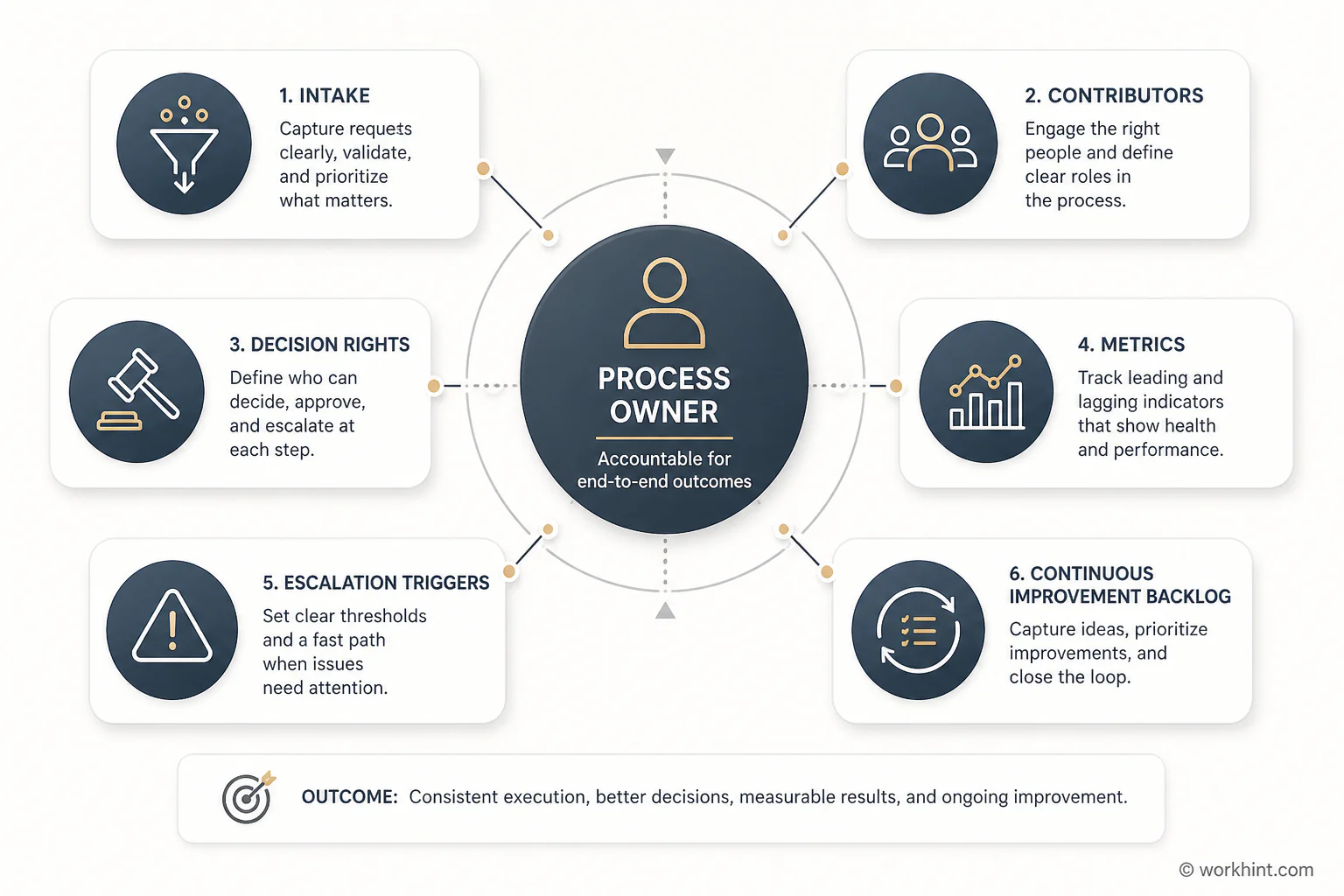
The exact responsibilities depend on the process, but most business process owners should own six things.
1. Process purpose and scope
The owner defines what the process is for, where it starts, where it ends, what is in scope, and what belongs somewhere else. This prevents process sprawl. A vendor onboarding process, for example, might start when a business user requests a new vendor and end when the vendor is approved, contracted, and available for work.
2. Roles and decision rights
The owner clarifies who submits work, who reviews it, who approves exceptions, who performs each step, and who can change the process. This is where many teams confuse collaboration with ownership. Many people can contribute, but one owner should be accountable for the process design and operating results.
3. Process standards and documentation
The owner maintains the current process map, SOP, forms, templates, required fields, service expectations, and control points. Quality management systems such as ISO 9001 put heavy emphasis on defined processes, responsibilities, evidence, and continual improvement. Even if your team does not need certification, the operating habit is useful.
4. Metrics and performance review
The owner defines the process metrics that reveal whether work is moving properly. Useful metrics often include cycle time, backlog, aging work, error rate, rework, handoff delays, SLA misses, customer or internal satisfaction, and exception volume.
5. Escalations and exception handling
The owner defines what happens when the process cannot follow the standard path. That includes overdue items, missing information, rejected approvals, policy exceptions, urgent requests, capacity issues, and disputes between teams.
6. Continuous improvement
The owner keeps an improvement backlog, reviews recurring friction, prioritizes changes, and confirms that changes actually improve outcomes. Without this responsibility, process ownership becomes maintenance instead of management.
A simple process ownership model
Use this model when assigning process ownership in an operations team.
| Element | What the owner defines | Operating question |
|---|---|---|
| Outcome | The result the process must deliver | What must be true when the process works? |
| Scope | Start point, end point, and boundaries | What is included and excluded? |
| Roles | Submitters, performers, reviewers, approvers, contributors | Who does what? |
| Decision rights | Who can approve, reject, override, or change rules | Who has authority when work is blocked? |
| Metrics | Cycle time, quality, backlog, exceptions, satisfaction | How do we know the process is healthy? |
| Escalation | Triggers, paths, owners, response expectations | What happens when the standard path fails? |
| Improvement | Review cadence, backlog, change rules, learning loop | How does the process get better? |
How to assign a business process owner
Start by choosing the person closest to the end-to-end outcome, not simply the person who performs the most tasks. A procurement process owner may sit in operations, finance, or procurement depending on who is accountable for vendor readiness. A customer onboarding process owner may sit in customer success, implementation, or operations depending on who owns time-to-value.
Then write a short ownership charter. Include the process name, business outcome, scope, process owner, supporting teams, approval authority, key metrics, escalation rules, review cadence, and change-control process. Keep it practical. If the charter cannot fit on one page, the ownership model is probably unclear.
Finally, review ownership quarterly or whenever the process changes materially. New products, new regions, AI-assisted steps, vendor changes, compliance requirements, or higher volume can all shift what the owner needs to control.
Common process ownership mistakes
- Naming a coordinator instead of an owner. A coordinator tracks activity. An owner is accountable for process performance.
- Assigning ownership to a committee. Committees can advise, but they rarely resolve blocked work quickly.
- Ignoring decision rights. If the owner cannot change rules, escalate issues, or influence priorities, the title has little value.
- Measuring only task completion. Completion does not prove quality, speed, or customer impact.
- Leaving the process in documents. SOPs are useful, but the real process lives in intake, routing, approvals, dashboards, and records.
Where Workhint fits
Workhint helps teams turn process ownership into a live work system. Instead of leaving the ownership model in a slide or SOP, a team can build the intake flow, roles, permissions, assignments, approvals, escalation rules, dashboards, records, and reporting around the process.
For example, a process owner for vendor onboarding could use Workhint to collect requests, route risk reviews, assign document tasks, capture approvals, trigger escalation when information is missing, show backlog by stage, and keep an improvement history. The owner still defines the process. Workhint helps make the process visible, repeatable, and easier to improve.
FAQ
What is a business process owner?
A business process owner is the person accountable for how a business process performs from end to end. They define the process, clarify roles, monitor metrics, manage exceptions, and drive improvements.
Is a process owner the same as a process manager?
Not always. A process owner is accountable for process outcomes and design. A process manager may handle day-to-day coordination, reporting, or execution. In smaller teams, one person may do both.
Can a process have multiple owners?
A process can have multiple contributors, reviewers, or subprocess owners, but one person should be accountable for the end-to-end process. Shared ownership usually weakens escalation and improvement.
What metrics should a process owner track?
Useful metrics include cycle time, backlog, aging work, rework, error rate, missed deadlines, exception volume, handoff delays, and satisfaction from internal or external customers.
Conclusion
The best process owners do not merely keep documentation current. They keep the work system healthy. They define the outcome, clarify roles, control decision rights, watch the metrics, resolve exceptions, and improve the process as the business changes. If a process crosses teams, affects customers, controls risk, or determines execution quality, it needs a real owner.
Leave a Reply