


Use this log to turn scattered customer complaints into owned, trackable, improvement-ready work.
A customer complaint log template gives a business one consistent place to record customer issues, assign follow-up, track resolution, and review patterns over time. It is not just a spreadsheet for unhappy messages. Used well, it becomes an operating record for customer experience, quality control, support, product, field operations, finance, and account management.
The goal is simple: every complaint should have a clear owner, status, severity, next action, and final outcome. Without that structure, complaints disappear into inboxes, chat threads, call notes, and memory. The customer waits, the same issue repeats, and the business loses the signal that could have prevented the next problem.
What is included
- A copy-ready customer complaint log template.
- Fields for severity, category, owner, status, resolution, and follow-up.
- A practical workflow for intake, triage, investigation, response, and review.
- An example complaint log entry that shows how the template works.
- Common mistakes that make complaint tracking unreliable.
How to use this customer complaint log template
Start by deciding which complaints belong in the log. A complaint can come through email, phone, chat, a support ticket, an account manager, a field team, a vendor, or a public review. If the customer is reporting a specific problem that needs action, create a log entry. Do not wait until the issue becomes escalated.
Capture the complaint in the customer’s words first, then add internal fields for routing. The FTC’s customer complaint guidance is a useful reminder that a strong complaint record should include the customer’s contact details, account or transaction reference, product or service information, dates, and the requested remedy. Internal teams can add severity, owner, root cause, and follow-up after intake.
Keep the log centralized. The Scottish Legal Complaints Commission complaint log guidance notes that complaint processes work better when complaint information is recorded and collated centrally. That principle applies beyond legal services. A central log helps teams see whether one customer has a one-off issue or whether many customers are experiencing the same failure.
Customer complaint log template
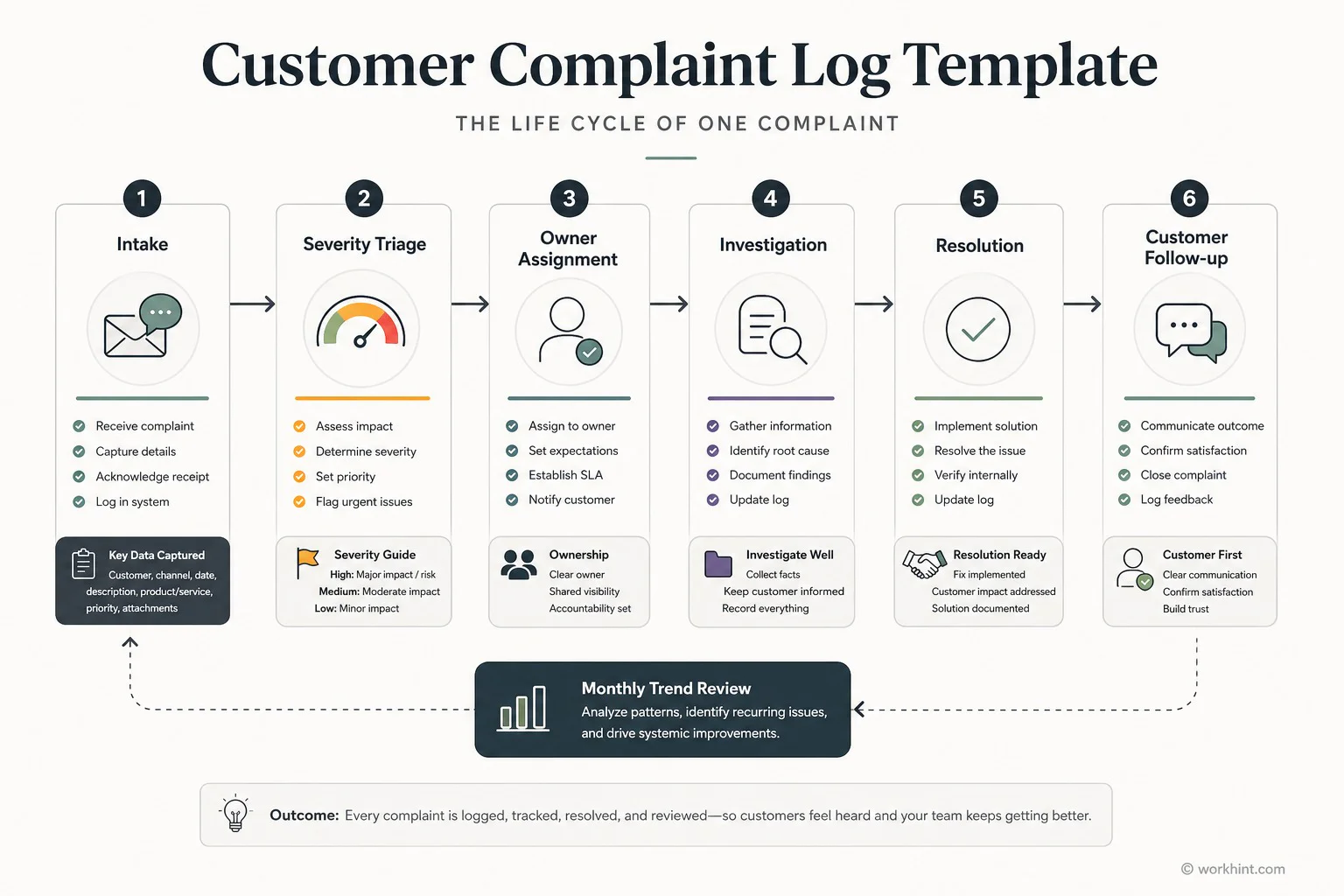
Copy the fields below into a spreadsheet, CRM, helpdesk, operations workspace, or workflow system. Keep the first version practical. You can add automation later, but every team should be able to understand the log without training.
| Field | What to capture | Example |
|---|---|---|
| Complaint ID | Unique reference for the complaint. | COMP-1042 |
| Date received | When the customer first reported the issue. | August 2, 2026 |
| Customer | Name, company, account, or contact record. | Northline Services, Priya Rao |
| Channel | Where the complaint arrived. | Email, phone, chat, form, review, account call |
| Category | The complaint type. | Billing, delivery, service quality, access, product, communication |
| Description | Plain-language summary of the issue. | Invoice included a charge for cancelled work. |
| Severity | Priority based on customer impact and business risk. | Low, medium, high, urgent |
| Owner | Person accountable for resolution. | Customer operations manager |
| Status | Current state of the complaint. | New, assigned, investigating, waiting, resolved, closed |
| Root cause | What appears to have caused the issue after review. | Cancelled scope was not updated before invoice approval. |
| Resolution | What the business did for the customer. | Issued credit and updated invoice approval checklist. |
| Follow-up date | When someone confirms the customer is satisfied or the fix held. | August 9, 2026 |
Complaint severity guide
Severity should be based on impact, urgency, and risk. Avoid making every frustrated message urgent, but do not bury complaints that could affect safety, money, privacy, contracts, or customer trust.
| Severity | Use when | Response expectation |
|---|---|---|
| Low | The issue is minor, isolated, and does not block the customer. | Acknowledge and resolve in the normal queue. |
| Medium | The issue affects work, billing, access, quality, or repeat confidence. | Assign an owner and give the customer a clear update path. |
| High | The issue affects an important customer, deadline, payment, compliance item, or repeated failure. | Escalate to the accountable manager and set a response deadline. |
| Urgent | The issue involves safety, legal exposure, data risk, major outage, or serious customer harm. | Trigger the formal incident, legal, security, or executive escalation path. |
Complaint resolution workflow
- Capture the complaint. Record the source, customer, date, product or service, description, and requested outcome.
- Acknowledge receipt. Tell the customer the issue was received, who owns it, and when they can expect the next update.
- Triage severity. Decide whether the complaint can stay in the normal queue or needs escalation.
- Investigate the cause. Review orders, messages, invoices, service notes, files, system records, or delivery evidence.
- Decide the response. Choose the remedy, correction, credit, explanation, rework, replacement, or escalation.
- Close the loop. Confirm the outcome with the customer and record the final status.
- Review trends. Look monthly for repeated complaint categories, owners, locations, vendors, products, or workflow steps.
This is where the log becomes useful. ISO’s quality management standards overview describes quality management as helping organizations improve products and services and consistently meet customer expectations. A complaint log supports that idea when the business uses it to identify patterns, not just close individual tickets.
Example complaint log entry
| Field | Entry |
|---|---|
| Complaint ID | COMP-1042 |
| Category | Billing |
| Severity | High |
| Description | Customer says a cancelled field visit was included on the July invoice. |
| Owner | Finance operations lead |
| Root cause | Operations cancelled the visit, but finance did not receive the cancellation record before invoice approval. |
| Resolution | Credit issued, invoice resent, cancellation status added to invoice review checklist. |
| Follow-up | Account manager to confirm customer acceptance within five business days. |
Common mistakes
- Logging only escalations. Small complaints often reveal the pattern before the big failure appears.
- Skipping ownership. A complaint without one accountable owner becomes a shared concern and nobody’s job.
- Confusing complaint intake with root cause. The first message tells you what the customer experienced. Investigation tells you why it happened.
- Closing the entry too early. Close only when the response is complete, recorded, and communicated.
- Never reviewing patterns. A log that is never reviewed is an archive, not a management tool.
Where Workhint fits
Workhint helps teams turn a customer complaint log template into a live complaint resolution workflow. A team can collect complaints through intake forms, route them by category and severity, assign owners, attach evidence, set response deadlines, escalate high-risk issues, track customer follow-up, and review recurring problems in one operational system.
That matters when complaints touch more than support. A billing complaint may need finance. A quality complaint may need operations. A delayed service complaint may need scheduling, field teams, vendors, and account management. Workhint keeps the template connected to the work required to resolve the complaint.
FAQ
What is a customer complaint log?
A customer complaint log is a structured record of customer issues, including who reported the complaint, what happened, who owns the response, the current status, the resolution, and any follow-up action.
What should a customer complaint log template include?
Include complaint ID, date received, customer, channel, category, description, severity, owner, status, root cause, resolution, follow-up date, and closure notes.
What is the difference between a complaint log and a feedback survey?
A feedback survey measures broader customer sentiment. A complaint log tracks a specific issue that needs investigation, ownership, response, and closure.
How often should teams review complaint logs?
Review open complaints weekly and complaint trends monthly. High-risk complaints should be reviewed immediately through the relevant escalation path.
Conclusion
A customer complaint log template gives teams a practical way to respond faster, preserve facts, assign ownership, and learn from recurring issues. Start with the core fields, keep the process simple, review patterns regularly, and connect the log to the workflows that actually fix the problem. The complaint is only the beginning. The operational response is what protects the customer relationship.
Leave a Reply