

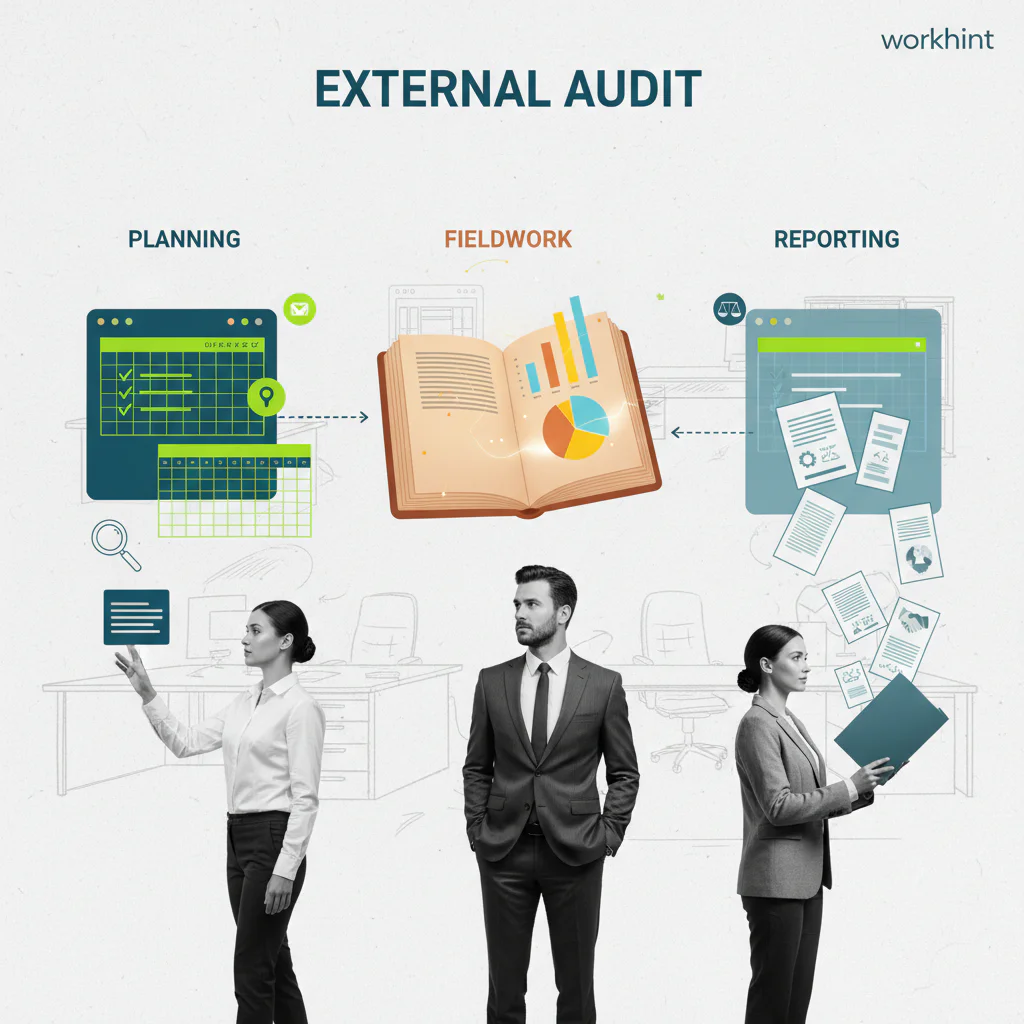
Feeling lost in endless audit checklists? Get clear on each phase so the process stops feeling like chaos.
Imagine you are staring at a stack of audit paperwork and the only thing that feels certain is the sense that something is missing. The checklist stretches forever, each item seems to belong to a different owner, and the handoff between internal staff and the external auditors feels like a game of telephone. That moment of quiet frustration is not a failure of will but a symptom of a work system that was never designed to make the invisible visible. When coordination is assumed rather than built, ownership drifts, and execution stalls in the gaps between who should do what and when. In this article we will follow the natural rhythm of an external audit, uncovering the hidden friction that slows teams and showing why naming that friction is the first step toward a smoother flow. Let us begin with the first phase, the kickoff, where expectations are set and the stage for everything that follows is laid.
One. How does a clear kickoff prevent hidden friction?
A kickoff that spells out who does what, when, and why turns a vague promise into a shared contract. When the external auditors arrive, they need to know the exact templates, the sample sizes, and the documentation format that will satisfy their review. By naming those artifacts up front, teams avoid the endless email chase that usually follows a vague agenda. The practice described by Bridgepoint Consulting shows that a simple checklist of deliverables, aligned with a timeline, reduces the number of clarification loops by half. It also creates a visible map of ownership, so no one slips into a gray zone where responsibility is assumed rather than assigned. The result is a smoother handoff, less duplicated effort, and a sense that the audit is a coordinated dance rather than a chaotic scramble.
Two. What does collaborative audit design look like across three lines?
When an audit touches operations, risk, and compliance, the three lines of defense must speak the same language. Collaboration is not a buzzword; it is a structure where internal audit acts as a conduit, translating strategic priorities into actionable steps for the business line and the oversight line. Internal Auditor Magazine highlights that teams who embed joint work sessions at the planning stage see faster issue resolution and stronger buy in. In practice this means scheduling a short alignment meeting after the kickoff, where each line lists its key concerns and agrees on evidence thresholds. The shared workspace becomes a living record rather than a static file drop. By treating the audit as a joint problem solving effort, organizations turn a compliance exercise into an opportunity for continuous improvement.
Three. How can automation turn evidence gathering from bottleneck to breeze?
Collecting proof of controls often feels like digging for treasure with a spoon. Automation replaces the spoon with a metal detector, surfacing the right documents at the right moment. Hyperproof demonstrates that a workflow that pulls logs, policy files, and test results into a single dashboard cuts collection time dramatically. The key is to map each audit objective to a data source and configure a trigger that updates the evidence repository as soon as new information appears. Teams then spend their energy on analysis, not on hunting. Moreover, an automated trail creates a transparent audit trail that external reviewers can follow without requesting additional files. The shift from manual chase to real time feed frees staff to focus on insight, turning the audit from a cost centre into a strategic asset.
The coordination gap highlighted in the audit example is fundamentally an ownership and visibility problem. When responsibilities are conveyed through ad‑hoc emails or informal meetings, the record of who should act and when is scattered, so delays and duplicated effort appear inevitable. Such informal coordination persists because there is no single source that records assignments, tracks handoffs, and surfaces status for all participants. A centralized work system supplies that missing backbone: it stores the agreed‑upon tasks, links them to the responsible party, and updates a shared view as work progresses. This structural layer turns implicit expectations into explicit data that can be referenced at any moment. Workhint, for instance, serves as one example of a centralized work system that embodies this approach, anchoring ownership and visibility within a unified platform. By providing a common ledger of work, the system removes the reliance on memory and individual messaging, which is why the pattern recurs across many external‑focused processes.
At the start we asked how a system can move from invisible friction to clear flow. Walking through kickoff, joint design and automated evidence shows that the answer is not a new tool but a simple act: give every step a name and a owner. When the map is visible the gaps disappear and the audit becomes a conversation rather than a chase. The lasting lesson is that clarity is a habit, not a project; each time we pause to label the hidden tug we turn chaos into a rhythm we can follow. Carry that habit forward and watch future audits feel less like a storm and more like a steady tide.
Leave a Reply