


Paying Mexico-based contractors works best when finance treats the payment as a documented operating workflow, not a one-off transfer.
Companies that pay contractors in Mexico need more than a payment app. They need a repeatable process for contractor status, tax records, invoices, currency decisions, approval routing, payment confirmation, and reconciliation. Without that structure, payments become slow, expensive, and difficult to defend during finance reviews.
This guide is written for finance and operations teams paying independent contractors, agencies, technical talent, creative partners, consultants, and service providers based in Mexico. It is not legal or tax advice. Use it as an operating framework, then confirm details with qualified counsel or a local advisor for your exact facts.
What’s in this article?
- The documents to collect before the first payment
- How CFDI, RFC, CLABE, SPEI, and W-8BEN fit into payment operations
- Payment method tradeoffs for Mexico contractor payments
- A practical approval and reconciliation workflow
- Common mistakes finance teams should avoid
Why Mexico contractor payments need a workflow
Mexico is a common contractor market for US and global companies because of time zone overlap, strong technical and operational talent, and growing cross-border service work. The finance challenge is that a contractor payment touches several systems at once: HR or operations owns the relationship, legal owns the agreement, finance owns the payment, and accounting owns the record.
If those steps are handled manually, the payment may move before the contract is signed, the wrong currency may be used, the invoice may lack required details, or the payment confirmation may never reach the accounting system. A small process gap becomes a month-end reconciliation problem.
How to pay contractors in Mexico
The cleanest process is to approve the contractor, collect payment and tax records, agree on currency and payment timing, require a usable invoice, route payment through finance approval, and reconcile the transfer against the invoice and contract. The payment rail matters, but the workflow matters more.
1. Confirm contractor status before payment
Before finance sends money, the business should confirm the person or company is being engaged as an independent contractor, not managed like an employee. The agreement should define scope, deliverables, ownership of work product, payment terms, confidentiality, termination, and dispute handling. For higher-risk roles, get local legal review before the first invoice is approved.
2. Collect the right records
For a US company paying a non-US individual, the IRS says Form W-8BEN is used by a foreign person to certify foreign status to the withholding agent or payer. Entities generally use the entity version of the W-8 form. Keep the form in your vendor file rather than treating it as an attachment lost inside email.
For the Mexico side, ask the contractor what invoice documentation they can provide and whether they issue CFDI invoices. SAT publishes official CFDI 4.0 invoice materials, and the invoice record should be kept with the payment approval. If the contractor issues a CFDI, finance should store the XML or PDF record, invoice number, date, amount, currency, service description, and tax details. SAT also provides a CFDI verification portal that teams can use when they need to validate a fiscal receipt.
3. Decide the payment method and currency
Common options include international wire, global contractor payment platform, local transfer through a payment provider, or a bank transfer into a Mexican account using local account details. Mexico’s SPEI system, operated by Banco de Mexico, enables fast electronic payments between bank deposit accounts; Banco de Mexico describes SPEI as an electronic payment system for near-immediate transfers.
For many finance teams, the practical question is whether to pay in USD or MXN. USD may be easier for the payer, but MXN can reduce uncertainty for a contractor who spends locally. The agreement should specify currency, who bears FX fees, the exchange-rate source if conversion is needed, expected settlement timing, and what happens if the payment provider returns or delays a transfer.
Payment method comparison
| Method | Best for | Watchouts |
|---|---|---|
| International wire | Large or occasional payments | Higher bank fees, slower troubleshooting, less transparent FX |
| Global payment platform | Recurring contractor programs | Platform coverage, onboarding friction, fee structure |
| Local MXN transfer | Contractors with Mexican bank accounts | Requires accurate local account details and provider support |
| Card-funded payment | Short-term cash timing flexibility | Card fees can outweigh convenience |
A payment approval workflow for Mexico contractors
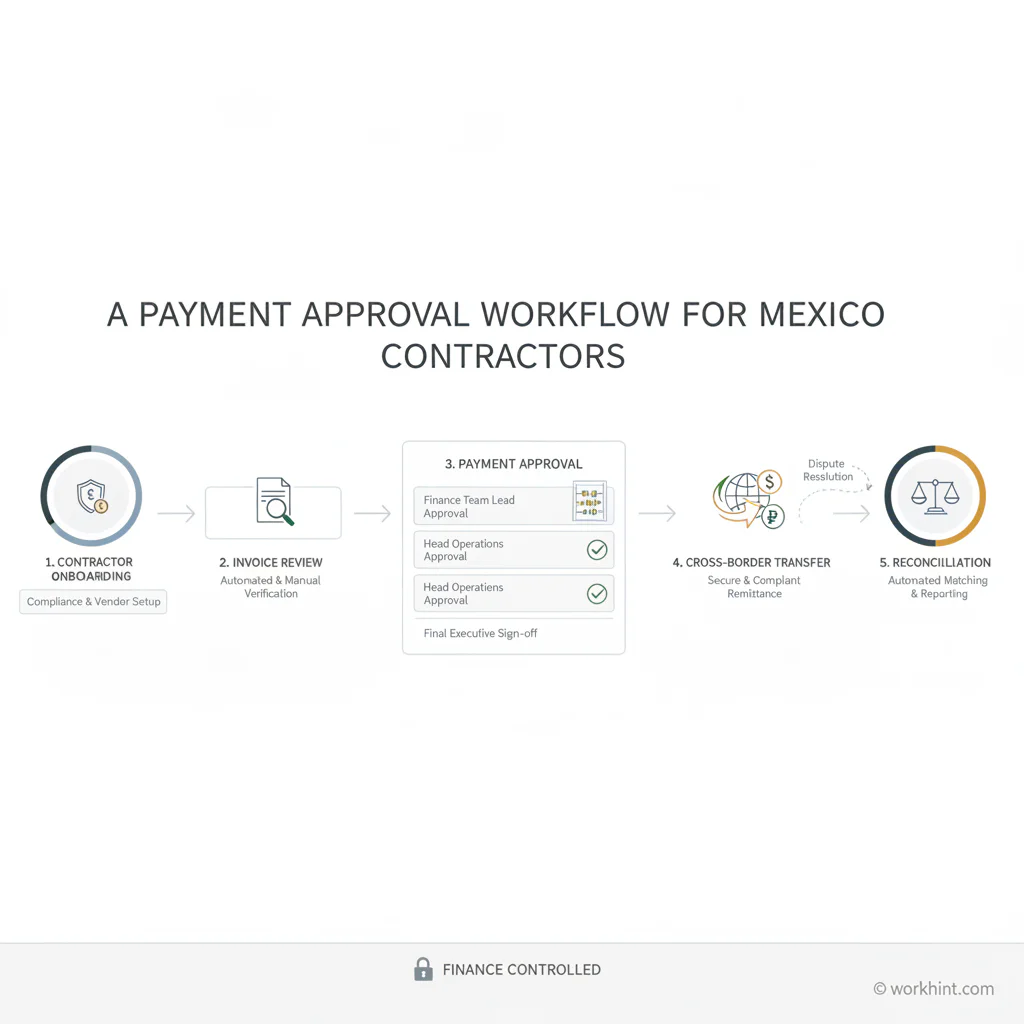
- Contractor submits onboarding records, including legal name, address, tax status, payment details, and required tax form.
- Operations confirms scope, deliverables, rate, and payment schedule.
- Finance reviews the invoice for contractor name, service period, amount, currency, tax details, payment instructions, and supporting records.
- Approver confirms the work was accepted and the invoice matches the agreement.
- Finance schedules payment through the approved rail and records estimated fees and FX rate.
- After settlement, finance stores the confirmation, updates payment status, and reconciles the transaction against the invoice.
This workflow is deliberately simple. The discipline is in making every step visible, assigned, and auditable. The goal is not to slow payments down. It is to prevent rework, missing documents, duplicate transfers, and vendor-status confusion.
Common mistakes to avoid
- Paying from email alone. Email approvals are easy to lose and hard to audit.
- Ignoring currency ownership. If the agreement does not define FX treatment, disputes can appear when rates move.
- Skipping invoice validation. A payment without a clean invoice record creates accounting cleanup later.
- Using one process for every country. Mexico payment details, invoice practices, and local banking terms differ from other markets.
- Separating payment from work acceptance. Finance should know who approved the work and why the invoice is payable.
Where Workhint fits
Workhint helps teams turn this payment process into a live operating workflow. A company can structure contractor onboarding, collect required documents, assign approval steps, route invoices to the right manager, track payment status, and keep records attached to the contractor and project. For Mexico contractor payments, that means finance does not need to chase operations, legal, and accounting across separate spreadsheets and message threads.
The value is not simply sending money. It is making the payment decision traceable from contractor setup to invoice approval to settlement confirmation.
FAQ
What is the best way to pay contractors in Mexico?
The best method depends on payment size, frequency, currency, contractor preference, and documentation needs. For recurring payments, a global payment platform or local-transfer-capable provider is often easier to manage than repeated manual wires.
Do US companies need W-8BEN forms for Mexico contractors?
US companies commonly collect W-8BEN from non-US individual contractors to document foreign status. Confirm the right W-8 form and withholding treatment with a tax advisor, especially if services are partly performed in the United States.
Should contractors in Mexico invoice in USD or MXN?
Either can work if the contract is clear. Finance should define the invoice currency, payment currency, FX source, fee responsibility, and settlement timing before the first payment.
What is CFDI?
CFDI is Mexico’s electronic fiscal invoice framework. If a contractor issues CFDI records, finance should store them with the invoice and payment record so accounting has a clear audit trail.
Conclusion
To pay contractors in Mexico reliably, build the payment around a controlled workflow: classify the relationship, collect records, agree on currency, validate invoices, approve the work, send payment through the right rail, and reconcile the transaction. The companies that handle this well do not rely on heroic finance follow-up. They make contractor payments part of a repeatable operating system.
Leave a Reply