


Starting a cleaning business is one of the more practical service businesses to launch because the first version can be simple: a clear offer, basic supplies, a way to book jobs, and a reliable process for delivering the work. The challenge is not usually the idea. It is turning a few cleaning jobs into a business that can quote, schedule, fulfill, and collect payment consistently.
This guide explains how to start a cleaning business with a realistic launch plan, simple pricing logic, and the operating system you need before the work gets messy.
What’s in this article?
- Why a cleaning business works
- What you need to launch
- How to price cleaning services
- How to get first customers
- How Workhint helps run the operation
- A first 7-day launch plan
- A final launch checklist
Why a cleaning business works
A cleaning business works because the problem is obvious and recurring. Homes, offices, rental units, clinics, gyms, and local businesses all need spaces cleaned repeatedly. The first offer can be narrow, such as standard home cleaning, move-out cleaning, office cleaning, or Airbnb turnover cleaning.
The best starting point is a service you can explain in one sentence and deliver with a repeatable checklist. For example: weekly residential cleaning for busy households, move-out cleaning for property managers, or office cleaning for small professional firms.
The business becomes stronger when you move from one-off jobs to recurring accounts. Recurring weekly, biweekly, or monthly cleaning gives you predictable revenue, easier scheduling, and better customer relationships.
What you need to launch
You do not need a large team to start. You need legal basics, dependable equipment, simple insurance, a clear offer, and a way to manage requests. Requirements vary by city and state, so check local business license rules before taking paid work. Many operators also consider general liability insurance because cleaners work inside customer spaces where property damage or injury claims can happen.
| Startup item | Typical starting range | Why it matters |
|---|---|---|
| Business registration and license | $50-$500 | Lets you operate professionally and meet local requirements. |
| Insurance | $300-$1,000 per year | Protects against common service-business risk. |
| Cleaning supplies | $100-$500 | Covers cleaners, cloths, gloves, trash bags, and consumables. |
| Equipment | $200-$900 | Includes vacuum, mop system, caddy, brushes, and basic tools. |
| Marketing basics | $100-$500 | Website, local listings, flyers, business cards, and first outreach. |
| Scheduling and operations | $0-$200/month | Helps manage leads, bookings, assignments, reminders, and payments. |
A lean residential cleaning business can often start with a few hundred to a few thousand dollars. Commercial cleaning, specialty equipment, employees, and vehicles can push the budget higher.
How to price cleaning services
Pricing should be easy for customers to understand and easy for you to deliver profitably. Most new cleaning businesses start with flat-rate packages for common jobs, then adjust based on home size, condition, frequency, and add-ons.
| Offer | Example pricing model | Best use |
|---|---|---|
| Standard home cleaning | Flat rate by bedrooms or square footage | Simple recurring residential work. |
| Deep cleaning | Standard rate plus condition-based fee | First-time cleans, neglected spaces, or seasonal jobs. |
| Move-in or move-out cleaning | Project quote | Property managers, renters, real estate agents, and landlords. |
| Small office cleaning | Monthly recurring contract | Predictable commercial revenue. |
Do not compete only on being cheap. Compete on reliability, checklist quality, speed of response, and whether customers know exactly what is included.
How to get first customers
The fastest first customers usually come from local trust channels. Start with neighborhoods, property managers, real estate agents, small offices, gyms, salons, Airbnb hosts, and community groups. Your first message should be specific: what you clean, where you serve, what the first package includes, and how someone can book an estimate.
Before spending heavily on ads, build proof. Take before-and-after photos when permitted, collect reviews, create a simple Google Business Profile, and ask early customers for referrals. A cleaning business grows faster when every job creates evidence that the next customer can trust.
How Workhint helps run it
Workhint can help structure the cleaning business as an operating system, not just a list of jobs. A cleaning request can become an intake form, estimate, scheduled job, assigned cleaner, job checklist, customer approval, invoice, payment, and review request.
For a solo operator, that keeps the business organized. For a growing team, it creates consistency: each cleaner knows the assignment, each customer gets the right follow-up, and each job has a clear status. That matters because cleaning businesses often lose margin through missed details, late arrivals, unclear scope, and manual follow-ups.
First 7-day launch plan
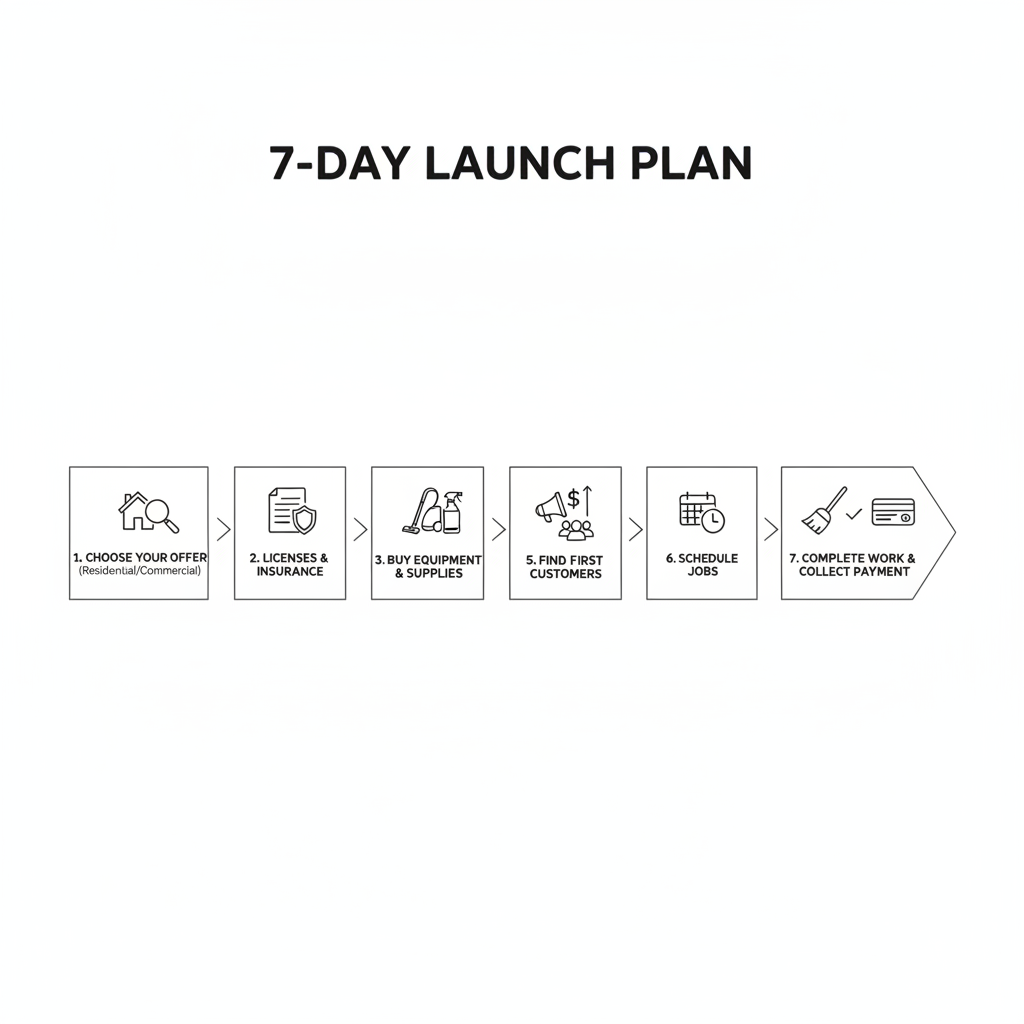
- Day 1: Choose one customer type and one offer, such as standard residential cleaning or move-out cleaning.
- Day 2: Check local license rules, choose a business name, and set up the basic legal and insurance path.
- Day 3: Buy only the equipment needed for your first offer and create a job checklist.
- Day 4: Set three simple packages and define what is included, excluded, and priced as an add-on.
- Day 5: Build your intake form, scheduling process, confirmation message, and payment flow.
- Day 6: Contact 25 local prospects or referral sources with a specific launch offer.
- Day 7: Follow up, book the first estimate or job, and improve the checklist based on real customer questions.
Final launch checklist
- Choose the cleaning niche and first customer segment.
- Confirm local business registration, license, tax, and insurance requirements.
- Create one standard cleaning checklist and one deep-cleaning checklist.
- Buy basic supplies and equipment for the first offer only.
- Create simple pricing packages and add-on rules.
- Set up customer intake, scheduling, job assignment, and payment tracking.
- Create a Google Business Profile and simple landing page.
- Contact first local prospects and referral partners.
- Ask every satisfied customer for a review or referral.
- Review every job to improve scope, timing, pricing, and quality.
A cleaning business is worth starting when you treat it like an operation from day one. The first goal is not to build a big company immediately. It is to create a repeatable service that customers trust, workers can deliver, and the business can manage without losing track of the details.
Leave a Reply