

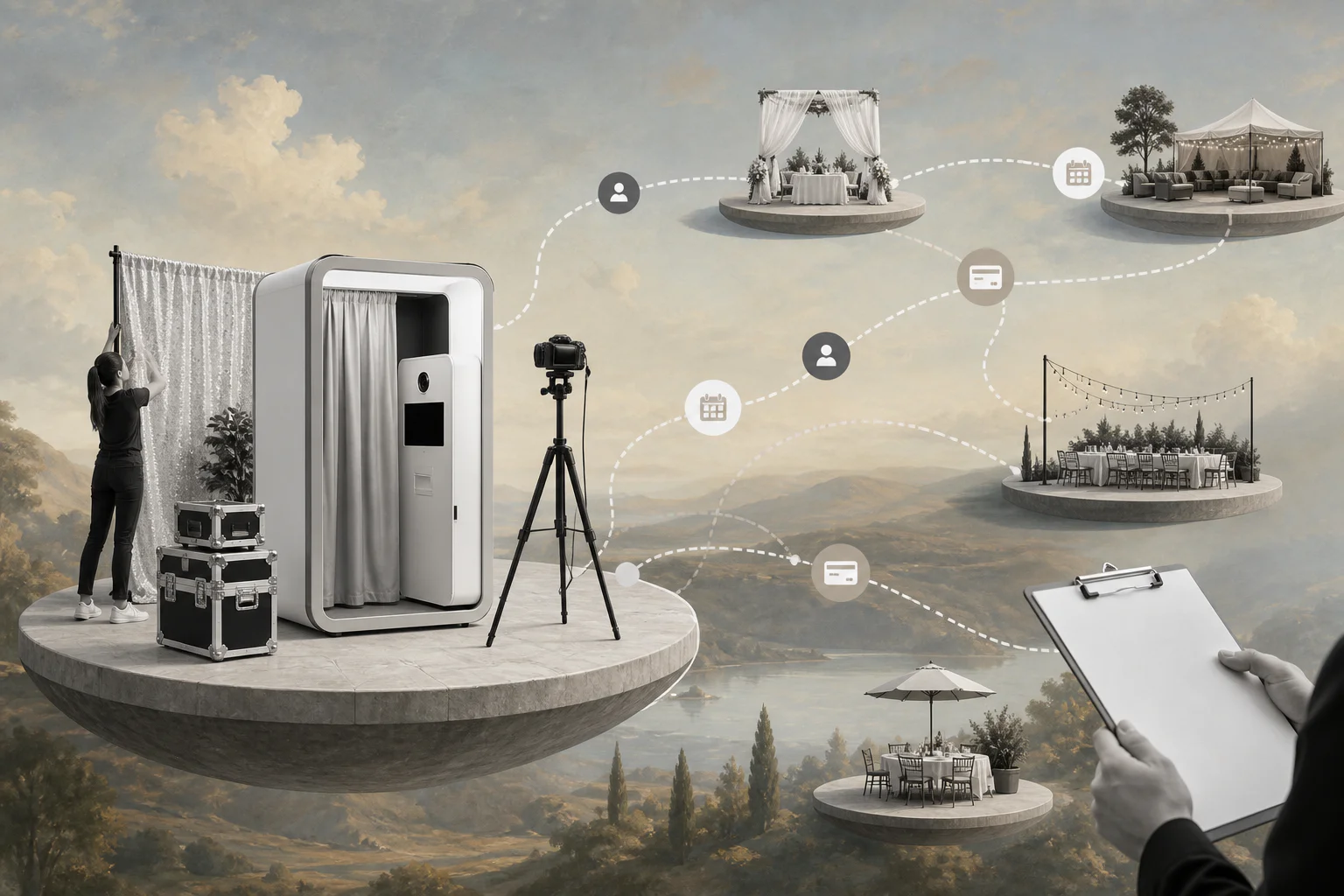
You can sell photo booth bookings before you own a fleet, hire staff, or build custom event software.
If you want to start a photo booth business, traditional advice usually begins with equipment: buy a booth, buy props, build a website, and start selling events.
That path can work, but it is not the only way to launch. A smarter first version is a branded booking platform with a small network of independent booth operators, event assistants, photographers, or rental partners who can fulfill jobs while you validate demand.
This lets you test weddings, corporate events, school functions, brand activations, and private parties without immediately buying every booth type yourself. Your first goal is to prove that people will book through your brand.
What’s in this article?
- Why this business works
- What you need to launch without hiring employees
- How to price photo booth packages
- How to get first customers
- How Workhint helps
- A 7-day launch plan, checklist, and FAQ
Why a photo booth business works
Photo booths sit in a useful part of the event market. They are easy to understand, create visible entertainment, and work across weddings, birthdays, conferences, school dances, launches, and company parties.
The business also has a clean operational model. A customer chooses a package, selects a date and venue, approves add-ons, pays a deposit, receives setup instructions, and gets a booth or attendant at the event.
The best early opportunity is controlling the customer experience. Begin with one offer, partner with booth owners or event contractors, and buy more equipment once bookings prove which packages sell.
Most guides cover booth types, cameras, props, and backdrops. Fewer explain how to coordinate bookings, availability, attendants, setup notes, payments, and follow-up.
What you need to launch
A lean launch needs a brand, a booking process, fulfillment capacity, and clear packages. It does not need an office, full-time employees, or a warehouse of booths.
Start by choosing one market and one first offer, such as open-air photo booth rentals for weddings in one city. Then decide whether you will fulfill events yourself, recruit independent operators, partner with booth owners, or use a hybrid model.
| Launch item | Lean first version | Estimated range |
|---|---|---|
| Business setup | LLC or local registration, bank account, basic contracts | $100 to $800 |
| Insurance | General liability and event vendor coverage where needed | $400 to $1,200 per year |
| Branded platform | Booking intake, customer portal, provider onboarding, payments | Start lean before custom software |
| Equipment access | One owned booth, rented booth, or partner operators | $0 to $6,000 upfront |
| Marketing | Local landing page, Google Business Profile, wedding vendor outreach | $200 to $1,000 |
| Operating materials | Setup checklist, event brief, customer agreement, assistant instructions | $50 to $300 |
If you buy equipment, an iPad or open-air booth is often the simplest first asset. If not, qualify reliable booth owners or event contractors who can operate under your brand standards.
Do not spend heavily on 360 booths, multiple backdrops, storage, or vans before you know what customers will pay.
How to price it
Photo booth pricing usually depends on event duration, booth type, print options, attendant coverage, custom branding, and venue distance. A simple package structure is easier to sell than a long add-on menu.
| Package | Best for | Example price | What to include |
|---|---|---|---|
| Starter booth | Small parties and school events | $400 to $700 | 2 hours, digital gallery, simple backdrop |
| Wedding booth | Weddings and private events | $700 to $1,200 | 3 to 4 hours, attendant, props, gallery, setup |
| Corporate booth | Launches and company events | $1,200 to $2,500+ | Branding, custom backdrop, data capture, premium support |
| Partner fulfillment | Platform-first launch | Keep 20% to 35% margin | Book through your brand, pay independent operator after event |
For a platform-first launch, price high enough to pay the operator, cover fees and support, and still keep a margin. If an operator charges $500 to fulfill a three-hour event, a $750 package leaves room for coordination and profit.
How to get first customers
The fastest first customers usually come from event ecosystems, not broad advertising. Start with planners, venues, DJs, photographers, schools, offices, coworking spaces, and local event organizers.
Create a booking page with three packages, availability rules, and a request form. Then contact local partners with a clear offer: reliable booth booking, quick quotes, polished communication, and referrals.
Use social proof early. After every event, collect setup photos, customer feedback, and a review. The business is easier to sell when the experience looks organized, not improvised.
How Workhint helps launch it
Workhint can generate the branded operating platform before custom software or a coordination team.
A customer can request a booth through your branded portal, choose an event date, describe the venue, select package options, approve a quote, and pay a deposit. Behind the scenes, Workhint can route that request to the right independent operator based on location, availability, booth type, and service standards.
The operator receives the event brief, setup checklist, arrival time, venue notes, and deliverable requirements. Your dashboard tracks quote status, assignments, deposits, messages, event completion, reviews, and contractor payouts.
The real business is not just the booth. It is the promise that an event host can book confidently and every operator follows the same process. Workhint gives you that process from request through payout, so you can validate demand before buying booths or hiring staff.
First 7-day launch plan
- Day 1: Choose one city, one customer segment, and one first package. Avoid trying to serve every event type.
- Day 2: Set up the branded Workhint platform with customer intake, package options, quote status, and booking flow.
- Day 3: Create the pricing, deposit, cancellation, setup checklist, event brief, and payout process.
- Day 4: Recruit three to five independent booth operators, photographers, or event assistants who can fulfill early jobs.
- Day 5: Contact venues, planners, DJs, photographers, schools, offices, and event spaces with your first offer.
- Day 6: Route every inquiry through the platform, issue quotes quickly, and test whether customers accept your pricing.
- Day 7: Review demand, operator readiness, margins, and objections before buying equipment or expanding packages.
Final launch checklist
- Choose a photo booth business name and launch city
- Register the business and set up a payment account
- Confirm insurance requirements
- Create three simple packages with clear duration and deliverables
- Build the branded customer intake and booking flow
- Recruit operators before accepting more bookings than you can fulfill
- Create setup, arrival, event completion, and photo delivery checklists
- Launch outreach to venues, planners, schools, offices, and local event professionals
- Validate demand before buying multiple booths or signing storage leases
FAQ
How much does it cost to start a photo booth business?
A lean launch can start with a few hundred dollars for registration, insurance, marketing, and a branded booking platform if you use partners. Buying your first booth usually raises startup costs into the low thousands.
Do I need to buy a photo booth before selling bookings?
No. You can start by partnering with local booth owners or independent event operators, then buy equipment after you prove which packages sell in your market.
Do photo booth businesses need insurance?
Usually yes. Many venues and corporate customers ask vendors for proof of general liability insurance. Requirements vary by location and event type, so verify them before accepting paid bookings.
How should I price photo booth rentals?
Start with package pricing based on duration, booth type, attendant coverage, delivery, and add-ons. Make sure the price covers fulfillment, travel, fees, support, and profit.
Can I run a photo booth business with no staff?
Yes, if you use independent contractors or partner operators and give them a clear event brief, checklist, assignment process, and payout workflow. The key is process control, not employee headcount.
Who are the best first customers?
Start with venues, wedding planners, DJs, photographers, schools, office managers, and corporate event coordinators. These people already influence event buying decisions.
What should I avoid buying at the beginning?
Avoid buying multiple booths, custom trailers, large prop inventories, storage space, or premium equipment before you have recurring demand and clear package margins.
Conclusion
A photo booth business is easiest to launch when you treat it as a branded event-service platform first and an equipment business second. Validate demand, build a reliable provider network, standardize the customer experience, and invest in owned assets only after bookings justify the spend.
Workhint gives you the operating foundation to do that quickly: customer requests, quotes, assignments, scheduling, event checklists, payments, reviews, and contractor payouts in one branded system.
Leave a Reply