


Contractor compliance works best when classification, documents, access, approvals, and payment all move through one controlled workflow.
An independent contractor compliance checklist helps a business decide whether contractor status is appropriate, document the decision, collect the right records, and manage the engagement without creating employee-style control. The point is not to slow work down. The point is to make the start of work, the approval of work, and the payment of work defensible and repeatable.
This article is written for operations, finance, HR, legal, and business owners who use freelancers, specialists, agencies, consultants, field providers, or other external workers. It is not legal or tax advice. Classification rules vary by country, state, industry, and fact pattern, so use this as an operating checklist and confirm sensitive decisions with counsel or a qualified advisor.
What’s in this article?
- Why contractor compliance matters before work starts.
- The classification questions to review before approving a contractor.
- A practical compliance checklist for documents, access, scope, payment, and records.
- Common mistakes that create avoidable misclassification risk.
- Where Workhint fits when contractor compliance needs to become a live workflow.
Why independent contractor compliance matters
Independent contractors give companies flexible access to specialized work, but the relationship has to be structured correctly. A signed agreement is useful, but it does not decide classification by itself. Regulators look at the real relationship: who controls the work, whether the worker operates independently, how payment works, what the contract says, and whether the company is treating the worker like an employee in practice.
The IRS explains that businesses should consider evidence of control and independence across behavioral control, financial control, and the relationship of the parties. IRS Publication 15-A also says the general rule is that an individual is an independent contractor when the payer controls or directs only the result of the work, not the means and methods used to accomplish it.
For wage-and-hour purposes, the U.S. Department of Labor’s 2026 independent contractor rulemaking describes an economic reality inquiry focused on whether the worker is in business for themself or economically dependent on the potential employer. State rules can be stricter. California’s official ABC test guidance, for example, starts with a presumption that a worker is an employee unless the hiring entity satisfies all three conditions of the test.
Independent contractor compliance checklist
The best checklist is not just a legal questionnaire. It is a sequence of operating gates. Each gate should have an owner, a required record, and a clear rule for whether the contractor can move forward.
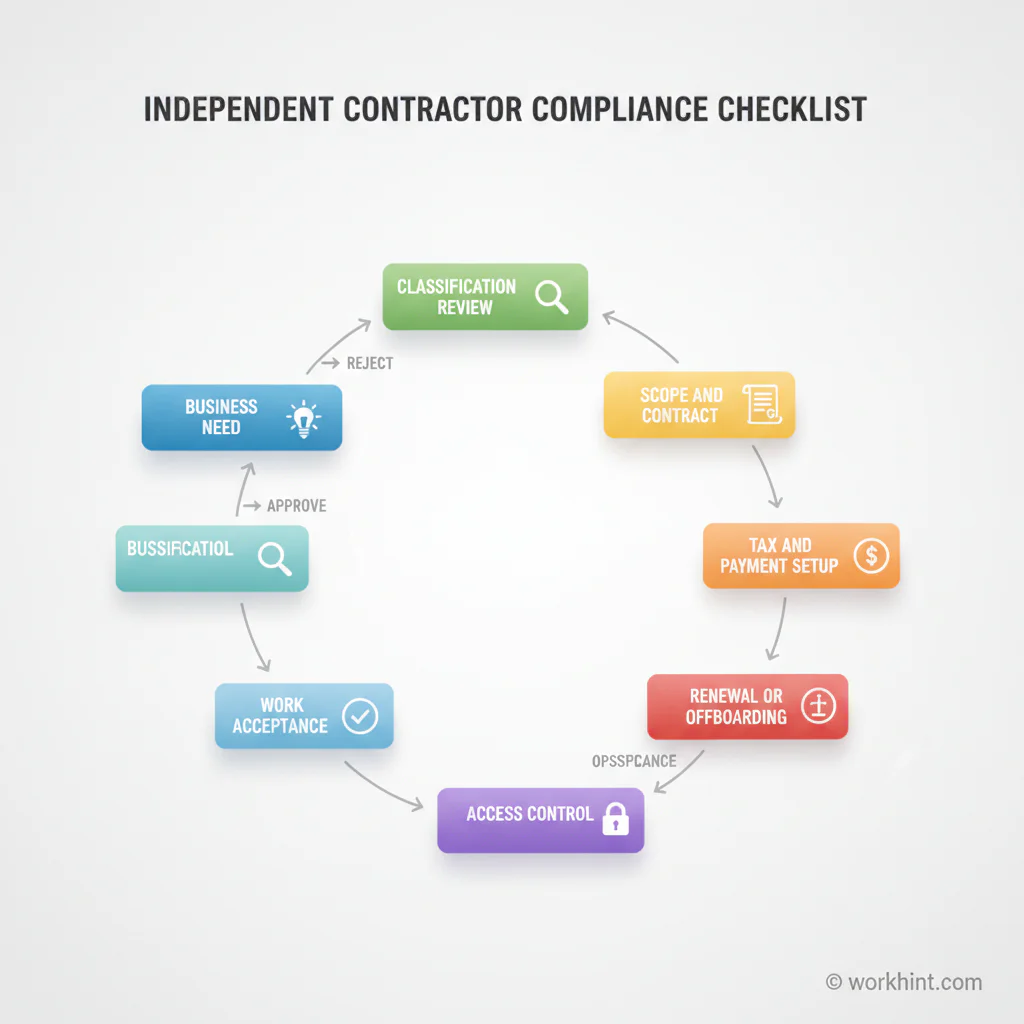
| Gate | What to check | Owner | Output |
|---|---|---|---|
| Business need | Specific outcome, project, timeline, budget, and reason a contractor is appropriate. | Business sponsor | Approved work request |
| Classification review | Control, independence, tools, method of work, permanence, exclusivity, and local rules. | Legal, HR, or compliance | Classification decision record |
| Scope and contract | Statement of work, deliverables, acceptance criteria, IP terms, confidentiality, termination, and change process. | Business sponsor and legal | Signed agreement and SOW |
| Tax and payment setup | W-9 or appropriate tax documentation, payment method, invoice requirements, currency, and withholding review. | Finance | Payment-ready vendor record |
| Access control | Only the systems, data, channels, and permissions needed for the contracted work. | IT or operations | Time-limited access approval |
| Work acceptance | Milestones, deliverable review, approval path, revision process, and payment trigger. | Project owner | Approved deliverable record |
| Renewal or offboarding | End date, extension decision, final payment, document retention, and access removal. | Operations | Closed or renewed engagement |
Step-by-step contractor compliance workflow
- Start with the work, not the person. Define the outcome, deliverable, timeline, and business owner before choosing contractor status.
- Review classification before the offer. Ask whether the company will control how the work is performed, whether the worker has independent business activity, whether the work is project-based, and whether local law uses a stricter test.
- Document the decision. Keep a short record of the facts reviewed. The IRS says no single factor decides status, so the record should explain the full relationship.
- Use a contractor-specific agreement. Avoid employee handbook language, benefits language, open-ended duties, or manager-directed schedules. Use deliverables, acceptance criteria, confidentiality terms, IP terms, and payment rules.
- Collect tax and payment documentation before work begins. IRS guidance on forms and associated taxes for independent contractors covers W-9, 1099-NEC, backup withholding, and nonresident alien withholding considerations.
- Grant limited access. Contractors should receive the tools and information needed for the work, with an expiration date and a clear owner for removal.
- Approve outputs, not daily activity. Review deliverables against the SOW. Avoid turning contractor management into employee supervision.
- Connect approval to payment. Finance should know which deliverables are accepted, which invoices are approved, and what tax record applies before releasing payment.
- Close the loop. At the end of the engagement, remove access, archive the agreement and payment records, and decide whether renewal needs a fresh classification review.
Common contractor compliance mistakes
- Letting work start before classification review: once a contractor is already inside systems, it becomes harder to pause for compliance questions.
- Using employee-style onboarding: mandatory training, assigned hours, direct supervision, and open-ended duties can blur the relationship.
- Collecting documents but losing ownership: a folder of forms is not a workflow if nobody owns review, renewal, retention, or offboarding.
- Ignoring state or country rules: federal tax treatment, wage-and-hour rules, and local classification tests may not line up perfectly.
- Approving payment from email: invoice approval should connect to accepted work, the contractor record, and the payment policy.
Where Workhint fits
Workhint fits when contractor compliance needs to become a repeatable operating system instead of a chain of spreadsheets, forms, messages, and manual reminders. A company can use Workhint to structure the intake request, route classification review, collect contractor documents, limit access by role, assign deliverables, manage approvals, and connect accepted work to payment readiness.
That matters because contractor compliance is not one form. It is a set of decisions that happen across business, legal, finance, IT, operations, and the contractor. Workhint helps those teams work from one live workflow so every contractor has a clear status: requested, approved, document-ready, access-ready, active, payment-ready, renewed, or offboarded.
FAQ
What should an independent contractor compliance checklist include?
It should include business justification, classification review, local law review, signed agreement, statement of work, tax documentation, payment setup, limited access, deliverable approval, record retention, renewal, and offboarding.
Who should own contractor compliance?
Ownership is usually shared. The business sponsor owns the need and deliverables, legal or HR owns classification review, finance owns tax and payment setup, IT owns access, and operations owns the end-to-end workflow.
Is a signed contractor agreement enough?
No. A contract helps, but classification depends on the real working relationship. Companies should align the agreement, actual work practices, access, payment process, and management style.
When should classification be reviewed again?
Review classification when the scope changes, the engagement becomes long-term, the contractor starts working like an internal employee, the location changes, or the company renews the relationship for a materially different role.
Do contractors always need a W-9?
U.S. businesses commonly request Form W-9 from U.S. contractors or vendors so they can prepare required information returns when applicable. Cross-border contractors may require different documentation and withholding review.
Conclusion
An independent contractor compliance checklist is useful only if it changes how the business operates. The practical goal is to approve the right type of relationship, document the decision, collect the right records, give contractors only the access they need, approve work against clear deliverables, and connect payment to accepted work. When those steps live in one workflow, contractor work can move quickly without leaving compliance, finance, and operations to clean up after the fact.

Leave a Reply