


A service delivery model turns customer promises into a system your team can repeat, measure, and improve.
A service delivery model is the operating design for how a business delivers a service from request to outcome. It defines who receives the request, how work is scoped, which team owns delivery, what systems are used, how quality is checked, when customers are updated, and how the service is measured after completion.
The practical goal is simple: make service delivery scalable without making it rigid. A strong model gives customers a consistent experience while giving teams enough structure to handle variation, exceptions, and growth.
What’s in this article?
- What a service delivery model should include
- Why service delivery breaks as teams scale
- A step-by-step workflow for designing the model
- A practical table for service delivery ownership and metrics
- Common mistakes that create delays and inconsistent service
- Where Workhint fits when the model needs to become a live operating system
Why the service delivery model matters
Service delivery is not just customer support. NetSuite defines service delivery as the process of planning and managing how clients receive and experience services, including the standards and policies that shape customer interactions. That makes it an operating system question, not only a customer experience question.
When the model is weak, requests arrive through too many channels, ownership is unclear, delivery steps vary by person, quality checks happen late, and managers cannot see whether delays are caused by intake, capacity, approvals, dependencies, or handoffs. The business may still complete the work, but every service requires manual coordination.
Microsoft’s Dynamics 365 guidance for the service-to-deliver process frames service delivery as an end-to-end flow that supports efficient operations, invoicing, and payment. That is useful beyond ERP: a service model should connect the promise, the work, the customer update, and the commercial closeout.
Service delivery model: the core components
A service delivery model should answer seven operational questions before the team starts adding tools or automations.
- Service promise: What outcome does the customer, client, employee, or internal stakeholder expect?
- Intake: What information is required before work can begin?
- Ownership: Who owns the request, the delivery, quality, customer communication, and closeout?
- Delivery path: What steps must happen, and which steps vary by service type, risk, location, or customer tier?
- Controls: What approvals, quality checks, compliance reviews, or budget limits are required?
- Visibility: Which statuses, dates, blockers, and metrics must be visible to managers and customers?
- Improvement loop: How does the team learn from delays, rework, exceptions, and customer feedback?
Service delivery model workflow
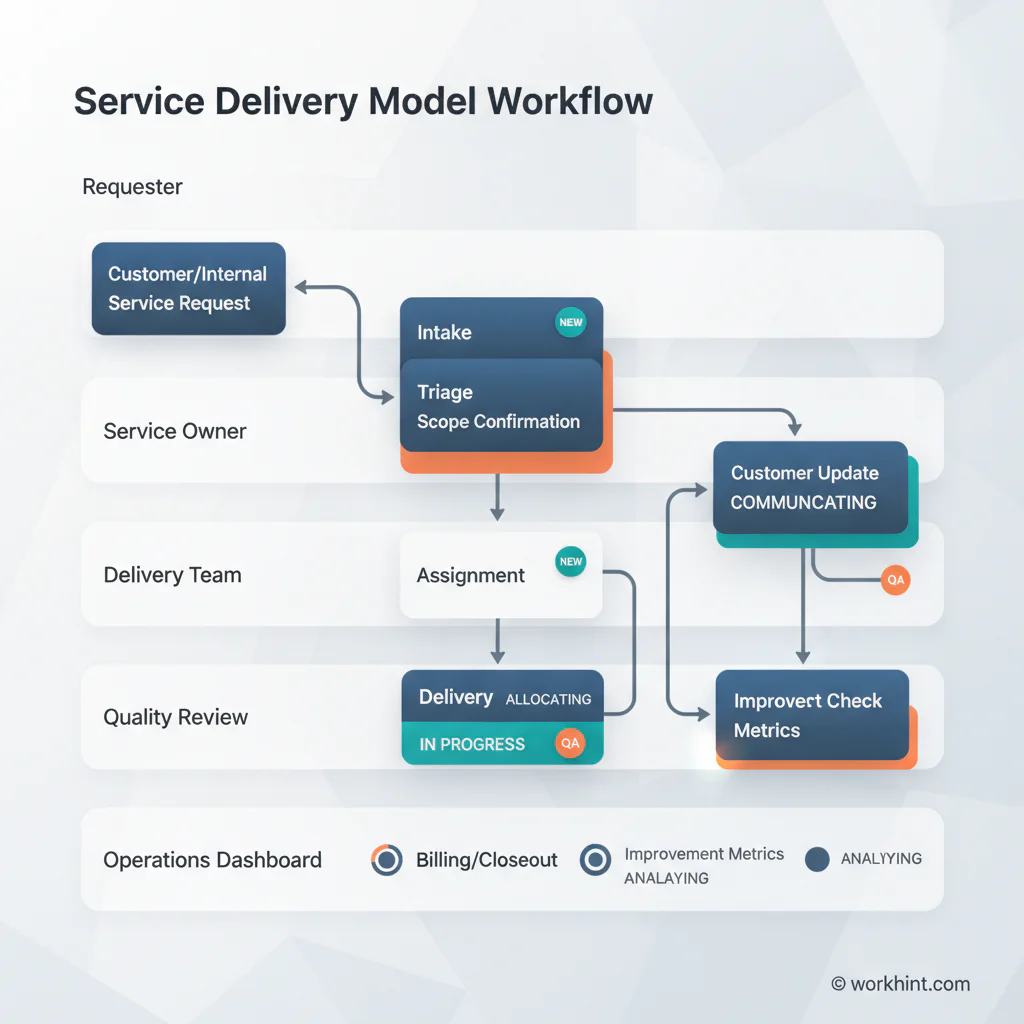
Use this workflow when a service is growing beyond founder-led coordination, inbox-based follow-up, or one-off project management.
- Define the service boundary. Name the service, the customer segment, the starting trigger, the final outcome, and what is explicitly outside scope.
- Standardize intake. Capture the minimum information needed to decide priority, scope, eligibility, owner, timeline, pricing, risk, and required resources.
- Route by service type. Differentiate simple requests, complex requests, urgent issues, regulated work, high-value customers, and exceptions.
- Assign one service owner. One role should own the outcome even when delivery involves multiple teams, vendors, contractors, or systems.
- Build the delivery stages. Turn the work into clear stages such as review, scope confirmation, scheduling, execution, quality check, approval, customer update, billing, and closeout.
- Add quality and exception gates. Decide what must be reviewed before completion, what happens when information is missing, and when the request escalates.
- Connect commercial and operational closeout. Make sure accepted delivery triggers the right invoice, payment status, documentation, reporting, or renewal step.
- Measure the system. Track cycle time, first-response time, rework, SLA breaches, handoff delays, quality issues, customer feedback, and margin where relevant.
Service delivery operating table
This table gives operations leaders a compact way to design the model without turning it into a long policy document.
| Design area | Decision to make | Primary owner | Metric to track |
|---|---|---|---|
| Service promise | What outcome is included? | Service leader | Expectation mismatch rate |
| Intake | What information is required? | Operations | Requests returned for missing details |
| Routing | Which path applies? | Service owner | Time to assignment |
| Delivery | Which stages must happen? | Delivery lead | Cycle time by stage |
| Quality | What must be checked? | Quality or operations lead | Rework and defect rate |
| Closeout | What completes the service? | Finance or account owner | Accepted work pending invoice or payment |
How much variation should the model allow?
A service delivery model should not force every customer through the same path. The Hackett Group describes a service delivery model as a structured model for effective and efficient work that includes service design, governance, analytics, human capital, and technology. That mix matters because different services need different levels of control.
Use a standard path for routine work, a guided path for configurable work, and an exception path for work that needs judgment or authority. For example, a standard support request may route directly to the delivery team. A custom implementation may require scoping, approval, scheduling, milestone review, and customer signoff. A regulated or high-risk request may need legal, compliance, or security review before work starts.
Common service delivery model mistakes
- Designing around departments instead of the customer journey. Customers experience the full flow, not the org chart.
- Letting intake stay informal. Missing context creates rework, delay, and inconsistent prioritization.
- Assigning work without ownership. A task owner is not always the same as the person accountable for the service outcome.
- Skipping exception design. Edge cases will happen; the model should define how they are routed, escalated, and documented.
- Measuring only completion volume. Volume does not show quality, speed, rework, customer friction, or profitability.
- Separating service delivery from billing or closeout. Work that is delivered but not accepted, invoiced, or documented is still unfinished operationally.
Where Workhint fits
Workhint fits when the service delivery model needs to become a live work system instead of a diagram or spreadsheet. A team can use Workhint to turn the model into request intake, role-based access, assignment rules, schedules, approvals, quality checks, customer updates, document collection, payment status, dashboards, and automation.
That is useful for service businesses, marketplaces, field teams, staffing operations, vendor networks, agencies, internal services, and external workforce programs. Workhint helps connect the service promise to the actual operating path, so delivery is not held together by scattered forms, messages, meetings, and manual follow-up.
FAQ
What is a service delivery model?
A service delivery model is the operating structure for delivering a service consistently. It defines intake, ownership, delivery stages, quality checks, customer communication, exceptions, metrics, and closeout.
What is the difference between a service delivery model and a service delivery process?
The model is the broader operating design: roles, standards, governance, tools, and measurement. The process is the step-by-step flow a request follows through that model.
Who should own the service delivery model?
Ownership usually sits with operations, service leadership, or the business unit responsible for the customer outcome. Delivery may involve many teams, but one leader should own the model’s performance.
What metrics should a service delivery model track?
Track request volume, time to assignment, cycle time, SLA performance, rework, quality issues, customer satisfaction, escalation rate, utilization, accepted work pending invoice, and margin where relevant.
When should a company redesign its service delivery model?
Redesign the model when requests are growing, service quality varies by person, customers lack visibility, handoffs are slow, exceptions are common, or managers cannot explain where delivery time is being lost.
Conclusion
A service delivery model is how a business makes its service promise operational. The best models define the customer outcome, standardize intake, assign ownership, route work intelligently, manage exceptions, verify quality, connect closeout, and measure performance. When those pieces work together, service delivery becomes repeatable without becoming rigid. That is what lets a team scale service volume while protecting customer trust and operational control.
Leave a Reply