

An SLA works only when the promise, measurement, and response workflow are clear before service begins.
A service level agreement template helps a business define what service will be delivered, how performance will be measured, who owns each responsibility, and what happens when targets are missed. It can be used for customer support, IT services, managed services, internal operations, vendor relationships, facilities support, implementation services, and recurring business services.
This article is not legal advice. Treat the template as an operating resource to adapt with counsel, procurement, finance, and service owners before it becomes part of a contract.
What’s included
- A practical service level agreement structure for business teams
- A section-by-section SLA template you can adapt
- Example service targets and review rules
- Common mistakes that make SLAs hard to manage
- Where Workhint fits when an SLA needs to become a live workflow
How to use this service level agreement template
Start by defining the service in plain business language. The National Institute of Standards and Technology describes a service level agreement as a service contract that defines the level of service to be provided and sets expectations between the provider and customer. That means the document should not only list targets. It should make the relationship manageable.
Use this template during procurement, vendor onboarding, customer implementation, internal shared-services design, or contract renewal. The best SLA is specific enough to manage daily work but simple enough for both sides to understand without a meeting.
Service level agreement template
Use the sections below as a working draft. Replace bracketed text with your business details.
1. Agreement overview
This service level agreement is between [service provider] and [customer or internal client] for [service name]. The agreement covers [scope of service] beginning on [start date] and will be reviewed [monthly, quarterly, or annually].
2. Service scope
The provider will deliver the following services: [list included services]. The following items are outside the SLA unless added through a written change: [excluded services, locations, systems, customer groups, request types, or support hours].
3. Service hours and availability
Service hours are [days and hours]. Planned maintenance windows are [schedule]. Emergency coverage is [available or not available] for [severity levels or service types]. If uptime or availability matters, define exactly how it is calculated and which downtime is excluded.
4. Request intake and classification
Requests must be submitted through [system, email, form, portal, or support channel]. Each request should include [service, requester, location, priority, business impact, deadline, attachments, and affected users]. The provider will classify requests using the priority model below.
| Priority | Business impact | Example response target | Example resolution target |
|---|---|---|---|
| Critical | Service unavailable for many users or revenue-critical work | 15 minutes | 4 hours or agreed recovery plan |
| High | Major function impaired with limited workaround | 1 business hour | 1 business day |
| Medium | Normal request, issue, or service question | 1 business day | 3 to 5 business days |
| Low | Administrative request, minor issue, or future improvement | 2 business days | Next planned cycle |
5. Roles and responsibilities
The provider is responsible for [service delivery, monitoring, response, communication, reporting, issue resolution, and escalation]. The customer is responsible for [timely information, access, approvals, accurate request details, testing, business decisions, and payment if applicable].
6. Performance metrics
Track only metrics that influence service quality or business confidence. Common SLA metrics include availability, first response time, resolution time, request backlog, escalation rate, change completion, customer satisfaction, and incident recurrence. The Service Desk Institute’s SLA template guidance emphasizes service descriptions, escalation points, hours of availability, turnaround times, priority definitions, and customer responsibilities, which are useful anchors for choosing metrics.
7. Reporting and reviews
The provider will report SLA performance every [week, month, or quarter]. Each report should include service volume, target performance, missed targets, root causes, open risks, planned improvements, and decisions needed from either party.
8. Escalation and remedies
If a target is missed, the provider will notify [owner] within [timeframe], provide a recovery plan, and escalate unresolved issues to [role or committee]. Remedies may include service credits, improvement plans, additional reporting, revised staffing, or contract review, depending on the commercial agreement.
9. Change control
Either party may request changes to service scope, metrics, hours, responsibilities, or pricing. Changes should document the reason, expected impact, approval owner, effective date, and whether historical SLA reporting remains comparable.
10. Signoff
The agreement is approved by [provider owner], [customer owner], and [finance, procurement, legal, or executive sponsor when required].
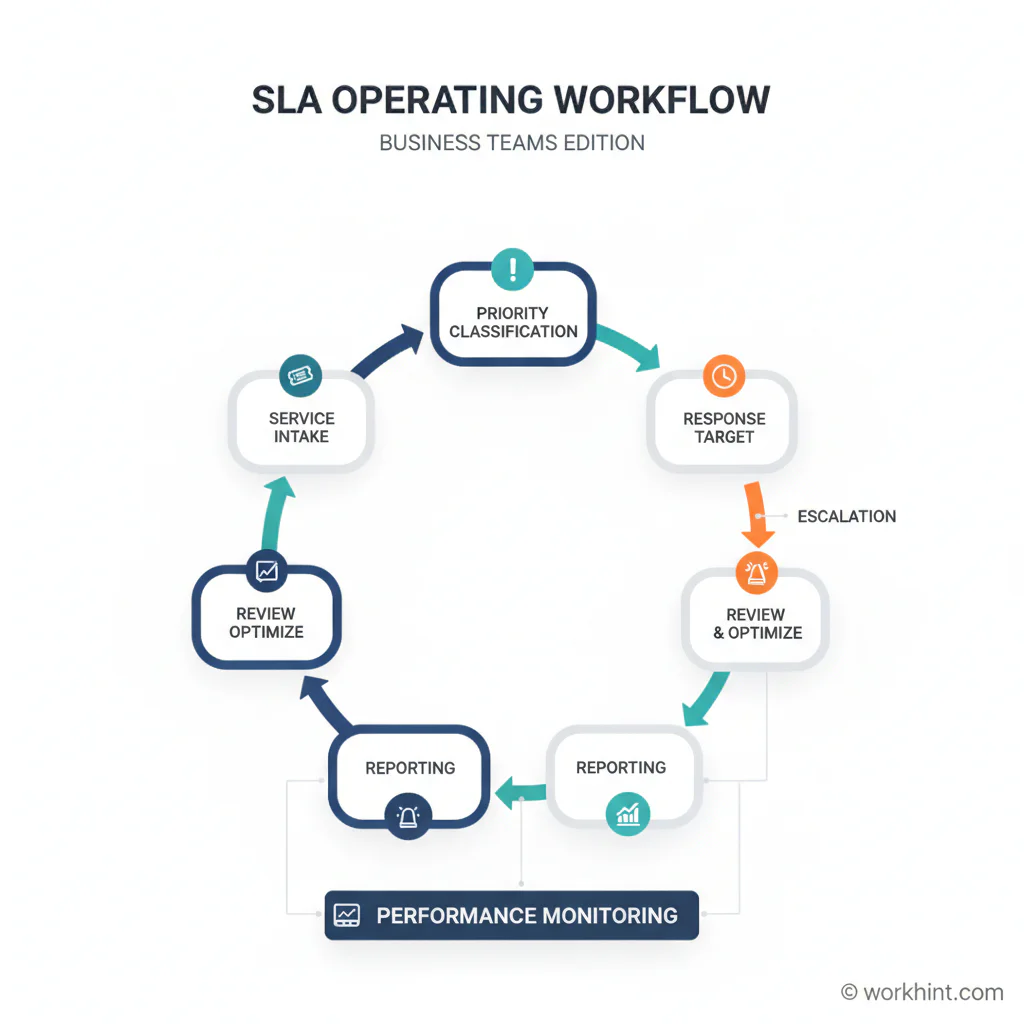
Example SLA workflow
- Define the service. Agree on the business service, users, channels, hours, and exclusions.
- Set realistic targets. Use business impact to define response and resolution targets instead of copying generic benchmarks.
- Assign owners. Name provider, customer, escalation, reporting, and approval owners.
- Connect intake to measurement. Make sure requests enter through a channel that captures the data needed to measure the SLA.
- Review exceptions. Investigate missed targets, repeat incidents, vague requests, and customer-side blockers.
- Update the agreement. Revise the SLA when service scope, usage, risk, staffing, or customer expectations change.
NASA’s shared services SLA is a useful example of a formal agreement that defines covered service families, roles, responsibilities, and performance expectations. Smaller companies do not need that level of documentation, but they do need the same operating clarity.
Common mistakes
- Using vague service promises. “Fast support” is not measurable. Define channels, hours, priority, response, and resolution.
- Measuring what the workflow cannot capture. If requests arrive through email, chat, and spreadsheets, SLA reporting will be unreliable.
- Copying targets from another company. The Service Desk Institute notes that every organization’s SLA requirements are different. Targets should reflect your service model, staffing, risk, and customer expectations.
- Ignoring customer responsibilities. A provider cannot meet targets if the customer does not provide access, approvals, accurate details, or timely decisions.
- Forgetting review cadence. SLAs need periodic review because demand, systems, staffing, and risk change.
Where Workhint fits
Workhint helps teams turn an SLA from a document into an operating workflow. A business can use Workhint to structure service intake, define requester and provider roles, route requests by priority, assign approvals, trigger escalation, collect evidence, track response and resolution status, and keep reporting visible across operations, finance, vendors, and customers.
That matters most when the SLA touches multiple groups. For example, a vendor support SLA may involve customer intake, operations triage, engineering escalation, finance remedies, procurement review, and quarterly business reporting. Workhint can help digitize that flow so the service promise is managed in the work itself, not only remembered when a report is due.
FAQ
What should a service level agreement include?
An SLA should include service scope, service hours, performance targets, request intake rules, priority definitions, roles, customer responsibilities, reporting cadence, escalation, remedies, change control, and review dates.
Is an SLA legally binding?
It can be if it is part of a contract or incorporated into commercial terms. Teams should treat SLA language carefully and review it with legal or procurement before using it with customers or vendors.
What is the difference between an SLA and a KPI?
An SLA is an agreement between parties. A KPI is a metric used to measure performance. SLA targets often use KPIs, but the SLA also defines scope, responsibilities, escalation, and review rules.
How often should an SLA be reviewed?
Quarterly review is a practical default for active services. High-risk services may need monthly review, while stable internal services may move to semiannual or annual review once performance is predictable.
Conclusion
A strong SLA makes service expectations operational. For SaaS and IT service contexts, Splunk’s SLA template guidance is another useful reference for common SLA components. Define the service, set measurable targets, clarify responsibilities, connect requests to reporting, and review performance on a fixed cadence. The document matters, but the workflow behind it is what keeps the promise real.
Leave a Reply