

You can start an Airbnb management business before hiring a team if you build the operating system first.
If you want to start an Airbnb management business, the old path is expensive: hire staff, buy tools, rent office space, and hope enough owners trust you. A leaner path is to validate demand first, build a branded service platform, and coordinate a network of independent local providers.
Short-term rental owners need help with guest communication, cleaning coordination, maintenance, listing updates, inspections, and payment tracking. Many do not need a traditional property management company on day one. They need reliable operations.
What’s in this article?
- Why Airbnb management works as a lean service business
- What you need before taking the first owner client
- How to price management, co-hosting, and coordination packages
- How to get first customers without looking like a large agency
- How Workhint helps launch the platform behind the business
- A practical 7-day launch plan and final checklist
Why This Business Works
Airbnb and short-term rental owners often want income from their property without becoming full-time operators. The work is repetitive, time-sensitive, and coordination-heavy. That creates an opening for a lean operator who can make the property easier to run.
Search results for this topic commonly focus on business registration, software, pricing, owner acquisition, and guest experience. The gap is daily operations: how cleaning, maintenance, inspections, owner approvals, and provider payouts actually move through one system.
The business works because you can start with coordination rather than asset ownership. You do not need to own properties, lease an office, or hire cleaners as employees. You can recruit independent cleaners, handymen, photographers, linen services, and guest-support partners, then manage quality through a structured process.
What You Need To Launch
You may need a business entity, local tax setup, liability insurance, contracts, payment processing, and any local permits or registrations that apply to short-term rental management in your city. Rules vary by location, so verify city and state requirements before taking clients.
| Launch item | Lean budget range | Why it matters |
|---|---|---|
| Business registration and basic legal setup | $100-$800 | Creates the company and supports contracts with owners |
| Insurance | $500-$2,000 per year | Helps protect the business from operational risk |
| Branded platform and website | $300-$1,500 | Gives owners a professional way to request and track service |
| Provider onboarding | $100-$500 | Covers background checks, documentation, and early recruiting |
| Local marketing | $200-$1,000 | Funds owner outreach, listings, partnerships, and local ads |
| Essential operating supplies | $100-$500 | Supports checklists, property walkthroughs, and basic documentation |
Avoid buying linens, cleaning equipment, vehicles, office space, or warehouse storage until customer demand proves the volume. Use provider partners first, then invest only where margins and reliability justify it.
How To Price It
Short-term rental management is usually priced as a percentage of booking revenue, a monthly fee, or a hybrid. Many full-service managers charge a percentage of gross bookings. Lighter co-hosting models can charge less because they handle fewer operational tasks.
| Package | Example price | Best for |
|---|---|---|
| Launch setup | $500-$1,500 one time | Owners who need listing, process, and provider setup |
| Co-host support | 10%-15% of booking revenue | Owners who still handle some tasks themselves |
| Full coordination | 18%-30% of booking revenue | Owners who want guest, cleaning, maintenance, and reporting handled |
| Maintenance coordination | $75-$150 per request plus provider cost | Owners who need help routing repairs and approvals |
Start with pricing that lets you deliver quality with a small portfolio. Underpricing early can create a fragile business because every property adds messages, exceptions, provider coordination, and owner communication.
How To Get First Customers
Your first customers are usually not large investors. They are local owners with one to five properties who are tired of managing guest issues, cleaning schedules, and maintenance coordination themselves.
- Contact local Airbnb hosts with a specific operational pain you can solve.
- Partner with cleaners, photographers, real estate agents, and furnishing services who already know owners.
- Create a simple landing page for one market and one property type.
- Offer a paid property operations audit before selling full management.
- Use local SEO around short-term rental management, Airbnb co-hosting, and vacation rental operations.
The first goal is demand validation. If owners will pay for an audit, onboarding package, or limited coordination plan, you have evidence before building a larger operation.
How Workhint Helps Launch It
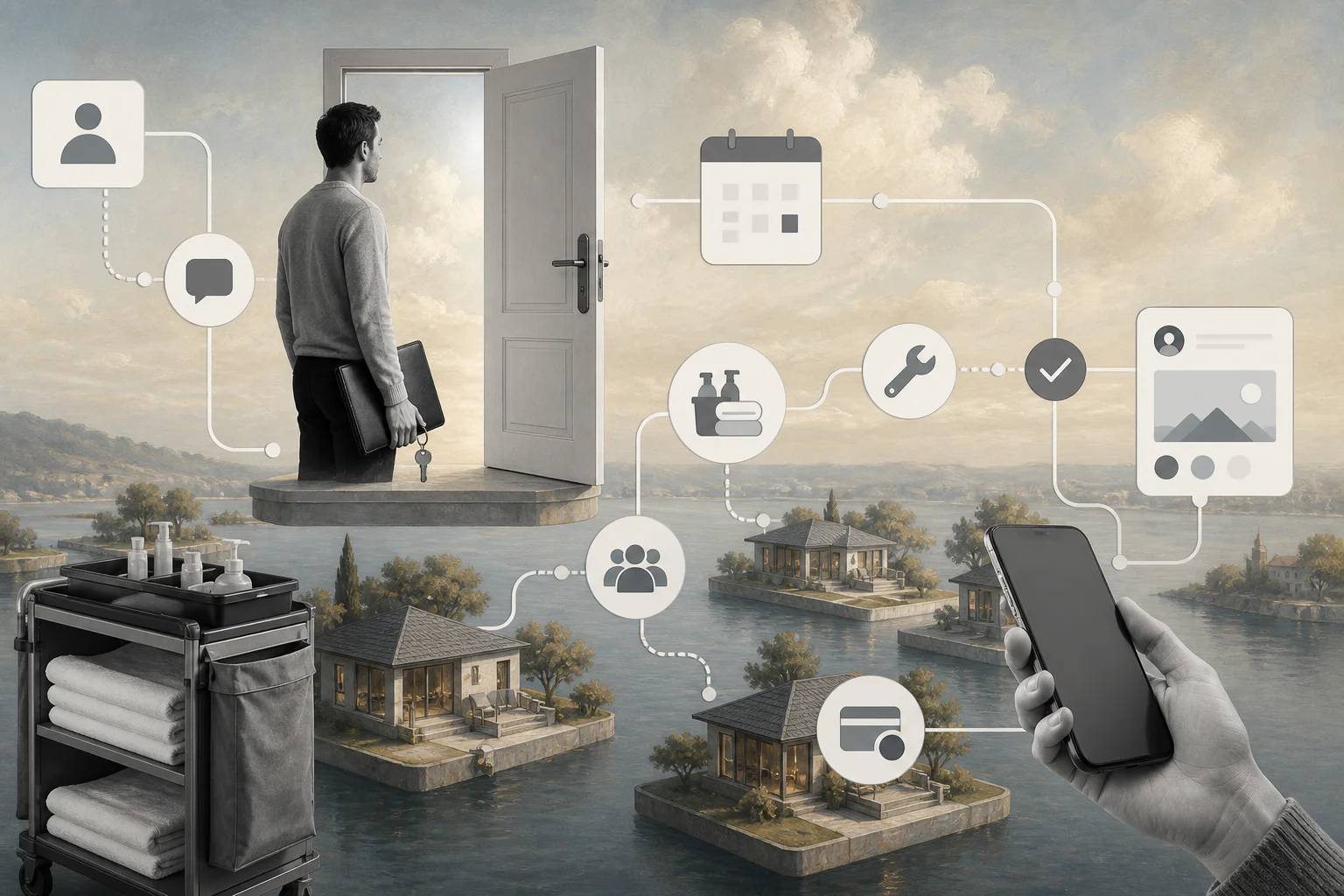
Workhint lets you launch the business as a branded operating platform instead of stitching together forms, calendars, spreadsheets, payment tools, and messaging apps. The owner sees your brand. Behind the scenes, Workhint structures the work.
A property owner can submit a management request through your branded portal. You collect property details, current listing status, cleaning requirements, maintenance contacts, house rules, photos, and approval preferences. Workhint routes that intake into your internal dashboard so you can qualify the property and prepare a quote.
Once the owner approves, Workhint can help onboard independent cleaners, inspection partners, handymen, photographers, and linen vendors. Each provider receives the right tasks, checklists, schedules, documents, and permissions. A turnover job can move from checkout time to cleaner assignment, checklist completion, photo review, issue escalation, owner approval, guest-ready confirmation, invoice, and provider payout.
This is the difference between selling services and launching a platform. You can look professional from the first owner conversation, coordinate independent providers without hiring employees, and expand property by property while the operating system keeps the work visible.
First 7-Day Launch Plan
- Day 1: Choose one launch market, one property type, and one first offer.
- Day 2: Set up the branded Workhint portal, owner intake, and internal dashboard basics.
- Day 3: Create pricing, quote approval, cleaning schedule, maintenance approval, payment, and provider payout flows.
- Day 4: Recruit the first independent cleaners, maintenance partners, photographers, and inspection support.
- Day 5: Contact local owners, agents, cleaners, and host communities with a clear coordination offer.
- Day 6: Route first conversations through the platform and document every operational exception.
- Day 7: Review demand, pricing, provider readiness, and fulfillment gaps before spending more.
Final Launch Checklist
- Choose a business name and launch market.
- Register the business and check local short-term rental rules.
- Create one clear service package for owner clients.
- Configure the branded Workhint customer portal and owner intake flow.
- Recruit independent cleaners, maintenance partners, photographers, and inspection support.
- Create quote approval, scheduling, checklist, payment, and payout workflows.
- Prepare owner contracts and provider agreements.
- Launch local outreach and validate demand before hiring staff or buying assets.
FAQ
How much does it cost to start an Airbnb management business?
A lean launch can often start with a few hundred to a few thousand dollars for registration, insurance, a branded platform, website, local marketing, and provider onboarding. Costs rise if you hire employees, rent office space, or buy supplies before proving demand.
Do I need employees to manage Airbnb properties?
No. You can start with independent providers for cleaning, maintenance, photography, inspection, and guest support. The important part is having clear contracts, schedules, quality checks, and payout workflows.
Do I need a license for Airbnb property management?
Requirements depend on location and the exact services you provide. Some areas regulate property management, real estate activity, lodging, taxes, or short-term rentals. Check city, county, and state rules before taking clients.
How do Airbnb managers get paid?
Common models include a percentage of booking revenue, a fixed monthly management fee, setup fees, or separate coordination fees for maintenance and special projects.
How do I get my first Airbnb management client?
Start with local owners, real estate agents, cleaners, photographers, and host communities. Offer a specific operational improvement, such as cleaning coordination, guest-readiness checks, or a paid property operations audit.
What should I avoid buying at the beginning?
Avoid vehicles, office space, storage, linens, bulk supplies, and full-time staff until property volume proves the need. Use provider partners first and invest after demand is validated.
Conclusion
You can start an Airbnb management business with no staff by selling a focused coordination service, recruiting a trusted provider network, and validating owner demand before making heavy investments.
Workhint gives you the branded platform and operating system to run the business from the first request through scheduling, approvals, service delivery, payments, and provider payouts. That lets you launch faster, learn from real demand, and scale only when the operation is ready.
Leave a Reply