


You can validate a braiding business before leasing a salon, hiring stylists, or buying more inventory than demand proves.
How to start a hair braiding business is a practical question because the service has clear demand, repeat customers, and relatively low equipment needs. The mistake is treating it like a salon buildout from day one.
A leaner path is to launch the brand first, recruit a small network of independent braiders, route requests through a customer platform, and validate which styles, neighborhoods, and price points actually sell.
What’s in this article?
- Why a hair braiding business works
- What you need to launch without staff
- How to price braiding services
- How to find your first customers
- How Workhint helps operate the business
- A 7-day launch plan, checklist, and FAQ
Why this business works
Hair braiding works because customers often buy for both style and convenience. Many styles take hours, require skill, and are booked around school, work, events, travel, and protective hair care routines. That creates demand for reliable scheduling, clear pricing, and trusted providers.
The business also supports repeat revenue. A customer who likes the result may return every few weeks or months, refer friends, book a different style, or schedule family appointments.
The provider-network model matters. Instead of hiring employees immediately, build a private network of independent braiders who already have skill, tools, portfolios, and availability. Your job is the brand, intake, quality standards, scheduling, payments, and customer experience.
How to start a hair braiding business with no staff
Before spending heavily, define one focused offer. Start with knotless braids, box braids, feed-in braids, cornrows, or kids’ styles in one city or neighborhood. A focused menu is easier to price, sell, schedule, and fulfill.
Licensing rules vary by state and local market. Some states exempt natural hair braiding from occupational licensing, while others require a specialty natural hair styling or braiding license. Check your state board and city rules before accepting paid appointments.
| Launch item | Lean budget | Why it matters |
|---|---|---|
| Business registration and local permits | $100 to $500 | Creates the legal base for accepting customers and opening accounts. |
| Licensing or compliance checks | $0 to $500+ | Depends on state and local rules for braiding and natural hair styling. |
| Insurance | $250 to $800 | Protects the business when services happen in homes, studios, or pop-up locations. |
| Brand, domain, and basic marketing | $100 to $600 | Gives customers a trusted place to book and compare services. |
| Provider onboarding and supplies standards | $100 to $500 | Helps independent braiders follow the same service, hygiene, photo, and cancellation rules. |
| Starter inventory or sample kits | $300 to $1,500 | Keep this small until you know which styles customers request most. |
Do not start by leasing a salon unless the model requires it. A salon can come later, after demand, provider availability, pricing, and repeat booking behavior are proven.
How to price it
Pricing should reflect time, style complexity, length, add-ons, travel, and provider skill. Avoid underpricing to win early customers.
| Service type | Example price range | Best use |
|---|---|---|
| Cornrows or simple natural styles | $60 to $150 | Fast entry offer and repeat local bookings. |
| Feed-in braids | $85 to $220 | Mid-ticket service with clear style options. |
| Box braids | $150 to $450 | Higher-ticket appointments that require more time and planning. |
| Knotless braids | $180 to $400+ | Popular premium service where size and length drive pricing. |
| Mobile or priority booking fee | $25 to $100 | Covers travel, scheduling complexity, or urgent demand. |
Start with three packages: a fast style, a premium style, and a mobile or priority option. This makes the first month easier to sell and measure.
How to get first customers
The first goal is demand validation, not looking large. Build a booking page, show sample styles from approved providers, publish clear starting prices, and collect requests before investing in a location.
Start with customers who already buy the service: students, parents, professionals, wedding guests, travelers, local community members, and people preparing for events. Use local Facebook groups, Instagram reels, TikTok clips, referral offers, campus communities, beauty supply stores, barbershops, and event planners.
Partnerships help. A beauty supply store, photographer, makeup artist, or event stylist may already serve the customer you want. Offer a referral fee or co-branded booking link.
How Workhint helps launch it
Workhint helps you launch the business as a branded service platform, not just manage appointments after the business exists. A customer lands on your portal, chooses a style, uploads inspiration photos, answers hair questions, selects location preferences, and requests a quote or booking window.
Behind the scenes, Workhint can route the request to qualified independent braiders based on service type, location, availability, portfolio, and compliance status. The provider can accept the appointment, confirm supplies, complete a checklist, upload completion photos, and mark the job finished.
The customer receives updates, approves pricing, pays online, and can leave a review. The owner sees provider onboarding, appointment status, customer communication, payouts, cancellations, and service performance in one operating dashboard.
First 7-day launch plan
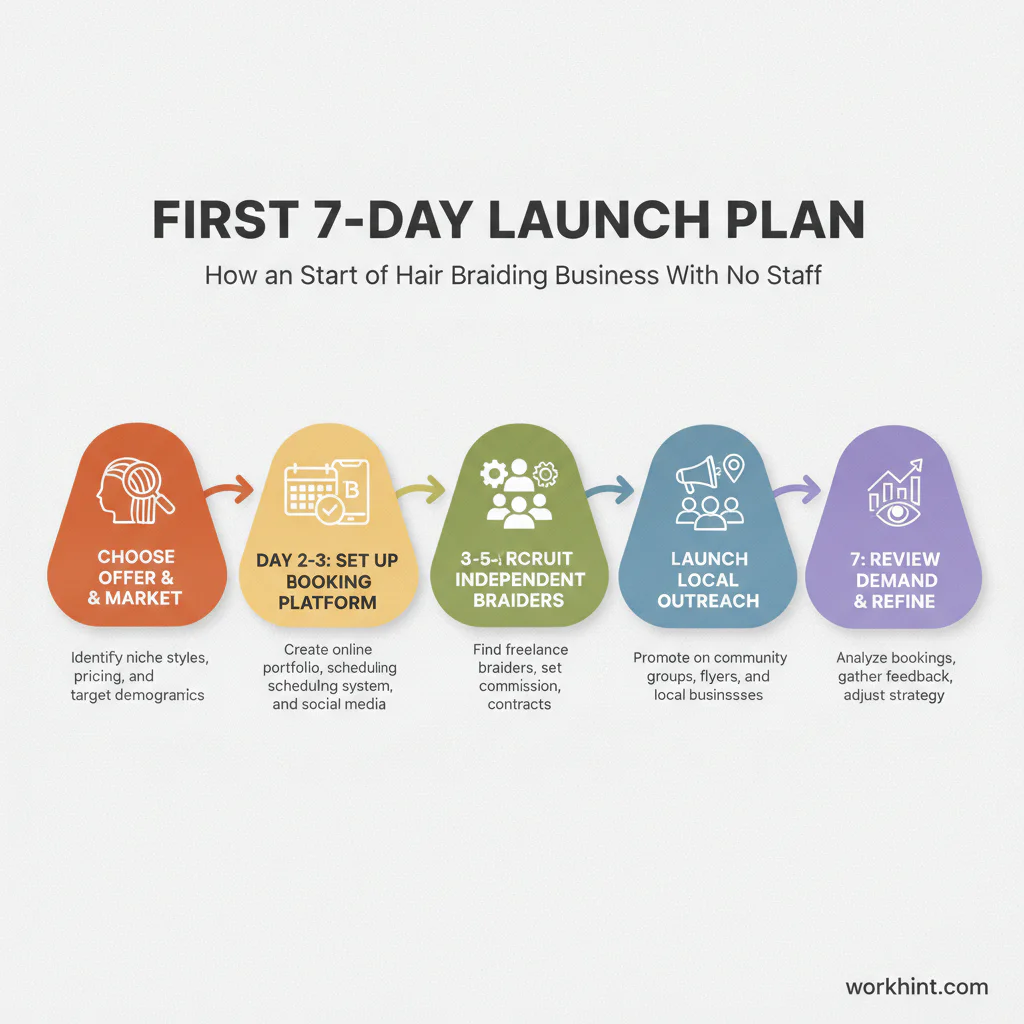
- Day 1: Choose one launch market, three core styles, and the customer type you want first.
- Day 2: Set up the branded Workhint platform basics, including customer intake and provider profiles.
- Day 3: Create pricing, quote approval, scheduling, payment, cancellation, and provider payout flows.
- Day 4: Recruit three to five independent braiders with portfolios, service areas, and availability.
- Day 5: Contact local demand sources and publish the first booking page or waitlist.
- Day 6: Route real requests through the platform and test provider response speed.
- Day 7: Review which services got interest, which providers were ready, and what to fix before spending more.
A strong first week shows requested styles, customer objections, provider capacity, pricing friction, and operational gaps. Invest after those signals are real.
Final launch checklist
- Choose a focused business name and launch market.
- Check state and local braiding, natural hair styling, and business license rules.
- Set insurance requirements for the business and providers.
- Create three simple service packages with clear starting prices.
- Configure customer intake, quote approval, scheduling, payments, and payout flows in Workhint.
- Recruit the first independent braiders and verify portfolios, availability, and service areas.
- Publish a branded booking page or demand-validation waitlist.
- Contact local partners, community groups, and referral sources.
- Book the first customers before buying excess inventory or leasing a salon.
FAQ
How much does it cost to start a hair braiding business?
A lean launch can often start with a few hundred to a few thousand dollars, depending on licensing, insurance, brand setup, provider onboarding, and starter supplies. Costs rise quickly if you lease a salon or buy large inventory before proving demand.
Do I need a license to start a hair braiding business?
It depends on your state and city. Some states exempt natural hair braiding from licensing, while others require a specialty license or natural hair styling credential. Always check your state board and local business rules before taking paid appointments.
Can I start a hair braiding business with no employees?
Yes, if you structure it as a branded platform with independent braiders or service partners. You still need clear provider agreements, quality standards, compliance checks, scheduling rules, payment flows, and customer support.
What services should I offer first?
Start with a narrow menu such as cornrows, feed-in braids, box braids, or knotless braids. A smaller menu is easier to price, market, schedule, and fulfill with a new provider network.
How do I find customers for a braiding business?
Use local social media, referral offers, community groups, campus networks, event partnerships, beauty supply stores, and short-form video. Send people to one clear booking or waitlist page so demand is measurable.
Should I lease a salon before launching?
Usually not. Validate demand, provider availability, pricing, and repeat bookings first. A salon may make sense later if customer volume, location demand, and provider utilization justify the fixed cost.
How profitable is a hair braiding business?
Profit depends on pricing, provider payout structure, appointment volume, customer acquisition cost, and overhead. The platform-first model protects margin by avoiding major fixed costs until the business has real booking data.
Conclusion
A hair braiding business does not have to begin as a traditional salon. The faster path is to validate demand with a focused offer, recruit independent braiders, and operate through a branded platform that handles intake, scheduling, payments, communication, and payouts.
Workhint gives that model an operating foundation before heavy investment. Start with demand, prove the network, then invest.
Leave a Reply